Silent but Dangerous: How Long STDs Stay Hidden Before Harm
Quick Answer: STDs can stay in your body for weeks, months, or even years without showing any signs. However, damage can start to happen during that time. You check your body. Nothing looks off. Nothing hurts.

Quick Answer: STDs can stay in your body for weeks, months, or even years without showing any signs. However, damage can start to happen during that time. Some infections, like chlamydia, can cause problems within weeks, while others, like HIV or syphilis, may not become serious for years if they aren't treated.
This Is Where People Get Misled: No Symptoms Doesn’t Mean No Risk
There’s a moment a lot of people have after a hookup or a new partner. You check your body. Nothing looks off. Nothing hurts. So your brain files it away as “probably fine.”
But here’s the uncomfortable truth: some of the most common STDs are designed to stay quiet at first. They don’t announce themselves. They don’t always itch, burn, or show visible signs. And during that time, they’re still active inside your body.
A patient once put it like this: “If it was serious, I figured I’d feel it. That’s what scared me the most later, I didn’t feel anything at all.”
This is exactly why infections like chlamydia and gonorrhea are so often missed early. Especially in women, symptoms can be so mild, or completely absent, that people don’t realize anything is wrong until complications show up.
And by then, the timeline matters.
How Long Before an STD Becomes Serious? It’s Not One Timeline
Not all STDs behave the same way. Some move fast. Others take their time. But none of them just “sit there harmlessly” forever.
The real issue isn’t just how long you’ve had it, it’s what the infection has been doing during that time.
| Time Since Infection | What May Be Happening | Risk Level |
|---|---|---|
| Days to 2 weeks | Incubation period, possible early symptoms | Low to moderate |
| 2–8 weeks | Infection spreads locally, symptoms may appear or stay silent | Moderate |
| 2–6 months | Complications begin (inflammation, internal spread) | High |
| 6+ months to years | Long-term damage (organs, fertility, immune system) | Very high |
This table isn’t meant to scare you, it’s meant to correct a very common assumption: that time equals safety. In reality, time without treatment usually means the opposite.
The Fast Movers: Infections That Can Turn Serious in Weeks
Some STDs don’t wait around. They move quickly, especially if they’re untreated and the body doesn’t fight them off effectively.
Chlamydia and gonorrhea are the biggest examples. They’re incredibly common, often symptomless, and capable of causing damage faster than most people expect.
Within just a few weeks, these infections can travel upward in the reproductive system. In people with vaginas, this can lead to pelvic inflammatory disease (PID), which isn’t just uncomfortable, it can permanently affect fertility.
One patient described it like this: “I thought it was just cramps that felt a little worse than usual. By the time I got checked, they told me it had already spread.”
Even in people with penises, untreated infections can lead to complications like epididymitis, which can impact fertility and cause chronic pain.
The key takeaway here isn’t panic, it’s awareness. These infections don’t always give you a clear warning window.
The Quiet Ones: STDs That Stay Hidden for Months or Years
This is where things get more deceptive. Some infections don’t cause immediate damage, but they also don’t go away.
Syphilis, for example, moves in stages. The first sign might be a painless sore that disappears on its own. That disappearance tricks people into thinking the problem is gone. It’s not. The infection simply moves deeper into the body.
Years later, untreated syphilis can affect the brain, heart, and nervous system. That’s not a scare tactic, it’s documented reality.
HIV works differently but just as quietly. Early symptoms can feel like a mild flu, or nothing at all. Then it can sit in the body for years, slowly weakening the immune system without obvious signs.
And then there’s HPV, which many people never know they have. Most cases clear on their own, but some strains can lead to cancers years down the line, especially cervical, anal, or throat cancers.
These are the infections that make people say:
“I had no idea. I felt completely normal.”
And that’s exactly why they become serious.
Not All Damage Feels Like Damage
One of the biggest misconceptions about STDs is that “serious” means painful, obvious, or dramatic. But a lot of long-term damage doesn’t feel urgent while it’s happening.
Scarring in reproductive organs doesn’t come with a loud warning. Immune system changes don’t announce themselves. Even early stages of organ involvement can be completely silent.
By the time symptoms become unmistakable, the infection has often been present for much longer than expected.
This is why doctors don’t rely on symptoms alone. Testing isn’t about confirming what you feel, it’s about catching what you can’t feel yet.
A Quick Reality Check: Can an STD Go Away on Its Own?
This question shows up constantly in late-night searches, and it’s easy to understand why. If symptoms fade, it feels like the body handled it.
But most bacterial STDs, like chlamydia and gonorrhea, don’t reliably clear on their own. And viral STDs, like herpes or HIV, stay in the body indefinitely.
What often happens instead is this:
“The symptoms stopped, so I assumed I was fine.”
In reality, the infection is still there, just less noticeable.
And it can still do this during that time:
- Spread internally: Moving beyond the initial infection site
- Be transmitted: Passed to partners even without symptoms
- Cause complications: Especially with long-term untreated cases
This is where delays turn into consequences, not overnight, but gradually.
What Actually Happens Over Time: STD Timelines That Don’t Match What You Feel
One of the hardest parts about understanding STDs is this: your body doesn’t always give you a clear timeline. You might expect a cause-and-effect pattern, exposure, symptoms, diagnosis, but real life rarely works that cleanly.
Instead, infections follow their own biological schedule. And that schedule doesn’t care whether you’re paying attention or not.
Let’s break this down in a way that reflects what’s actually happening under the surface.
From Exposure to Damage: A Closer Look by Infection
Each STD has its own rhythm. Some escalate quickly, while others build quietly over time. But they all have one thing in common: the longer they go without treatment, the higher the risk of problems.
| STD | Early Stage (Days–Weeks) | Hidden Phase | When It Becomes Serious |
|---|---|---|---|
| Chlamydia | Often no symptoms or mild irritation | Weeks to months unnoticed | Can cause PID and infertility within months |
| Gonorrhea | Burning, discharge, or nothing at all | Weeks if untreated | Spreads to reproductive organs, bloodstream |
| Syphilis | Painless sore that disappears | Months to years | Organ damage, neurological complications |
| HIV | Flu-like symptoms or none | Years without clear signs | Immune system damage (AIDS stage) |
| HPV | Often no symptoms | Years | Cancer risk in some strains |
This is where people start to realize something unsettling: you can feel completely normal while something serious is developing in the background.
“I Thought It Was Nothing”, A Case That Happens More Than You Think
Jordan, 27, didn’t think much of it at first. A little discomfort after sex, maybe some spotting, but nothing that seemed urgent. “I googled it and everything said it could be normal,” they said. “So I waited.”
Months passed. The symptoms came and went, never intense enough to force action. It wasn’t until a routine checkup that the truth came out: untreated chlamydia that had progressed to pelvic inflammatory disease.
“The doctor told me it had likely been there for months. That’s when it hit me, I wasn’t fine. I just didn’t feel it.”
This kind of story isn’t rare. It’s actually one of the most common patterns clinicians see: mild or inconsistent symptoms that don’t trigger urgency until complications appear.
Why Some STDs Stay Silent While Still Causing Harm
It’s not random. There are biological reasons why certain infections don’t trigger obvious symptoms right away.
There are some bacteria and viruses that can:
- Avoid immune detection: They don't cause a strong inflammatory response right away.
- Infect internal tissues: Damage happens in places you can't see or feel.
- Progress gradually: The body changes to hide early warning signs.
This is especially true for infections affecting reproductive organs or the immune system. By the time symptoms show up clearly, the infection has often already advanced.
That’s why the question “how long can you have an STD without knowing?” is so important, and so uncomfortable.
When Symptoms Show Up Late, and Why That’s Riskier
Sometimes symptoms don’t appear until the infection has already progressed. And when they do show up late, they’re often more severe or harder to ignore.
For example:
- Chronic pelvic pain: Can develop after untreated infections spread
- Testicular pain: May signal deeper infection in men
- Neurological symptoms: In advanced syphilis cases
These aren’t early warning signs, they’re signals that the infection has been present for a while.
And this is where the idea of “serious” shifts. It’s no longer about the infection itself, it’s about the damage it’s caused.
Where Testing Changes Everything (Even If You Feel Fine)
This is the turning point in most STD stories, not symptoms, not complications, but testing.
Because once you know, the timeline stops working against you.
You don’t need to wait for pain, discharge, or visible signs to take action. In fact, waiting for those signs is often what allows infections to become serious in the first place.
If there’s even a small question in your mind, after a new partner, unprotected sex, or a symptom that didn’t quite make sense, that’s enough reason to check.
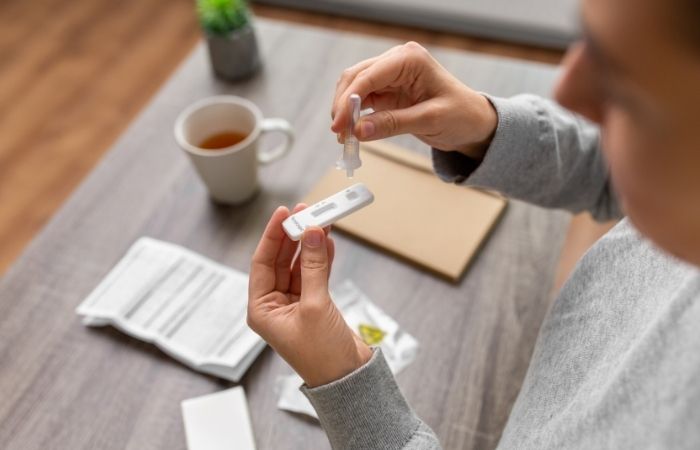
And if going to a clinic feels like a barrier, there are discreet options available. You can explore at-home testing through STD Rapid Test Kits, which allow you to get answers privately and quickly.
For broader screening, something like a combo STD home test kit can check for multiple infections at once, especially useful when symptoms aren’t clear.
This isn’t about assuming the worst. It’s about removing the guesswork.
The Emotional Timeline: Why People Wait Longer Than They Planned
Delaying testing isn’t usually about neglect. It’s usually about uncertainty, fear, or just life getting in the way.
People tell themselves things like:
“I’ll wait and see if it goes away.”
“It’s probably nothing serious.”
“I don’t have symptoms, so I’m fine.”
These thoughts are incredibly common, and completely human. But they also extend the timeline where an infection can quietly progress.
The longer that uncertainty lasts, the more room the infection has to move beyond the early, easily treatable stage.
What “Serious” Actually Means (Beyond Just Having an Infection)
When doctors say an STD has become serious, they’re usually not talking about the infection existing. They’re talking about complications.
That includes things like:
- Infertility: Often associated with untreated chlamydia or gonorrhea.
- Chronic pain: Especially pelvic or testicular pain
- Organ damage: Seen in advanced syphilis or hepatitis infections
- Immune system decline: In untreated HIV
- Cancer risk: Associated with certain HPV strains
And here’s the key detail: these don’t happen overnight. They develop slowly, often without clear warning signs.
That’s why someone can treat the infection later, but still deal with effects that started months or years earlier.
The Window Where Treatment Is Simple vs. Complicated
There’s a major difference between catching an STD early and catching it late. Not just emotionally, but medically.
| Stage | What Treatment Looks Like | Long-Term Risk |
|---|---|---|
| Early detection | Simple antibiotics or monitoring | Minimal to none |
| Delayed detection | More complex treatment, follow-ups | Moderate risk of complications |
| Late-stage complications | Specialist care, long-term management | High, sometimes irreversible |
This is why timing matters so much. Not because treatment disappears, but because the consequences become harder to undo.
Can Damage Be Reversed, or Is It Permanent?
This depends entirely on the infection and how far it has progressed.
Some outcomes are fully reversible with treatment. Others are not.
For example:
- Bacterial infections: Often curable, especially early
- Inflammation: May improve with treatment
- Scar tissue: Usually permanent
- Fertility damage: Sometimes irreversible
That’s the part most people aren’t told clearly enough: treating the STD doesn’t always erase what happened before treatment.
And that’s why earlier is always better, even if later is still treatable.
The Myth That Causes the Most Harm: “If It Was Serious, I’d Know”
This belief shows up everywhere, in conversations, forums, late-night searches. It sounds logical. But it’s one of the most dangerous assumptions people make.
Because seriousness doesn’t always feel urgent.
You can have:
- No pain
- No visible symptoms
- No disruption to daily life
And still be dealing with an infection that’s progressing internally.
One clinician put it bluntly: “If symptoms were reliable, we wouldn’t see so many late diagnoses.”
This isn’t about fear, it’s about accuracy. Symptoms are inconsistent. Testing is reliable.
What Actually Lowers Your Risk (Even If You’ve Waited)
If you’re reading this and thinking you may have delayed testing, here’s the part that matters most: you’re not out of options.
Taking action now can still stop more problems from happening, even if some time has passed.
That means:
- Getting tested: Even if there are no symptoms
- Following treatment fully: If positive
- Retesting if needed: Especially after treatment or new exposure
You don’t need perfect timing. You just need a starting point.
If access or privacy has been holding you back, at-home testing is designed exactly for that gap. You can check discreetly through STD Rapid Test Kits without appointments or waiting rooms.
And if you’re unsure what you might have, a broader option like the combo STD home test kit helps cover multiple infections in one step.
This isn’t about catching up, it’s about moving forward with clarity.
What to Watch For (Even If It’s Subtle)
Not all STD symptoms are dramatic. In fact, many of them are easy to dismiss or misinterpret.
Some of the most commonly overlooked signs include:
- Mild burning: Especially during urination
- Unusual discharge: Even if it’s not severe
- Light spotting: Outside of normal cycles
- Pelvic or testicular discomfort: That comes and goes
And sometimes, there are no signs at all.
That’s why so many people end up searching things like “std no symptoms but still infected” or “how long can you have an std without knowing.” The answer, as you’ve seen, is often longer than expected.
Testing Windows: When Results Are Actually Reliable
Another reason people delay testing is confusion about timing. Testing too early can lead to false reassurance, while testing too late increases the risk of complications.
Here’s a simplified guide to when common STDs can be detected:
| STD | Earliest Reliable Test Time | Best Testing Window |
|---|---|---|
| Chlamydia | 5–7 days | 2 weeks |
| Gonorrhea | 5–7 days | 2 weeks |
| Syphilis | 3 weeks | 6 weeks+ |
| HIV | 10–14 days | 4–6 weeks+ |
| HPV | No standard early test | Detected via screening over time |
This is where timing becomes practical, not theoretical. Testing within the right window gives you answers you can actually trust.
FAQs
- 1. How long can you have an STD without knowing?
- Honestly? Longer than most people expect. You could have something like chlamydia or HPV for months, or even years, without any obvious symptoms. That’s why so many people are genuinely shocked when a routine test comes back positive.
- 2. Can an STD become serious even if I feel completely fine?
- Yeah, and that’s the tricky part. Some infections do their damage quietly, especially in the early stages. Just because you feel normal doesn't mean everything is okay; it just means your body isn't sending out any warning signs yet.
- 3. Is it too late if I’ve been putting off testing for a while?
- No, it’s not too late. People wait weeks, months, sometimes longer, and treatment is still very possible. The goal now isn’t to stress about the delay, it’s just to get clarity and move forward.
- 4. Does that mean the STD is gone if the symptoms go away?
- Not necessarily. A lot of STDs have symptoms that come and go, which can make it feel like the problem fixed itself. In reality, the infection can still be there, just quieter.
- 5. What’s the biggest risk of leaving an STD untreated?
- It's not usually the infection itself, but what happens over time as a result of it. Fertility problems, chronic pain, and internal problems don't happen right away, but they can get worse if nothing stops them.
- 6. How do people not notice something serious happening?
- Because it doesn’t always feel serious while it’s happening. There’s no dramatic moment, no clear signal. It’s more like subtle changes, or nothing at all, until much later.
- 7. Can I still pass an STD if I don’t have symptoms?
- Yes, and this surprises a lot of people. You don’t need visible signs to transmit an infection. That “everything looks fine” phase is actually when a lot of spread happens.
- 8. What if I’m just overthinking this?
- Maybe, but that’s not a bad thing. Most people who end up catching something early started with a small “what if” thought. Acting on it doesn’t mean something’s wrong, it just means you’re taking care of yourself.
- 9. How soon after sex should I realistically get tested?
- It depends on the infection, but a good rule is around 1–2 weeks for common bacterial STDs, and a bit longer for others like HIV. If you’re unsure, testing now and again later can cover both bases.
- 10. What’s the easiest way to stop worrying about it?
- Get tested. That’s it. No amount of Googling replaces an actual answer, and once you have that, the mental spiral usually stops pretty fast.
You Deserve Clarity, Not Guesswork
Most STDs don’t announce themselves. They don’t interrupt your day or force your attention right away. They sit in the background, quiet enough to ignore, but active enough to matter.
The goal isn’t to panic over every possibility. It’s to stop relying on symptoms as proof that everything is fine. Because with infections like these, silence doesn’t mean safety, it just means you don’t have the full picture yet.
If there’s been exposure, test. If symptoms came and went, test. If something just doesn’t sit right, that’s reason enough. You don’t need certainty to take action, you just need a starting point.
Don’t wait and wonder. If infection is even a small possibility, start with a discreet screen like the Combo STD Home Test Kit. Your results are private. Your timeline is yours. And clarity always beats guessing.
How We Sourced This Article: This article combines current clinical guidance on sexually transmitted infections with peer-reviewed research on infection timelines, symptom presentation, and long-term complications. We reviewed public health data, infectious disease literature, and real-world patient patterns to reflect how STDs actually progress, not just how they’re described in textbooks.
- Centers for Disease Control and Prevention – Sexually Transmitted Diseases Overview
- Fact Sheet on Sexually Transmitted Infections from the World Health Organization
- NHS – Sexually Transmitted Infections Guide
- National Library of Medicine – STI Research Database
- Planned Parenthood – STD Information
- Centers for Disease Control and Prevention – What Is HIV?
- NHS – Chlamydia Complications