When Is It Safe to Have Sex After an STD Diagnosis?
You can have sex again after an STD diagnosis, but only when the infection is no longer transmissible based on biology, not how you feel.

Last updated: March 2026
You can have sex again after an STD diagnosis, but only when the infection is no longer transmissible based on biology, not how you feel. That timing depends on whether the infection has been cleared or controlled and whether testing confirms your status. According to the CDC, transmission risk is directly tied to whether the infection is still present in the body, not whether symptoms are noticeable.
Most people don’t hear that clearly at first. You’re staring at your result, maybe checking it again just to make sure it didn’t magically change, and your brain jumps straight to: “What does this mean for my sex life?” That question matters, but the answer is far more structured and predictable than it feels in that moment.

What Actually Changes After an STD Diagnosis?
The biggest change is not in your body, but in your awareness of it. Before you received the diagnosis, everything felt normal because you didn’t have a label put on what was happening in your body. After you received the diagnosis, suddenly that body of yours is something you need to be aware of and question and deal with.
From a physical perspective, most of the time, when people contract an STD, there are only two types of viruses. One is treatable and curable, such as chlamydia or gonorrhea. The other is present in the body and not curable but can be managed, such as herpes or HIV. The World Health Organization (WHO) states that most STIs are curable or manageable with appropriate care and treatment, which is an important point that people often overlook when they first hear that they have an STD.
What people often do is assume that the diagnosis of an STD permanently changes who you are and will affect your future relationships. What it actually changes is your awareness of your own body and the viruses that are in it. You’re not making decisions based on assumption and guesswork; you’re making decisions based on the reality of the viruses and how they work in your body.
Are You Still Contagious Right Now?
This is the most important question, and also the one people get wrong the most. Contagiousness is not based on how you feel, how much time has passed, or whether symptoms have disappeared. It’s based on whether the infection is still active in your body.
For bacterial infections like chlamydia and gonorrhea, the mechanism is straightforward. The bacteria live in mucosal tissues and bodily fluids. When present, they can be transmitted during sex. Treatment works by eliminating those bacteria, but until that process is complete, transmission is still possible. The NHS clearly states that you should avoid sex until treatment is completed and the infection is resolved.
What throws people off is that symptoms often improve before the infection is fully cleared. That creates a false sense of safety. From a biological standpoint, the bacteria can still be present even if you feel completely fine.
Viral infections behave differently. Viruses like herpes remain in the body long-term, but they are not equally active at all times. Transmission risk increases when the virus is active, such as during outbreaks, and decreases when it is dormant. According to research indexed by the National Center for Biotechnology Information (NCBI), viral shedding patterns explain why transmission risk fluctuates rather than staying constant.
HIV adds another layer. Transmission depends on viral load, the amount of virus in the blood. When viral load is suppressed, transmission risk drops dramatically. The CDC HIV guidelines confirm that sustained suppression reduces transmission risk to effectively zero, which fundamentally changes how safe sex is approached in managed cases.
| Factor | What It Means |
|---|---|
| Active Infection | Bacteria or virus is still present and transmissible |
| Post-Treatment Phase | Infection may still be clearing even if symptoms are gone |
| Viral Activity | Higher transmission risk during outbreaks or high viral load |
| Confirmed Clearance | Testing shows infection is no longer present |
The Mental Spiral vs What’s Actually Happening in Your Body
There’s a very specific moment that most people go through after they get diagnosed. You’re in bed, and you’re going through all the search results. You’re reading all the worst-case scenarios. And suddenly, it’s all just too big. Every little thing that’s going on with your body is suddenly suspicious. Every little thing that’s happened in your past is suddenly a mistake.
The problem is that it’s all in your head. It’s all in your own brain. You’re making assumptions because your brain is making assumptions. You don’t have enough information. And that’s why it’s going to vary wildly depending on how much information you actually have.
Biologically speaking, nothing’s going on. The infection’s just going along. It’s just replicating. It’s just responding to the medication. It’s just in a dormant state. It’s not adapting to your brain. It’s not adapting to your concerns. It’s just going along.
The problem is that your brain is making assumptions. Your brain is making guesses. And your brain is making those guesses because it doesn’t have enough information. And the problem is that your brain is going to think that the worst-case scenario is always the most likely. And that’s why the waiting period is the hardest. It’s not the infection. It’s the lack of information.
Why Guessing About Your Status Doesn’t Work
At some point, most people try to figure it out without testing. You check your body, look for symptoms, and try to decide if everything seems normal. If nothing stands out, it’s tempting to assume you’re fine.
The problem is that many STDs are asymptomatic. The CDC notes that infections like chlamydia often show no symptoms at all, which means you can carry and transmit them without realizing it. That makes symptom-based decisions unreliable.
From a biological standpoint, symptoms are just one possible outcome of infection, not a requirement. The infection can still exist and be transmissible even when there are no visible signs.
This is where people unintentionally take risks. They rely on how they feel instead of confirming what’s actually happening. That gap between perception and reality is where transmission happens.
Testing exists to close that gap. It replaces assumptions with measurable answers. Instead of wondering whether the infection is still present, you confirm it. And once you have that confirmation, your decisions become clear.
If you’re in that in-between phase, feeling okay but not fully confident, that’s your signal. You don’t need more guessing. You need clarity. In Part 2, we’ll break down exactly when to test, what the results actually mean, and how to know with certainty when it’s safe to have sex again.
The Testing Timeline That Actually Determines Everything
This is where things stop being guesswork and start being measurable. Every STD follows a biological timeline called an incubation period, which is the time between exposure and when the infection becomes detectable in your body. Until that point, even the best test in the world can come back negative, not because you’re clear, but because your body hasn’t produced enough detectable markers yet.
That’s why timing matters more than most people realize. You can do everything “right,” take a test, and still get a misleading result if it’s too early. This is one of the most common reasons people either panic unnecessarily or feel falsely reassured.
Think of it like this: testing isn’t just about taking a test, it’s about taking the test at the right time. That timing is what turns a result into something you can actually trust.
If you’re in that phase where you’re constantly thinking, “Should I test now or wait?”, you’re already in the window where clarity matters more than speed. The goal isn’t to test fast. The goal is to test accurately.
| STD | When to Test |
|---|---|
| Chlamydia | test from 14 days after exposure |
| Gonorrhea | test from 3 weeks after exposure |
| Syphilis | test from 6 weeks after exposure |
| HIV | test at 6 weeks for first indicator, retest at 12 weeks for certainty |
| Herpes HSV-1 and HSV-2 | test from 6 weeks after exposure |
| Hepatitis B | test from 6 weeks after exposure |
| Hepatitis C | test from 8–11 weeks after exposure |
These timelines aren’t arbitrary. They reflect how long it takes for each infection to either replicate to detectable levels or trigger an immune response that shows up on a test. Testing outside of these windows introduces uncertainty, and uncertainty is exactly what you’re trying to eliminate.
What Your Test Result Actually Means (No Guessing)
Once you test at the correct time, the result becomes meaningful. A negative result means the infection was not detected at that specific point in your body’s timeline. If the test was taken within the proper window, that’s a reliable answer.
If the test was taken too early, though, a negative result doesn’t mean you’re clear; it means the infection may not have been detectable yet. This is where people get tripped up. They see “negative” and assume certainty, when in reality, the timing didn’t support that conclusion.
A positive result is more straightforward. It means the infection is present. That gives you clarity, not confusion. You now know exactly what needs to be addressed before resuming sex safely.
This is why testing isn’t just a checkbox; it’s a decision point. The result tells you whether you’re ready to move forward or whether you need to pause and address the infection first.
| Result | What It Means |
|---|---|
| Negative (within window) | No infection detected at a reliable time point |
| Negative (too early) | Infection may still be present but undetectable |
| Positive | Infection confirmed; treatment or management required |
| Uncertain timing | Retesting needed to confirm status |
The goal here isn’t just to get a result, it’s to get a result you can trust. That trust is what allows you to make decisions about sex without second-guessing every move.
When Retesting Is Necessary (And Why It’s Not Optional)
The whole point of retesting is not to be paranoid; it’s to bridge the biological gap. If you get tested too early, there’s this window in which the infection is developing but hasn’t been detected. This means that your results aren’t entirely representative.
From a biological point of view, this is because your body hasn’t produced enough bacteria or antibodies to cross the threshold. The results aren’t false; they’re just too early.
When you get tested again at the right time, your body will have produced enough bacteria and antibodies. This will prove whether your results were true or if they needed updating. Without this second test, you’re making decisions based on incomplete information.
This is particularly important if you’re planning on having sex. You don’t want to be making decisions based on the possibility that your results were too early and might carry the risk of passing the infection.
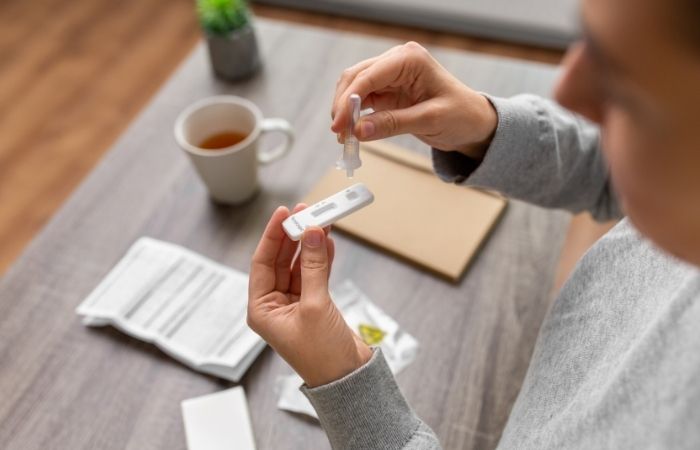
How to Know You’re No Longer Contagious
This is where all of this comes together. You are no longer contagious if one of two things is true: your body is clear of the infection, or your body is working with the infection in such a way that the possibility of passing it on is minimized to an insignificant degree.
For bacterial infections, this means that the treatment for the infection has worked and that the bacteria have been eliminated from your body. In some cases, this also means that further testing has been done and that your body is clear of the bacteria. When your body is clear of the bacteria, there is nothing to transmit.
For viral infections, this means that the factors that control the transmission of the virus are understood. For instance, this might mean that if you have herpes, you do not have sex during an outbreak. For HIV, this might mean that your viral load is suppressed.
The way that the concept of ‘not contagious’ actually works is that it is not based on any specific length of time.
Using Testing as Your Exit From the ‘What If’ Loop
If you’ve been stuck replaying scenarios in your head, when you were exposed, whether protection failed, whether symptoms mean something, this is where that loop ends. Testing replaces all of that mental noise with a clear answer.
You don’t need to keep analyzing every detail or trying to predict outcomes. You just need to confirm your status at the right time. That’s what gives you control again.
If you want to handle this privately and without overcomplicating the process, you can check your status using STD Test Kits. It’s a straightforward way to move from uncertainty to clarity without adding more stress to the situation.
When Is It Actually Safe to Have Sex Again?
This, of course, is where people need a definitive green light, but it’s not a specific date on a calendar. It’s safe, or it’s not, based on whether or not the infection has been cleared or controlled to a point where transmission of that infection is no longer a concern. This isn’t based on impatience or relieving symptoms.
When it comes to bacterial infections, such as chlamydia and gonorrhea, the process is quite simple but very easy to get wrong. The infection occurs in the mucosal membranes, and transmission of the infection occurs through the exchange of fluids. The infection is cured by killing the bacteria, but until the entire course of that cure and your body has cleared out any remaining bacteria, transmission of the infection can and will still occur.
This, of course, is why finishing the course of your prescription and not stopping early or prematurely, even if your symptoms have lessened or even disappeared, is not a suggestion but a requirement. It’s not safe, and from a transmission standpoint, even a small amount of bacteria is all it will take to start the cycle all over again.
When it comes to a viral infection, such as herpes, the time line isn’t so much a clearing of the infection but a controlling of it. Herpes, for example, is more easily transmitted when there are outbreaks because the virus migrates to the surface of your skin. When there are no outbreaks, the infection is still present but not as active, so transmission of that infection is greatly reduced.
HIV, of course, works differently. When your viral load is brought to a point where it’s no longer detectable, the amount of virus in your blood supply is no longer sufficient to transmit the infection. This, of course, allows for safe sex in long-term relationships where this infection, and this infection only, is being managed.
So, to give you a definitive answer, you are safe to resume sexual relations when the infection has either been cleared or controlled. Anything before that, however, is simply a roll of the dice.
What Happens If You Resume Sex Too Early
This is where a lot of people unintentionally create bigger problems. You feel better, you assume things are fine, and you decide to move forward. The issue is that your body may still be in the process of clearing the infection, even if you can’t feel it anymore.
From a biological standpoint, early sexual activity can reintroduce the infection into a partner or expose you again if your partner hasn’t completed treatment. That’s how reinfection loops start. It’s not bad luck, it’s timing.
Reinfection doesn’t just reset things emotionally. It resets the entire biological process. The infection begins replicating again, symptoms may return, and the testing timeline starts over. That means more waiting, more uncertainty, and more frustration.
This is why medical guidance emphasizes waiting for confirmation, not just improvement. The difference between those two is what separates a clean resolution from a repeating cycle.
How Reinfection Actually Happens (And Why It’s So Common)
Reinfection sounds complicated, but it follows a simple pattern. One person clears or treats the infection, the other doesn’t, and then they resume sex too soon. The infection is passed right back, often without either person realizing it immediately.
Biologically, this works because the pathogen, whether bacteria or a virus, is still present in one partner. When sexual contact happens, transmission occurs again, just like the first time. The body doesn’t “remember” to block it in this context.
This is especially common in situations where communication is unclear or where one partner assumes the other has already handled it. Without coordinated testing and treatment, both people are operating on different timelines, and that mismatch creates risk.
The fix is simple but requires discipline: both partners need to be tested, both need to complete treatment if necessary, and both need to wait until it’s confirmed safe. If one person skips a step, the entire system breaks down.
Using Protection Strategically (Not Just Automatically)
It is not an either-or situation but more of a tool that is used to minimize risks when used appropriately. Condoms, for example, provide a physical barrier against the transmission of infected fluids. This greatly minimizes the chances of getting infected with chlamydia, gonorrhea, and even HIV.
However, condoms do not protect all skin surfaces. As such, skin-infecting diseases such as herpes and HPV can still be contracted even when one is using protection. This is where the type of disease comes in, just as much as the use of protection.
Using protection strategically involves timing and awareness. One is not entirely dependent on one form of protection but is rather using multiple forms of protection, which include timing and awareness.
When all these factors come together, the risks are greatly reduced. However, when one of these factors is missing, the system is not entirely reliable.
How to Rebuild Confidence Around Sex
One of the less talked-about effects of an STD diagnosis is how it changes your confidence. Even after treatment or testing, people often hesitate. They second-guess whether they’re truly safe or worry about how a partner might react.
This hesitation isn’t coming from the infection, it’s coming from uncertainty. Once you have confirmed results and understand your status, that uncertainty starts to fade. You’re no longer guessing, which makes decisions feel more grounded.
Confidence comes from clarity. When you know your status, understand transmission, and have taken the right steps, sex stops feeling risky and starts feeling normal again. It’s not about ignoring the situation; it’s about understanding it well enough that it no longer controls your behavior.
Why Communication Becomes Part of Safe Sex
At some point, biology intersects with conversation. Safe sex after an STD diagnosis isn’t just about what’s happening in your body; it’s also about what your partner knows. Communication fills the gap between those two things.
The key is clarity, not drama. You’re not delivering a confession; you’re sharing information that allows both people to make informed decisions. That shift in mindset changes how the conversation feels.
When you explain what the infection is, what you’ve done about it, and where things stand now, you’re creating transparency. That transparency reduces uncertainty for both people, which makes the situation easier to navigate.

What Dating and Sex Look Like Long-Term After an STD
By the time you’ve gone through testing, timing, and treatment, something shifts, you stop reacting and start understanding. This is where most people realize that the diagnosis didn’t permanently change their sex life. It just forced them to approach it with more awareness.
In long-term relationships, this becomes part of normal communication. You’re not constantly bringing it up, but both people understand the context. Whether it’s confirming testing before becoming exclusive or being mindful of symptoms, it becomes routine rather than a source of stress.
For people navigating dating, the adjustment is more about mindset than reality. The fear is usually, “How will someone react?” But in practice, clear and confident communication tends to land better than expected. Most people respond to honesty and responsibility, not perfection.
What changes isn’t your ability to connect with people. What changes is that you’re making decisions with actual information instead of assumptions. That’s not a limitation, it’s an upgrade in how you approach your health and relationships.
How to Normalize the Conversation Without Making It a Big Deal
The conversation about STDs feels bigger in your head than it usually plays out in real life. Most of that weight comes from stigma, not biology. Once you strip that away, what you’re left with is a straightforward health discussion.
Timing matters here. You don’t need to open with it immediately, but it should come up before sex becomes part of the situation. That way, both people have the information they need to make a decision without pressure.
The way you say it matters just as much as what you say. Keeping it direct and calm changes the tone completely. You’re not presenting a problem, you’re sharing context. That framing makes the conversation feel normal instead of heavy.
And here’s something people don’t expect: these conversations often build trust. Being open about testing and sexual health signals responsibility, which is something most people value in a partner.
Letting Go of the “This Changed Everything” Mindset
Right after a diagnosis, it’s easy to feel like something permanent just happened, that your relationships, your dating life, or your confidence are all going to be different now. That feeling comes from uncertainty, not reality.
Once you move through the full process, testing, understanding transmission, and making informed decisions, you start to see that most of your life hasn’t changed at all. You still date, you still connect with people, and you still have a normal sex life.
The only real difference is that you’re more informed. You understand how infections spread, you know when testing matters, and you’re less likely to rely on assumptions. That’s not a limitation; it’s a level of awareness most people don’t have.
What fades over time isn’t just the anxiety, it’s the sense that this was ever as big as it felt in the beginning.
Using Testing as an Ongoing Tool, Not a One-Time Event
One of the biggest changes in mindset is understanding that testing is not something you only do in response to something that’s happened. It’s something you do to maintain your clarity going forward. Instead of waiting for things to get murky, you’re staying on top of your situation.
This is particularly important in new relationships or in any situation where there’s a potential for exposure. It becomes less about reacting to something and more about staying in control of your decisions.
If you’re looking to maintain that clarity without making things any more difficult, using a private option such as STD Test Kits can make things much easier. It helps eliminate the hesitation that prevents so many people from getting the clarity they need.
It becomes something you do because you want to be sure, rather than because you’re worried.
What Actually Keeps You Safe Moving Forward
Safety after an STD diagnosis isn’t about avoiding sex; it’s about understanding how to reduce risk consistently. That comes down to a few core factors: knowing your status, understanding timing, communicating clearly, and using protection when appropriate.
Each of these plays a role, but none of them works as well on their own as they do together. Testing without communication leaves your partner in the dark. Protection without timing doesn’t eliminate risk. It’s the combination that creates real safety.
From a biological standpoint, you’re managing exposure pathways. You’re reducing the chance that an active infection is present during sexual contact. When that risk is controlled, sex becomes safe again, not because you’re ignoring the situation, but because you understand it.
FAQs
Can I have a normal sex life after an STD?
Yes. Once you understand your status and follow proper timing and precautions, your sex life can return to normal.
Do I have to tell every partner about a past STD?
You should disclose relevant information before sex so both people can make informed decisions, especially if the infection is ongoing.
Will people reject me because of an STD?
Some may, but many will not. Clear communication and confidence tend to lead to better outcomes than avoidance.
How often should I get tested going forward?
Testing frequency depends on your level of sexual activity and exposure risk, but regular testing helps maintain clarity.
Is it safe to date while managing an STD?
Yes. With proper precautions and communication, dating remains completely possible.
Can I rely on symptoms to know if something is wrong?
No. Many STDs do not cause noticeable symptoms, so testing is necessary for confirmation.
What if I feel anxious even after testing?
That usually comes from lingering uncertainty. Rechecking your status can help reinforce clarity.
Does having one STD make me more likely to get another?
It can increase risk if exposure continues, which is why ongoing testing and protection matter.
Is using protection enough to stay safe?
It reduces risk significantly but works best when combined with testing and timing awareness.
What’s the best long-term strategy?
Stay informed, test regularly, communicate clearly, and avoid guessing about your status.
Our article was constructed based on current advice from the most prominent public health and medical organizations, and then molded into simple language based on the situations that people actually experience, such as treatment, reinfection by a partner, no-symptom exposure, and the uncomfortable question of whether it “came back.” In the background, our pool of research included more diverse public health advice, clinical advice, and medical references, but the following are the most pertinent and useful for readers who want to verify our claims for themselves.