Purple Spots in the Mouth: Could This Be an STD or HIV Symptom?
Quick Answer: There are a variety of things that could cause purple spots in the mouth, such as bruising, blood vessel problems, or infection. To be sure, you should get tested. That reaction isn’t dramatic, it’s human.

Quick Answer: There are a variety of things that could cause purple spots in the mouth, such as bruising, blood vessel problems, or infection. Although rare, they could be related to HIV-related diseases such as Kaposi's Sarcoma, but they are usually not related to STDs in any way. To be sure, you should get tested.
This Is Where Most People Panic (And Why That Reaction Makes Sense)
There’s a very specific moment that happens when you notice something unusual in your body, especially in your mouth. It feels visible, exposed, impossible to ignore. And because oral symptoms are often linked online to HIV or STDs, your brain connects those dots instantly, whether it’s logical or not.
I’ve had patients describe this exact spiral: “I saw one spot and suddenly I was replaying every hookup I’ve had in the last year.” That reaction isn’t dramatic, it’s human. The internet has trained people to associate anything unusual with something serious, especially when it comes to sexual health.
But here’s the grounded truth: a single purple spot, even a few, does not automatically point to an STD. In fact, many oral discolorations come from things like minor trauma (biting your cheek without realizing it), irritation from hot food, or harmless vascular changes. The challenge is that some rare conditions, like Kaposi sarcoma, can look similar at first glance.

What Purple Spots in the Mouth Actually Are (In Plain Terms)
Let’s strip away the panic and talk about what you’re actually seeing. A purple spot in the mouth is usually related to blood vessels. That color typically comes from pooled or altered blood under the surface tissue, not necessarily from infection.
Think of it like a bruise, but inside your mouth. You might not remember biting yourself, but it happens more often than people realize. Even something as simple as crunchy food, aggressive brushing, or dental irritation can create small areas that look alarming but are harmless.
There are also benign conditions like oral varicosities (basically enlarged veins) or small blood vessel clusters that appear darker than the surrounding tissue. These can show up suddenly and stick around without meaning anything dangerous.
That said, not all spots are identical. Some are flat, some slightly raised, some painless, others tender. The details matter, but they don’t always point clearly to a diagnosis just by looking.
When It Starts Crossing Into STD or HIV Territory
This is the part most people are really here for: when should you actually worry that a mouth spot could be linked to an STD or HIV?
Most common STDs, like chlamydia or gonorrhea, don’t usually cause visible purple spots in the mouth. They tend to show up as sore throat symptoms, redness, or sometimes no symptoms at all. Herpes can cause sores, but those are typically painful, blister-like, and not usually described as flat purple lesions.
HIV itself doesn’t directly cause purple spots either. What it can do, if untreated over time, is weaken the immune system enough that certain opportunistic conditions develop. That’s where things like Kaposi sarcoma come into the conversation.
But this is important: Kaposi sarcoma is not an early HIV symptom. It typically appears in more advanced or untreated cases. So if your only symptom is a single purple spot and you feel otherwise normal, that context matters a lot.
Kaposi Sarcoma: The Condition Everyone Googles (But Rarely Understands)
Let’s talk directly about the thing that’s probably sitting in the back of your mind: Kaposi sarcoma.
This is a type of cancer linked to a virus called HHV-8, and it’s most commonly associated with people who have significantly weakened immune systems, especially those with untreated or advanced HIV. It can show up in the mouth as purple, red, or brown lesions, often on the roof of the mouth or gums.
Here’s how people often describe it: “It didn’t hurt. It just looked… wrong.” That’s part of why it causes so much anxiety. It doesn’t always come with pain, which makes it feel more ominous.
But context is everything. Today, with widespread HIV testing and treatment, Kaposi sarcoma is far less common than it used to be. Most people who are regularly tested or on treatment never develop it at all.
And this is the part that gets lost online: seeing a purple spot does not mean you have Kaposi sarcoma. Not even close. It’s one possibility among many, and statistically, not the most likely one.
What Makes a Spot More Concerning vs Probably Harmless
There’s no way to really know for sure what’s going on with a mouth lesion just by looking in the mirror. There are some patterns that can be followed to determine what to do next.
Spots that are likely to be on the less worrisome side are usually isolated, sudden in onset, and come and go. They may be associated with minor trauma that may not even be noticeable when it happened. These spots usually do not get larger, spread, or multiply quickly.
Spots that are more worrisome are usually long-standing, get larger in size, appear in clusters, or come with other symptoms such as fatigue, weight loss, or other spots on the body.
This doesn’t mean something bad is necessarily going on; it just means that it’s time to stop guessing and get some clarity on what’s really going on. Because trying to figure out what’s going on with oral health by searching on the internet is one of the quickest ways to get into a spin without really getting any answers.
What Other Conditions Can Cause Purple Spots in the Mouth?
This is where things start to calm down a bit, because once you zoom out, you realize there are actually a lot of non-STD reasons this can happen. In fact, most purple spots people notice in their mouth fall into this category.
One of the most common causes is minor trauma. That might sound too simple, but it’s incredibly real. Biting your cheek while eating, irritation from a toothbrush, or even rough oral sex can create small blood vessel breaks under the surface. These can show up as purple or dark red spots that look way more serious than they actually are.
Another possibility is something called a “blood blister.” These can appear suddenly, especially after eating something hot or crunchy. People often describe them as soft, dark, and slightly raised. They can look dramatic, but they’re usually harmless and resolve on their own.
There are also vascular conditions like oral varices, which are basically enlarged veins. These tend to appear more in adults and can show up as bluish or purplish areas, especially under the tongue or along the inner cheeks. They’re benign, but if you’ve never seen one before, they can absolutely trigger anxiety.
Even certain medications, vitamin deficiencies, or mild infections can affect how blood vessels behave in the mouth. So when you see that color change, it’s not automatically pointing to something sexually transmitted, it’s often just your body reacting to irritation or pressure.
What Kaposi Sarcoma Actually Looks Like (Beyond Google Images)
If you’ve already searched this topic, you’ve probably seen the images, and they’re not subtle. But what’s important to understand is that online images tend to show more advanced or textbook cases, not early or ambiguous ones.
In real life, Kaposi sarcoma lesions in the mouth are typically flat or slightly raised and can range from purple to reddish-brown. They often appear on the roof of the mouth (the palate) or along the gums. Unlike a simple bruise, they don’t fade quickly. They tend to persist and sometimes slowly grow over time.
A patient once described it like this: “It wasn’t painful. It just stayed there. And after a few weeks, I realized it wasn’t going anywhere.” That persistence is one of the biggest distinguishing factors.
Another key detail is context. Kaposi sarcoma rarely shows up in isolation in otherwise healthy individuals with no other symptoms. It’s usually part of a bigger clinical picture, often in people who have untreated or advanced HIV, where the immune system is significantly weakened.
So while it’s important to be aware of it, it’s equally important not to jump straight to that conclusion based on one visual similarity.
The Timing Question: When Symptoms Appear vs When Testing Works
This is where things get a little counterintuitive, and where a lot of people get misled by their own urgency.
Let’s say you had a recent sexual encounter, and now you’re noticing something in your mouth. The instinct is to connect the two immediately. But most STDs, and even HIV, don’t show up in visible ways that quickly, especially not as isolated purple spots.
Biology runs on its own schedule. There’s something called a “window period,” which is the time between exposure and when a test can reliably detect an infection. During this time, symptoms may or may not appear, and testing too early can give false reassurance.
| Condition | Typical Symptom Timing | Reliable Testing Window |
|---|---|---|
| HIV | 2–4 weeks (if symptoms occur) | 2–6 weeks (antigen/antibody tests) |
| Oral Herpes | 2–12 days after exposure | When sores are present |
| Gonorrhea (oral) | Often no symptoms | 7–14 days |
| Chlamydia (oral) | Rarely noticeable symptoms | 7–14 days |
So if you’re noticing a spot just days after a hookup, it’s usually too early for something like HIV-related conditions to be the cause. That doesn’t mean ignore it, it just means timing matters when interpreting what your body is doing.
This is also why testing becomes your anchor. It takes you out of the guessing game and gives you something concrete to work with, instead of trying to decode symptoms that may not even be connected.
When to Stop Watching and Actually Do Something
There’s a point where monitoring a symptom crosses into overthinking it. You check it in the mirror every morning, maybe take photos, compare angles, wonder if it’s getting bigger, or if you’re just imagining it.
If a spot has been there for more than two weeks without improvement, that’s a reasonable time to get it checked. Not because it’s definitely serious, but because persistence deserves clarity. Your body is good at healing minor issues. When something sticks around, it’s worth understanding why.
If you’ve had a recent sexual exposure and the anxiety is building, testing is honestly the fastest way to regain control. Instead of guessing whether a visual symptom is connected, you can confirm what’s actually happening in your body.
That’s where something like a combo STD home test kit becomes useful, it checks for multiple infections at once, which is exactly what most people are worried about in this situation.
And if HIV is specifically on your mind, early testing followed by a repeat test at the right window gives you real answers, not just reassurance based on what something looks like.
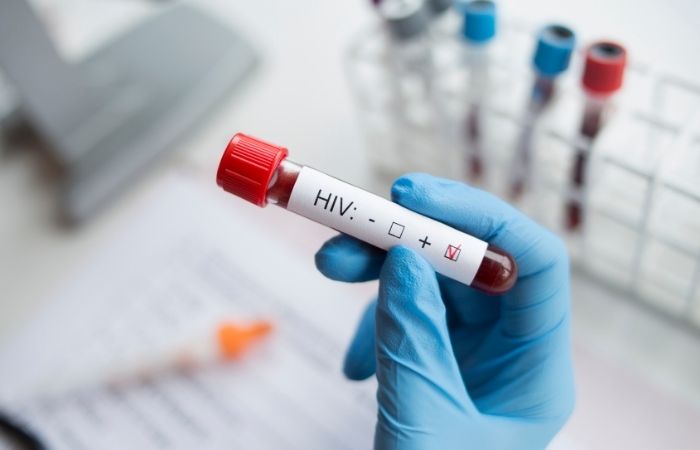
What Testing Actually Tells You (And What It Doesn’t)
This is the part that cuts through all the uncertainty. Because no matter how much you analyze a spot in the mirror, symptoms alone can’t confirm whether something is an STD or HIV. They can only suggest possibilities, and often misleading ones.
Testing, on the other hand, gives you a direct answer about what’s happening in your body. Not what it looks like. Not what it might be. What it actually is.
Someone once told me, “I spent five days convinced I had HIV because of a sore throat and a spot on my tongue. The test came back negative, and it turned out to be irritation from vaping.” That’s the gap between assumption and reality.
When it comes to HIV specifically, modern tests are highly accurate when taken at the right time. The key is understanding that timing matters more than symptoms. You don’t test based on how something looks, you test based on when a possible exposure happened.
For most people, starting with a discreet option from STD Test Kits can break that cycle of uncertainty. It gives you something concrete to work with instead of guessing based on visual clues that aren’t reliable.
Why Google Images Makes This So Much Worse
Let’s be honest, most people don’t stop at reading. They go straight to images. And that’s where things spiral.
The problem is that search results tend to show the most extreme, advanced, or textbook cases. That means if you type in “Kaposi sarcoma mouth,” you’re not seeing the average presentation, you’re seeing the clearest, most dramatic examples.
So you end up comparing a tiny, subtle spot in your mouth to a severe clinical image and thinking they match. Even when they don’t.
I’ve had people say, “It looks exactly like the picture,” and when you actually compare them side by side, they’re completely different in size, texture, and spread. But anxiety doesn’t process details, it looks for patterns.
This is why symptom-checking through images is one of the least reliable ways to understand what’s happening. It amplifies fear without improving accuracy. And it often delays the one thing that actually gives clarity: testing.
The Emotional Side No One Talks About
There’s a very real emotional layer to all of this that doesn’t get enough attention. It’s not just about a spot, it’s about what that spot might represent.
For some people, it’s tied to a recent hookup they’re already second-guessing. For others, it’s about trust in a partner. And sometimes, it’s just the weight of uncertainty, sitting there, waiting, wondering if something bigger is going on.
I’ve heard versions of this over and over: “I wasn’t even that worried until I looked it up.” That’s the moment where curiosity turns into anxiety. And once that switch flips, it’s hard to turn it off without real answers.
This is exactly why testing isn’t just a medical step, it’s a mental reset. It gives you a clear direction forward instead of leaving you stuck in a loop of “what if.”
And if the result is negative, you don’t just get relief, you get your focus back. If it’s positive, you get a plan. Either way, you move forward with clarity instead of fear.
If It Is HIV-Related, Here’s What That Actually Means Today
This is where a lot of outdated fear still lives. People hear “HIV” and immediately think worst-case scenario. But the reality today is very different from what it used to be.
With modern treatment, people living with HIV can have normal life expectancy and cannot transmit the virus when properly managed (this is known as “undetectable = untransmittable”). That’s a massive shift from how HIV was understood decades ago.
Conditions like Kaposi sarcoma are now far less common in people who are diagnosed early and receiving treatment. In fact, many cases today occur in individuals who were unaware of their HIV status or not yet in care.
So even in the unlikely scenario that a symptom is connected to HIV, the most important factor isn’t the symptom itself, it’s whether you get tested and treated. That’s what determines outcomes.
And this is why early testing matters. Not because something is definitely wrong, but because knowing your status puts you in control of what happens next.
How to Tell a Partner (If That’s What’s Making This Harder)
For a lot of people, the stress isn’t just about the symptom, it’s about what it might mean for someone else. You start thinking, “Do I need to say something? What if this is serious? What if I’m wrong?”
That conversation can feel heavier than the symptom itself. Not because you’ve done anything wrong, but because sexual health still carries a weird amount of stigma. Even when it shouldn’t.
Here’s the grounded approach: you don’t need to panic-text someone based on a guess. What you do need is information. Testing comes first. Once you know what’s actually going on, the conversation becomes clearer, calmer, and more productive.
If something does come back positive, most STDs are treatable, and partners can be tested and treated as well. It becomes a shared health situation, not a blame situation. That shift matters more than people realize.
Prevention, Retesting, and Not Ending Up Back in This Spiral
Let’s be real, most people don’t want to go through this kind of mental spiral again. The constant checking, the Googling, the second-guessing. The good news is, there are ways to reduce both your actual risk and your anxiety moving forward.
Regular testing is one of the simplest ways to stay ahead of uncertainty. Not because you expect something to be wrong, but because it removes the “unknown” factor that causes most of the stress in the first place.
If you’ve had a new partner or an exposure that’s been on your mind, a baseline test followed by a retest at the appropriate window gives you a full picture. You’re not relying on symptoms, which, as you’ve seen, can be misleading.
There’s also a mental shift that happens when testing becomes routine instead of reactive. It stops being something you only do when you’re scared and becomes something you do as part of taking care of yourself.
And honestly, that’s the goal here, not just avoiding infections, but avoiding the kind of uncertainty that sends you down a late-night search spiral in the first place.
FAQs
- 1. Can purple spots in the mouth be an STD?
- Most purple spots in the mouth are not due to STDs. Infections like chlamydia and gonorrhea do not usually cause purple spots in the mouth. However, Kaposi sarcoma, a symptom of HIV, may cause purple spots in the mouth.
- 2. What do HIV mouth spots look like?
- HIV mouth spots may look like white patches, due to thrush. In advanced stages, purple spots may appear due to Kaposi sarcoma.
- 3. How common is Kaposi sarcoma today?
- Kaposi sarcoma is not commonly found in people today, especially in those whose HIV infection has been detected and treated in the early stages. Kaposi sarcoma has been found in people whose HIV infection has not been treated.
- 4. Can a single purple spot mean HIV?
- No, a single purple spot does not mean that a person has HIV. To detect whether a person has HIV, tests have to be conducted. Several harmless diseases may also cause purple spots.
- 5. Do oral STDs cause purple lesions?
- Oral STDs do not cause purple lesions. They may cause a sore throat, redness, and ulcers. However, herpes may also cause lesions, but they may not look like purple spots.
- 6. How long do I need to wait before I take an HIV test?
- You need to wait between 2 to 6 weeks before taking an HIV test. This depends on the type of HIV test.
- 7. What if the spot doesn’t go away?
- If the spots do not go away within two weeks, it is important to consider seeking medical or dental attention. The persistence of the spots in your mouth is more important than their appearance.
- 8. Can stress cause spots in the mouth?
- Stress may not cause purple spots in your mouth. However, stress may cause you to grind your teeth or bite your tongue or inside your cheeks, which may cause spots in your mouth.
- 9. Do I need to take an STD/HIV test even if I am not experiencing any symptoms?
- Yes, you need to consider taking an STD/HIV test even if you are not experiencing any symptoms. Many STD/HIV infections may be asymptotic. This means that you may be infected without even realizing it.
- 10. Are at-home STD tests accurate?
- Yes, at-home STD tests are accurate. They provide a convenient way to obtain accurate results without having to visit a medical facility.
You Deserve Answers, Not Assumptions
Finding something unfamiliar in your body, especially something visible like a purple spot in your mouth, can flip a switch fast. Your brain fills in the blanks with worst-case scenarios, and suddenly you’re stuck trying to diagnose yourself with incomplete information.
But here’s the truth: most of the time, it’s not what you fear. And the fastest way to confirm that isn’t guessing, it’s testing. Real answers don’t come from comparing symptoms online. They come from knowing what’s actually happening in your body.
If you want to get out of the uncertainty loop, start with a trusted option like this at-home combo STD test kit. It’s private, straightforward, and gives you clarity without the stress of waiting rooms or second-guessing symptoms.
Our article was constructed based on current advice from the most prominent public health and medical organizations, and then molded into simple language based on the situations that people actually experience, such as treatment, reinfection by a partner, no-symptom exposure, and the uncomfortable question of whether it “came back.” In the background, our pool of research included more diverse public health advice, clinical advice, and medical references, but the following are the most pertinent and useful for readers who want to verify our claims for themselves.