Yellow or Green Discharge: STD, UTI, or Something Else?
Quick Answer: Yellow or green discharge can indicate infections like gonorrhea, chlamydia, trichomoniasis, bacterial vaginosis, or occasionally irritation. Discharge changes throughout the menstrual cycle. Stress shifts.

Quick Answer: Yellow or green discharge can indicate infections like gonorrhea, chlamydia, trichomoniasis, bacterial vaginosis, or occasionally irritation. Color alone isn’t enough, odor, pain, burning, timing, and testing history matter more than shade.
First: Color Is a Clue, Not a Verdict
Let’s take a breath before we jump to worst-case scenarios. Discharge changes throughout the menstrual cycle. It thickens, thins, becomes creamy, becomes stretchy. Hormones shift. Stress shifts. New partners shift your microbiome.
But when discharge turns distinctly yellow or green, especially if it’s thicker, frothy, or paired with burning or pelvic pain, your body may be responding to infection. According to the CDC, abnormal discharge is one of the most common reported symptoms of sexually transmitted infections worldwide.
Still, not every infection is sexually transmitted. That’s where things get confusing, and why comparison matters.

STD vs UTI vs Vaginal Imbalance: What’s Actually Different?
Many people Google “is yellow discharge a UTI” when they notice burning and color changes at the same time. The overlap in symptoms makes sense. But UTIs and STDs affect different systems in the body.
A urinary tract infection typically affects the bladder and urethra. STDs like gonorrhea and chlamydia infect mucous membranes of the cervix, urethra, rectum, or throat. Vaginal imbalances like bacterial vaginosis shift the natural bacteria inside the vagina itself.
| Condition | Discharge Color | Common Extra Symptoms | Sexually Transmitted? |
|---|---|---|---|
| Gonorrhea | Yellow or green, sometimes thick | Burning with urination, pelvic pain, bleeding between periods | Yes |
| Chlamydia | Yellowish, often mild | Pain during sex, lower abdominal discomfort, sometimes no symptoms | Yes |
| Trichomoniasis | Greenish-yellow, frothy | Strong odor, itching, irritation | Yes |
| Bacterial Vaginosis | Grayish or yellow | Fishy odor, especially after sex | Not technically an STD, but sex-related shifts common |
| UTI | No vaginal discharge change typical | Urgent frequent urination, bladder pressure, cloudy urine | No |
Table 1. Symptom comparison overview. Color alone is not diagnostic, testing confirms infection.
The key difference? UTIs usually change urine, not vaginal discharge. If discharge color changes significantly, we’re often looking at a vaginal or cervical source, not just bladder inflammation.
When Green Discharge After Sex Deserves Attention
Timing matters. If discharge changes within days to weeks after a new sexual encounter, especially unprotected vaginal or anal sex, the suspicion for gonorrhea or chlamydia rises. Both can cause yellow or green discharge. Both can be asymptomatic. And both are easily treatable when caught early.
Aisha, 26, described it this way: “I kept telling myself it was just a yeast infection. But the color was off. It wasn’t white. It wasn’t cottage-cheesy. It was yellow-green. I knew something wasn’t right.”
She tested positive for gonorrhea two weeks later. Treatment was straightforward. The emotional spiral beforehand was the hardest part.
If this is you right now, spiraling, you’re not dramatic. You’re human. But guessing won’t help you. Testing will.
If you need answers without walking into a waiting room, you can explore discreet options at STD Test Kits. There are rapid at-home options for infections commonly associated with yellow or green discharge, including combo STD test kits that screen for multiple infections at once.
When It’s Probably Not an STD
Not all yellow discharge means you need to text your last partner immediately.
Hormonal birth control changes discharge color and thickness. Recent antibiotics can temporarily shift vaginal flora. Bacterial vaginosis often produces a grayish-yellow discharge with a noticeable odor but is not classified as a sexually transmitted disease.
Even dehydration can make discharge appear darker or more concentrated. And sometimes what looks green in certain lighting is actually pale yellow.
The difference often comes down to accompanying symptoms. Is there pelvic pain? Fever? Bleeding between periods? Severe burning with urination? Those details guide next steps more than color alone.
What Yellow or Green Discharge Looks Like in Different Infections
Let’s slow this down and look closely. Because when people search “gonorrhea discharge color” or “trichomoniasis discharge color,” what they really want is a visual translation of anxiety. They want to know: does this look like mine?
Gonorrhea discharge is often described as thick, yellow, or green. In people with vaginas, it may increase in volume and come with pelvic pressure or bleeding between periods. In people with penises, it can appear as a green or yellow drip from the urethra, often paired with sharp burning during urination.
Chlamydia discharge is usually milder in color, more yellow than green, and many people have no noticeable discharge at all. That’s part of why it spreads so easily. According to the World Health Organization, most chlamydia infections are asymptomatic, especially in women.
Trichomoniasis is the one classically linked to greenish-yellow discharge that can look frothy or bubbly. It often has a strong odor and can cause itching or irritation. The Mayo Clinic notes that this infection may also cause discomfort during sex and urination.
And then there’s bacterial vaginosis. Not technically an STD, but frequently triggered by new sexual activity. BV discharge is often thin and grayish-yellow with a fishy smell, especially after intercourse.
When It’s a UTI Instead
A true urinary tract infection usually doesn’t change vaginal discharge color. Instead, it affects urine itself. The urine may appear cloudy, darker, or strong-smelling. You may feel intense urgency, like you have to pee constantly, even when very little comes out.
There’s often lower abdominal pressure rather than vaginal irritation. And while UTIs can coexist with STDs, they are not caused by sexual transmission in the same way.
If you have burning urination without discharge changes, bladder pressure, and no unusual vaginal odor, a UTI becomes more likely. If discharge is clearly green or yellow and increased, that leans more toward a vaginal or cervical infection.
People With Penises: Green Discharge Is a Bigger Red Flag
In people with penises, discharge is less common overall. So when it happens, and especially when it’s green or yellow, it deserves attention.
Rafael, 31, noticed a greenish stain in his underwear two weeks after a new partner. “I kept hoping it was sweat,” he said. “But it didn’t feel like sweat. It burned when I peed.”
He tested positive for gonorrhea. Early treatment prevented complications, but waiting longer could have led to epididymitis or fertility issues.
Green discharge from the penis is rarely caused by a UTI alone. It more commonly signals urethritis, often due to gonorrhea or chlamydia. According to the CDC’s gonorrhea fact sheet, urethral discharge is one of the hallmark symptoms in men.
Symptoms That Change the Urgency
Color matters less than context. If yellow or green discharge appears with any of the following, testing should not wait:
| Symptom Combination | Why It Matters | Recommended Action |
|---|---|---|
| Discharge + pelvic pain + fever | Possible pelvic inflammatory disease | Seek urgent in-person medical care |
| Green discharge + strong odor + itching | Possible trichomoniasis or BV | Test and treat promptly |
| Green penile discharge + burning | Likely urethritis (often gonorrhea) | Test immediately |
| Yellow discharge but no pain | Could still be asymptomatic STD | Schedule testing soon |
Table 2. Symptom severity and urgency guide. Fever or severe pain requires clinic evaluation.
Testing Is the Only Way to Know
Google cannot swab you. Reddit cannot confirm your diagnosis. And discharge color comparisons on image boards are unreliable at best.
Testing removes the guesswork. Modern nucleic acid amplification tests (NAATs) are highly sensitive for gonorrhea and chlamydia, often detecting infection within 7 to 14 days after exposure. Blood tests can detect syphilis and HIV. Vaginal swabs can detect trichomoniasis and bacterial vaginosis.
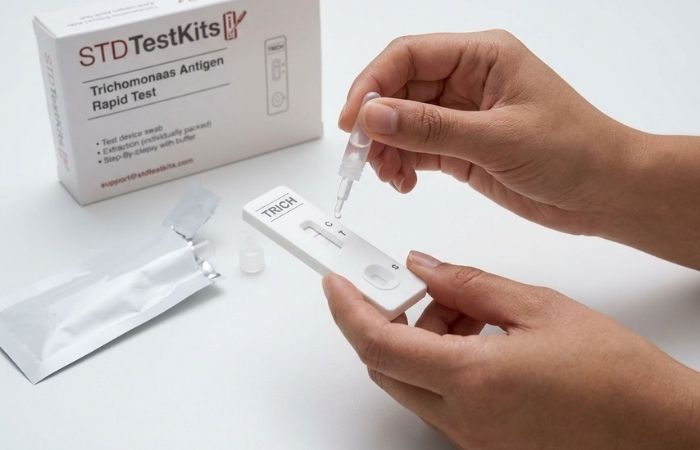
If clinic access feels intimidating, privacy-focused options exist. At-home kits allow discreet sample collection with lab-grade processing. Many people prefer that control. You can explore rapid and combo testing options through multi-STD test kits that check for several infections at once.
The goal isn’t fear. It’s clarity.
If It’s an STD, What Happens Next?
This is the part where your brain jumps ahead. You picture awkward texts. You imagine worst-case complications. You wonder if you “should have known better.” Let’s interrupt that spiral.
If yellow or green discharge turns out to be gonorrhea, chlamydia, or trichomoniasis, treatment is straightforward in most cases. Antibiotics are highly effective. The key is catching it before the infection climbs upward and causes complications like pelvic inflammatory disease or spreads to partners.
According to the CDC STD Treatment Guidelines, prompt treatment not only resolves symptoms but significantly reduces transmission risk. That means testing early is protective, not shameful.
Most people feel physically better within days of starting medication. Emotionally? That part can take longer. But information replaces fear. And once you know what you’re dealing with, the next step becomes obvious.
How Long Should You Wait Before Testing?
Timing matters more than color. If discharge appears a few days after sex, you might feel urgency to test immediately. But every infection has a window period, the time between exposure and when a test can reliably detect it.
For gonorrhea and chlamydia, most NAAT tests are reliable about 7 to 14 days after exposure. Testing too early can produce false reassurance. For trichomoniasis, detection often becomes reliable within one to four weeks.
If you’re unsure about timing, a practical rule is this: test now if symptoms are present, and retest in two weeks if exposure was recent. That second test adds confidence.
This is where many people appreciate discreet access. You can begin with a rapid screening test and follow up if needed. Returning to STD Test Kits gives you options without sitting in a waiting room rehearsing explanations in your head.
What If It’s Bacterial Vaginosis Instead?
Not all yellow discharge carries a sexually transmitted disease. Bacterial vaginosis (BV) results from an unbalance of the natural bacteria in the vagina. This can result from a new sexual partner, douching, or even for no reason at all.
Bacterial vaginosis discharge resembles a thin, grayish or yellowish discharge with a strong odor. This odor may become even stronger after sexual intercourse. Unlike gonorrhea and chlamydia, BV does not normally cause pain in the pelvic region or a severe burning sensation while urinating.
Bacterial vaginosis can also be treated with antibiotics, but a partner may not need to be treated. Guessing the cause of the disease may result in incomplete treatment and recurring symptoms.
When Discharge Signals Something More Serious
Most causes of yellow or green discharge are treatable. But there are moments when waiting is not the right move.
If discharge is paired with high fever, severe lower abdominal pain, nausea, or pain during intercourse, pelvic inflammatory disease becomes a concern. PID can develop when untreated infections spread upward into the reproductive organs.
The NHS guidance on pelvic inflammatory disease emphasizes that early treatment reduces long-term risks like infertility and chronic pelvic pain.
In those situations, skip the at-home testing and seek urgent care. At-home kits are powerful tools for clarity, but they are not substitutes for emergency evaluation.
The Emotional Layer No One Talks About
Color changes trigger more than medical questions. They trigger identity questions.
“I felt dirty,” said Noor, 24. “Even before I knew what it was, I felt ashamed.”
That shame doesn’t belong to you. Sex is human. Microbes are human. Bodies react to friction, new bacteria, and exposure in predictable biological ways. There is no moral dimension to discharge color.
The fastest way out of anxiety is information. The fastest way to protect partners is confirmation. The fastest way to feel steady again is to move from guessing to knowing.
How to Tell the Difference Without Spiraling
If you’re staring at yellow or green discharge and trying to decode it, here’s the grounded way to think about it. Don’t isolate one symptom. Layer them.
Ask yourself: Is there strong odor? Is there pelvic pain? Is urination intensely painful or just slightly uncomfortable? Did this begin after a new partner? Has this happened before?
Color is a starting clue. Pattern is the bigger picture.
Yellow discharge without odor and without pain might reflect hormonal shifts. Green discharge with burning and a new sexual partner leans more toward gonorrhea or trichomoniasis. Burning urination without discharge change leans more toward UTI.
If you’re still unsure, that uncertainty itself is your answer. Test.
Testing Without the Waiting Room Anxiety
Not everyone wants to sit under fluorescent lights rehearsing their sexual history. Privacy matters. Control matters. For many people, that’s where at-home testing changes the experience entirely.
Discreet options through STD Test Kits allow you to test from home for common infections linked to yellow or green discharge. A combo STD home test kit can screen for multiple infections at once, reducing guesswork and repeated appointments.
Results are private. Shipping is discreet. And most importantly, clarity replaces speculation.
You deserve answers, not assumptions.
FAQs
- 1. If I have yellow discharge, does that mean that I have an STD?
- No, it does not. And I mean that emphatically. It is true that some women experience changes to the discharge that may be caused by having had sexual relations. But discharge can be caused by many things, such as hormone fluctuations, changes in vaginal bacteria, and even stress. So, while discharge is a symptom that warrants checking, the answer to the question is no, having yellow discharge does not necessarily mean that you have an STD. It does, however, mean that you should check to find out for sure rather than wonder.
- 2. But green discharge is different. That looks more ominous. Is that a different story?
- Green discharge does, in fact, raise more red flags, especially if the discharge is thick and frothy. But is it different? Well, yes, gonorrhea and trichomoniasis are more likely to be the culprits, but the reality is that these are easily cured infections. What is not easily cured is the lack of action on the part of the person who is not getting tested because the discharge is green.
- 3. If the discharge does not have a bad smell, then is that a good thing?
- No, because while the absence of a foul odor may be indicative of a bacterial infection such as BV, some STDs, such as trichomoniasis, may not have much odor at all. And, in fact, the majority of women who have chlamydia have no odor at all, just a yellow discharge. So, the absence of a foul odor does not necessarily mean that you are safe, because the foul odor is not the issue, the issue is that you are not getting tested.
- 4. Can a UTI cause discharge changes?
- A UTI, or Urinary Tract Infection, is usually evidenced by changes to the urine, such as a cloudy urine, a foul odor, and the feeling of having to urinate frequently. But a change to the discharge that is yellow or green usually indicates that the source is not the bladder, but the vagina or cervix. So, while it is possible to have a UTI and discharge, the discharge is usually not caused by the UTI, and the answer to the question is no, a UTI does not usually affect the discharge.
- 5. If I had sexual relations a few days ago, does that mean
- Not necessarily. Some may take a few days, while others may take a couple of weeks. If symptoms are present, get tested now. If symptoms are absent, get tested in 1-2 weeks, considering that the exposure was recent. Think of it as verifying the story your body tells.
- 6. What if I get a negative result, but my discharge still looks weird?
- That’s not you being dramatic. Get re-tested because your symptoms don’t go away. It could be bacterial vaginosis, irritation from products, or other possible reasons. A negative result for STD doesn’t mean that your symptoms are imaginary.
- 7. Do I have to tell my partner immediately?
- If you haven’t gotten tested yet, don’t send that panic text to your partner yet. Get your results first. When you get a confirmed result of having an STD, informing your partner is important, but it’s more of prevention than blame.
- 8. Is green discharge ever considered normal?
- True green discharge is seldom considered “normal.” Pale yellow discharge may be considered “normal,” depending on the light and your menstrual cycles.
- 9. I feel embarrassed even asking about all of this. Is that normal?
- Absolutely. Discharge is at the crossroads of sex, private issues, and vulnerability. However, your body doesn’t run on shame; your body runs on biology. Biology doesn’t care that your discharge may be yellow or green; biology cares that you get tested.
- 10. What’s the smartest thing I can do next if I am still unsure?
- Stop trying to color match your symptoms against images you find online. Test. Whether that's a clinic or an unobtrusive option to do in the comfort of your own home, knowing beats wondering every single time.
You Deserve Clarity, Not Guesswork
Yellow or green discharge is a signal, not a sentence. Sometimes it means infection. Sometimes it means imbalance. What it never means is that you are reckless, dirty, or irresponsible.
The fastest way to calm uncertainty is to replace it with facts. Whether you choose clinic testing or a discreet at-home option, don’t stay stuck in speculation. Take control of your sexual health today and get the answers your body is asking for.
How We Sourced This Article: This guide integrates current recommendations from the CDC, WHO, Mayo Clinic, and NHS with peer-reviewed STI research and lived-experience reporting to ensure both clinical accuracy and emotional clarity. Approximately fifteen authoritative sources informed the content. The six listed below represent the most reader-accessible and medically reliable references.