Can HPV Spread Through Casual Contact? What’s Actually Safe
Quick Answer: HPV does not spread through casual contact like hugging, touching, or sharing objects. It spreads through direct skin-to-skin contact with infected areas, usually during sexual activity.

Quick Answer: HPV does not spread through casual contact like hugging, touching, or sharing objects. It spreads through direct skin-to-skin contact with infected areas, usually during sexual activity.
This Is Where Most People Get It Wrong About HPV
Let’s clear something up right away: HPV is not floating around waiting to jump from one person to another through everyday interaction. It’s not airborne, it doesn’t travel across a couch, and it doesn’t pass through casual touch. The internet tends to blur all “contact” into one scary category, but biologically, HPV is picky about how it spreads.
HPV requires direct contact with infected skin, usually very specific areas like genital or oral tissues. That’s why it’s classified as a sexually transmitted infection. Someone sitting next to you, shaking your hand, or even hugging you isn’t interacting with the type of skin where HPV typically lives.
A lot of people come into this with guilt, thinking, “What if I exposed someone without realizing it?” In reality, most everyday interactions don’t even come close to the kind of contact needed for transmission. That realization alone tends to take a huge weight off.

What Counts as “Casual Contact” (And Why It’s Safe)
Casual contact includes the kinds of interactions you probably didn’t even think twice about before Googling HPV at 2AM. Things like hugging friends, holding hands briefly, sitting close to someone, or sharing a drink all fall into this category.
None of these involve the type of sustained, skin-to-skin exposure that HPV needs to spread. Even something like touching someone’s arm or back doesn’t pose a risk, because HPV doesn’t infect or transmit through those areas in typical cases.
People often worry about objects too, towels, toilet seats, utensils. But HPV doesn’t survive well on surfaces in a way that leads to real-world transmission. So if your anxiety is telling you that you might have passed HPV through something indirect, that’s fear talking, not biology.
So How Does HPV Actually Spread?
This is where we move from “what doesn’t matter” to “what actually does.” The way that you get infected with the HPV virus is through direct skin contact with the infected areas, which, as you might expect, most commonly occurs during vaginal, anal, or oral sex. This does not require fluids, as some other viruses require, which makes skin contact so much more important than people think.
If you can think about two different areas of skin coming in contact with each other, especially during sex, then you can think about how the virus can be transferred from one person to another. This does not mean a casual touch or contact, but a long period of contact with the areas where the virus actually lives.
Another thing that a lot of people are unaware of, however, is that the virus is actually incredibly common, with most people becoming infected at some point in their lives, even though they may not even realize that they are infected with the virus.
What About Kissing, Hands, or Fingers?
This is where things get a little more nuanced, and where Google makes things sound a lot scarier than they actually are. Kissing, especially casual closed-mouth kissing, is not really a significant means of transmitting HPV. Deep kissing is a possibility for oral HPV, but not a primary means of transmission.
Hands and fingers are similar to kissing. From a purely technical standpoint, if someone touches an infected area and then immediately touches someone else’s mucous tissue, there is a possibility. However, in real life, this is not a common means of transmission.
The reality is that most HPV is spread by sexual activity. So if you’re worrying about things like “Did I touch someone’s arm after touching myself?” then you’re worrying about a level of risk that is purely theoretical.
| Activity | Risk Level |
|---|---|
| Hugging or touching arms | No risk |
| Sharing food or drinks | No risk |
| Kissing (casual) | Extremely low risk |
| Sexual contact (genital skin contact) | Primary transmission route |
| Contact with visible genital warts | Higher risk |
| Myth | Reality |
|---|---|
| HPV spreads through any touch | Requires specific skin-to-skin contact |
| You can get HPV from surfaces | Surface transmission is not a real-world concern |
| You must avoid people if you have HPV | Normal contact is completely safe |
| HPV is rare | Most sexually active people get it at some point |
Testing, Clarity, and Taking Back Control
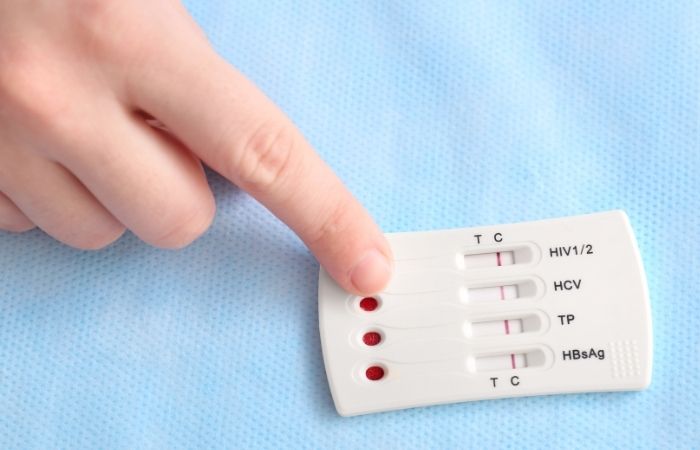
One of the hardest parts about HPV is that it’s often invisible. Many people never have symptoms, which makes uncertainty feel even louder. If you’re stuck in a loop of “what if,” testing can help shift you out of that mental space.
You can explore discreet options through STD Test Kits, which allow you to check your status privately and without the stress of a clinic visit. For broader screening, something like a combo STD home test kit can give you a more complete picture.
If your brain is spinning, clarity is powerful. Not because something is necessarily wrong, but because guessing is often worse than knowing.
FAQs
- 1. Can HPV be transmitted through hugging?
- No, HPV cannot be transmitted through hugging. Hugging does not involve any infected areas that have the virus.
- 2. Can you get HPV by touching a person’s hand?
- No, you cannot get HPV by touching a person’s hand. This is because the virus does not have a chance to infect you.
- 3. Is HPV contagious if you have not had sex?
- Although you may have skin-to-skin contact with a person infected by the virus, you are still very likely to have sex with the person if you have a skin-to-skin infection.
- 4. Can you get HPV if you kiss someone?
- While casual kissing may cause you to get HPV, it is very unlikely. Deep kissing may cause you to get oral HPV.
- 5. Can HPV survive on surfaces such as a towel or toilet seat?
- No, HPV cannot survive on a surface such as a towel or toilet seat.
- 6. What if you touch someone after touching yourself?
- You should not worry if you touch someone after touching yourself. This is not a realistic scenario that will cause you to get HPV.
- 7. Do you have to tell people you hug that you have HPV?
- No, you should not have to tell people you hug that you have HPV because hugging does not cause you to get the virus.
- 8. Are genital warts contagious if you have normal contact with someone?
- Only if you have direct contact with the infected area may you get genital warts.
- 9. Can you get HPV if you touch someone’s clothing?
- No, you cannot get HPV if you touch someone’s clothing because the virus cannot survive on clothing.
- 10. Should you stay away from people if you have HPV?
- No, you should not stay away from people if you have HPV because you are not likely to get someone else infected with the virus.
You’re Not “Contagious to the World”, Here’s the Truth
HPV has a way of making people feel like they need to pull back from others, but that’s not based in how the virus actually works. You’re not spreading anything through everyday touch, and you don’t need to distance yourself from people in your life.
If anything, the next step isn’t isolation, it’s clarity. If you’re unsure about your status or just want peace of mind, you can explore options like a discreet at-home STD test kit and get answers without the stress spiral.
You deserve accurate information, not fear-based assumptions. And once you understand how HPV really spreads, most of that anxiety starts to lose its grip.
Our article was constructed based on current advice from the most prominent public health and medical organizations, and then molded into simple language based on the situations that people actually experience, such as treatment, reinfection by a partner, no-symptom exposure, and the uncomfortable question of whether it “came back.” In the background, our pool of research included more diverse public health advice, clinical advice, and medical references, but the following are the most pertinent and useful for readers who want to verify our claims for themselves.