How Soon After Sex Can You Test for STDs?
Last updated: March 2026 Why the Timing of Your STD Test Actually Matters Here is what most people do not fully understand about STD testing: a test does not detect the infection itself in the way you might imagine.
Why the Timing of Your STD Test Actually Matters
Here is what most people do not fully understand about STD testing: a test does not detect the infection itself in the way you might imagine. Depending on the type of test, it is either detecting antibodies your immune system has produced in response to the infection, or it is detecting specific proteins or genetic material from the pathogen. Either way, your body needs time to produce enough of what the test is looking for before it shows up as a positive result. Before that threshold is reached, the infection can be fully present in your body, actively replicating, potentially transmissible, and the test will still come back negative.
This is called the window period, and it is not a flaw in the test. It is a biological reality. Your immune system does not work on your anxiety timeline. After exposure to chlamydia, for example, it takes the bacteria time to establish itself in your tissues, and it takes your body time to produce a detectable response. Testing on day three might feel proactive, but the result carries almost no meaningful information. A negative on day three after potential chlamydia exposure does not mean you are clear; it means you tested before the window closed.
The consequences of this misunderstanding are significant. According to the CDC, a large proportion of STI transmissions happen precisely because people believe they have been tested and cleared when, in reality they tested too early, got a false negative, and continued having unprotected sex. The CDC's 2024 provisional surveillance data shows that despite a modest overall decline in reported STIs, there were still more than 2.2 million cases of chlamydia, gonorrhea, and syphilis reported in the United States in 2024 alone, a figure that almost certainly undercounts real infections because of missed and mistimed testing.
Testing at the right time is not a technicality. It is the difference between a result you can act on and a result that means nothing.
The Testing Window for Every Major STD, In Plain English
Different infections have different window periods because they work differently inside your body. A bacterial infection like chlamydia moves faster through your system than a virus like hepatitis C, which requires a longer replication cycle before it reaches detectable levels in blood. Understanding why each window is what it is helps you take the timeline seriously rather than just following a rule you do not understand.
Chlamydia, test from 14 days after exposure
Chlamydia is caused by a bacterium that infects mucosal tissue, the lining of the genitals, throat, and rectum. It replicates relatively quickly, which is why its window period is the shortest of the common bacterial STDs. By 14 days post-exposure, most tests can reliably detect the bacterial DNA or the body's response to it. Testing before this point risks a false negative because the bacterial load may not yet be high enough to register. Most people with chlamydia have no symptoms at all, which makes timed testing after exposure the only reliable way to know.
Gonorrhea, test from 3 weeks after exposure
Gonorrhea, also bacterial, has a slightly longer window than chlamydia despite both being fast-moving infections. The bacterium that causes gonorrhea, Neisseria gonorrhoeae, behaves differently depending on where in the body it establishes itself. Genital infections may produce symptoms faster, sometimes as soon as a few days, but a symptomatic response is not the same as a detectable test result. Even if burning or discharge appears within a week, waiting the full 3 weeks before testing gives you a much more reliable result. Importantly, throat and rectal gonorrhea are almost always asymptomatic, meaning timing matters even more for those sites.
Syphilis, test from 6 weeks after exposure
Syphilis is caused by the bacterium Treponema pallidum, and it moves through the body in stages. The primary stage, typically a painless sore called a chancre, can appear anywhere from 10 days to 3 months after exposure, which makes symptom-based timing unreliable. Blood tests for syphilis detect antibodies, and antibody production takes time. While some people produce detectable antibodies as early as 3 weeks, the 6-week mark is when testing becomes reliably accurate. It is worth noting that congenital syphilis, passed from mother to baby, rose for the 12th consecutive year in the US in 2024, which makes timely and accurate syphilis testing particularly urgent for anyone who is pregnant or trying to conceive.
HIV, test from 6 weeks (first indicator); retest at 12 weeks for certainty
HIV has one of the more complex testing timelines because the type of test you take affects how early it can detect the virus. Modern combination antigen/antibody tests, which look for both HIV antibodies and the p24 antigen, can detect infection as early as 18 to 45 days after exposure according to CDC guidance. However, the 6-week mark is when these tests become reliably accurate for most people. Because a small number of people take longer to produce a detectable response, a negative result at 6 weeks should be confirmed with a retest at 12 weeks if you had a high-risk exposure. A negative result at 12 weeks with a combination test is considered conclusive.
Herpes HSV-1 and HSV-2, test from 6 weeks after exposure
Herpes testing is one of the most misunderstood areas of sexual health. Blood tests for herpes detect antibodies, and antibody production after herpes exposure is notoriously slow and variable. Some people begin producing detectable antibodies within 3 weeks; others take up to 6 months. The 6-week mark is the earliest point at which a blood test is considered reasonably reliable, but it is worth knowing that testing at 12 to 16 weeks provides even greater accuracy. If you have an active sore or blister, a swab test of that lesion is far more accurate than a blood test during an outbreak and does not require waiting. Without symptoms, however, blood testing after the appropriate window is the only option.
Hepatitis B, test from 6 weeks after exposure
The hepatitis B virus infects liver cells, and the window period reflects the time needed for both viral replication and the body's immune response to reach detectable levels. Surface antigen tests, which look for a specific protein on the virus's outer shell, can detect hepatitis B from around 6 weeks after exposure. Most people with acute hepatitis B either have no symptoms or experience flu-like symptoms that are easy to dismiss, making timed testing the only reliable path to an answer.
Hepatitis C, test from 8 to 11 weeks after exposure
Hepatitis C has the longest window period of the common STDs because of the way the virus replicates in liver tissue. Antibody tests for hepatitis C are not reliable until 8 to 11 weeks after exposure. RNA tests, which detect the virus's genetic material directly, can find the infection earlier, sometimes from around 1 to 2 weeks, but these are typically clinical tests rather than standard at-home options. For most practical purposes, waiting at least 8 weeks before testing for hepatitis C is the minimum, with 11 to 12 weeks being the safer threshold.
| Infection | Test From | Notes |
|---|---|---|
| Chlamydia | 14 days after exposure | Often no symptoms; urine or swab test |
| Gonorrhea | 3 weeks after exposure | Throat and rectal gonorrhea almost always silent |
| Syphilis | 6 weeks after exposure | Painless sore may or may not appear; blood test |
| HIV | 6 weeks (retest at 12 weeks for certainty) | Combination antigen/antibody test recommended |
| Herpes HSV-1 & HSV-2 | 6 weeks after exposure | 12–16 weeks for highest accuracy; swab if active sore |
| Hepatitis B | 6 weeks after exposure | Surface antigen test; often asymptomatic |
| Hepatitis C | 8–11 weeks after exposure | Longest window; antibody test standard |
What Happens If You Test Too Early?
You get a negative result that does not mean what you think it means. This is the core problem with testing before the window closes, and it plays out in a very predictable way. Someone has a sexual encounter they are worried about. They test two or three days later, get a negative, feel relieved, and either stop worrying or, worse, continue having unprotected sex with a partner under the assumption they are clear. Then, four weeks later, a partner calls with a positive result. The early test did not catch the infection because the infection was not yet detectable. The biology had not caught up to the anxiety.
A false negative in this context is not a testing error. The test worked exactly as designed, it just found nothing because there was nothing to find yet. This is worth understanding clearly: a negative result before the window closes is clinically meaningless for that exposure. It does not rule out infection. It does not give you clearance. It is simply a measurement taken too early to produce useful data.
If you have already tested too early after a specific exposure, the right move is to retest at the appropriate window for whatever you were worried about. If you tested for chlamydia at day 5 and got a negative, test again at day 14 or later. If you tested for HIV at 3 weeks and got a negative, test again at 6 weeks and reconfirm at 12. Do not assume the early negative carries forward, it does not. The only result that counts is the one taken after the window has closed.
There is also a behavioral risk worth naming here. People who believe they have tested negative, even incorrectly, often relax their precautions. They tell partners they have been tested and are clean. They stop using protection. This is how infections spread quietly through networks of people who all believe they were tested and cleared. If you are not sure whether your test was taken at the right time, treat yourself as potentially infectious and retest at the correct window before making any decisions based on that result.
At-Home Rapid Testing, Which Kit to Use and When
At-home rapid tests have made STD testing genuinely accessible in a way it has never been before. You do not need an appointment, a waiting room, or an awkward conversation with a doctor you have never met. You test in your own bathroom, get results in minutes, and deal with whatever comes next on your own terms. But the convenience of at-home testing does not change the biology of window periods, and the most important thing to get right with any at-home kit is the timing.
The most practical approach for most people after a potential exposure is to identify which infections are relevant to the encounter, based on what happened, whether protection was used, and whether a partner has disclosed anything, and then plan two testing points: one at the earliest reliable window for the fastest-moving infections, and a follow-up at 6 to 12 weeks for those with longer windows. For someone who had unprotected vaginal or anal sex with a new partner, a reasonable plan looks like this: test for chlamydia at 14 days, test for gonorrhea at 3 weeks, then run a full panel at 6 to 8 weeks to cover syphilis, HIV, herpes, and hepatitis B, with a hepatitis C retest at 11 to 12 weeks if relevant.
For comprehensive coverage, the 7-in-1 Complete At-Home STD Test Kit covers HSV-2, chlamydia, gonorrhea, syphilis, HIV, hepatitis B, and hepatitis C in a single kit, which is the right choice after most heterosexual unprotected exposures. If oral herpes is also a concern, the 8-in-1 Complete At-Home STD Test Kit adds HSV-1 to the panel. Women who want the most complete screen available, including trichomoniasis and HPV, should look at the Women's 10-in-1 At-Home STD Test Kit, which covers all of the above plus the two most common infections that are easy to miss on a standard panel.
| Situation | Recommended Kit | When to Test |
|---|---|---|
| Unprotected sex with new partner (male or female) | 7-in-1 Complete | 6 weeks post-exposure; retest HIV at 12 weeks |
| Concerned about oral herpes as well | 8-in-1 Complete | 6 weeks post-exposure |
| Woman wanting full panel including HPV and trich | Women's 10-in-1 | 6–8 weeks post-exposure |
| Concerned specifically about chlamydia only | Chlamydia Single Test | 14 days post-exposure |
| Concerned about chlamydia and gonorrhea together | Chlamydia & Gonorrhea 2-in-1 | 3 weeks post-exposure |
Specific Situations, When Exactly Should You Test?
Window periods are not one-size-fits-all in practice. The specific situation you are testing after changes which infections are most relevant and therefore which windows matter most. Here is how to think through the most common scenarios.
After unprotected sex with a new partner
This is the broadest scenario and typically calls for the most complete testing approach. If you do not know the other person's STD status, assume any infection could theoretically be in play. The practical plan: test for chlamydia at 14 days if you want an early answer on the most common bacterial infection, then run a full panel, chlamydia, gonorrhea, syphilis, HIV, herpes, hepatitis B, and hepatitis C, at 6 weeks. HIV should be retested at 12 weeks. Hepatitis C should be retested at 11 weeks if there was any blood-to-blood contact risk.
After a condom broke
A condom break mid-sex is a partial exposure, not a full one, but it is enough to transmit any of the major infections. Treat it the same as unprotected sex for testing purposes. Use the same window periods and the same panel. The fact that you intended to use protection does not change the biology of what may have been transmitted during the time the condom was not doing its job.
After oral sex only
Oral sex carries real but lower transmission risk for several infections. Gonorrhea is the one most reliably transmitted through oral sex, throat gonorrhea is common and almost always asymptomatic. Chlamydia can also establish throat infections through oral sex, as can syphilis. Herpes HSV-1 is very commonly transmitted through oral contact. HIV transmission through oral sex alone is considered very low risk by the CDC, but not zero. For oral-only exposures, focus on gonorrhea (3-week window), chlamydia (14-day window), syphilis (6-week window), and herpes (6-week window). A throat swab is required to detect throat gonorrhea, a standard urine test will miss it.
After a partner tells you they tested positive
This is the scenario with the clearest timeline to work from. If a partner notifies you that they tested positive for a specific infection, you know the exposure date and the infection. Use the appropriate window period for that specific infection, do not test immediately, even though the instinct is to find out as fast as possible. If a partner discloses a chlamydia positive, wait 14 days from your last sexual contact before testing. If they disclose HIV, wait 6 weeks for a first result and retest at 12 weeks. Testing the day you find out, before the window has closed, will very likely produce a false negative that gives you false reassurance.
After a one-night stand with an unknown partner
You are lying in bed the next morning wondering whether to test. The answer is yes, but not today. The most useful thing you can do right now is note the date, think about what happened and whether protection was used, and set calendar reminders for your testing windows. For most one-night stand scenarios involving vaginal or anal sex without a condom, a chlamydia test at 14 days, followed by a full panel at 6 weeks, followed by an HIV retest at 12 weeks, is a complete and responsible approach. If you are a woman, adding trichomoniasis and HPV to your panel is also worth considering.
Can You Test the Same Day? What Rapid Tests Can and Cannot Do
Same-day testing after a sexual encounter is one of those things that feels like it should be possible in 2026, and for a very narrow set of circumstances, it is. If you already have symptoms, a sore, discharge, burning, a rash, testing on the day symptoms appear can be clinically useful, particularly for infections like gonorrhea, chlamydia, and herpes where a swab of an active lesion can detect the pathogen directly without waiting for antibody production. Symptom-based testing is different from exposure-based testing, and for visible or palpable symptoms, speed matters.
For exposure-based testing, meaning you had sex, you are worried, and you have no symptoms, same-day testing will almost certainly tell you nothing useful. The exception is if you are testing for a previous exposure that you have now waited the appropriate time on. If today is 15 days after an unprotected encounter and you have been waiting to test for chlamydia, testing today is exactly right. The "same-day" framing only becomes a problem when it means testing within 24 to 72 hours of the specific exposure you are worried about.
At-home rapid tests are an excellent tool for testing at the right time. According to research cited by GoodRx, at-home STD tests can be just as reliable as clinic-based testing when samples are collected correctly and the test is taken within the appropriate window. The accuracy figures for the kits available through STD Test Kits are strong, 99%+ for chlamydia, 99%+ for gonorrhea, 99% for syphilis, and 99.8% for HIV, but those figures assume the test was taken after the window period has closed. An accurate test taken too early is still an inaccurate result.
After You Test, Reading Your Results and What They Actually Mean
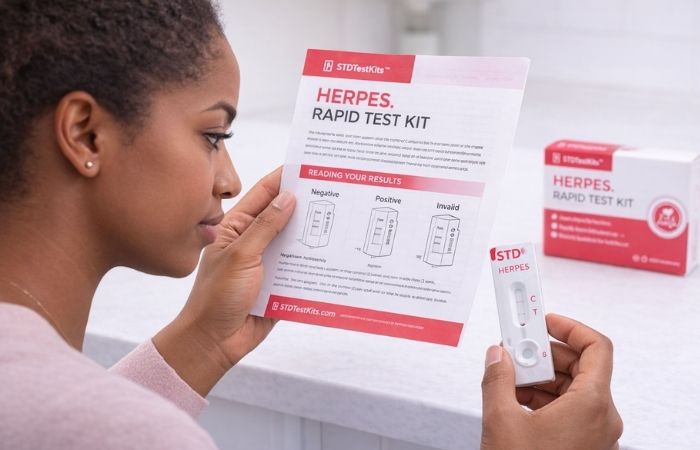
A negative result means different things depending on when you tested. If you tested after the appropriate window period for the infection in question, a negative is genuinely reassuring, it means the test looked for what it was designed to detect and found nothing. You can act on that result with confidence. If you tested before the window closed, a negative is essentially uninformative. It does not confirm you are clear. It simply means the test could not yet detect what may or may not be present. In this case, the responsible move is to retest at the correct window before drawing any conclusions.
A positive result, regardless of timing, means you need to follow up with a healthcare provider. For bacterial infections like chlamydia, gonorrhea, and syphilis, treatment is available and effective, these infections can be cured. For viral infections like HIV, herpes, and hepatitis, treatment exists that controls the infection, reduces transmission risk, and protects your long-term health. A positive result is not a catastrophe. It is information. The people who experience the worst outcomes from STDs are generally those who tested too late, not too early.
One more thing worth saying plainly: if you test negative for everything at the right windows after a specific exposure, you have done everything right. You do not need to keep testing for that exposure indefinitely. Set a reminder for routine annual testing if you are sexually active, or test after any new exposure using the same window-period logic, and you are managing your sexual health responsibly.
FAQs
- 1. Can I test for STDs the day after sex?
- You can, but it will not give you a meaningful result for that exposure. Most infections need at least 14 days, and several need 6 weeks or more, before a test can reliably detect them. Testing the day after is extremely likely to produce a false negative, even if an infection is present. Wait for the appropriate window period before testing.
- 2. What is the earliest I can test for chlamydia after exposure?
- The earliest reliable window for chlamydia is 14 days after exposure. Testing before this point risks a false negative. If you had a potential exposure, mark 14 days on your calendar and test then. Chlamydia is the most commonly reported STI in the US, and it almost always has no symptoms, timing your test correctly is the only reliable way to know.
- 3. How soon after sex can I test for HIV?
- With a modern combination antigen/antibody test, HIV can be reliably detected from 6 weeks after exposure. A negative result at 6 weeks is strongly reassuring, but for complete certainty after a high-risk exposure, retesting at 12 weeks is recommended. A negative at 12 weeks with a combination test is considered conclusive by the CDC.
- 4. Does a negative result mean I definitely do not have an STD?
- Only if you tested after the appropriate window period for the specific infection. A negative result taken too early, before the window closes, does not rule out infection. If you are not sure whether you tested at the right time, retest at the correct window before acting on the result.
- 5. Can I test for herpes right after an exposure?
- No. Blood tests for herpes detect antibodies, and your body typically does not produce detectable antibodies until at least 6 weeks after exposure. Testing earlier will almost certainly return a false negative. If you have an active sore or blister, a swab test of that lesion can provide much earlier and more accurate results than a blood test.
- 6. Do I need to test for all STDs after every sexual encounter?
- Not necessarily. Your testing approach should be proportional to the exposure. A brief encounter with a known, recently tested partner carries different risk than unprotected sex with a new partner of unknown status. As a general rule, annual testing is appropriate for anyone who is sexually active, with additional testing after any new unprotected exposure or after a partner discloses an infection.
- 7. What should I do if I already tested too early and got a negative?
- Retest at the appropriate window. An early negative does not carry forward, it tells you nothing about the exposure you are worried about. If you tested for gonorrhea at 5 days and got a negative, test again at 3 weeks. If you tested for HIV at 2 weeks and got a negative, test again at 6 weeks and confirm at 12. Treat yourself as potentially infectious in the meantime.
- 8. Can gonorrhea or chlamydia be detected before symptoms appear?
- Yes, and this is exactly why timed testing matters so much. Both gonorrhea and chlamydia are frequently asymptomatic, the majority of people with these infections never develop noticeable symptoms. Testing at the right window, regardless of whether you feel anything, is the only reliable way to detect these infections.
- 9. Does the type of sex affect which STDs I should test for?
- Yes. Oral sex primarily raises the risk for throat gonorrhea, chlamydia, syphilis, and herpes. Anal sex raises the risk for rectal gonorrhea, chlamydia, herpes, syphilis, HIV, and hepatitis. Vaginal sex can transmit all of the above plus trichomoniasis and HPV. Make sure the kit you choose covers the infections relevant to your specific exposure.
- 10. How long after a condom break should I test?
- Use the same window periods as for unprotected sex. A condom break is a full-exposure event for whatever occurred during the time the condom failed. Test for chlamydia at 14 days, gonorrhea at 3 weeks, and run a full panel at 6 weeks, retesting HIV at 12 weeks. There is no shortened timeline because the exposure happened briefly or accidentally.
Test When the Time Is Right, Here Is Where to Start
Knowing your window periods is half the battle. The other half is actually having the right test kit ready when the time comes, so you are not scrambling to find something at the last minute or delaying because a clinic appointment does not fit your schedule. At-home testing puts you in control of that timeline completely.
For most exposures involving unprotected vaginal or anal sex, the 7-in-1 Complete At-Home STD Test Kit covers the full standard panel, HSV-2, chlamydia, gonorrhea, syphilis, HIV, hepatitis B, and hepatitis C, in a single discreet kit you can use at home. If you want to add HSV-1 to that panel, the 8-in-1 Complete At-Home STD Test Kit has you covered. Women looking for the most complete screen available, including trichomoniasis and HPV, should consider the Women's 10-in-1 At-Home STD Test Kit. All kits are discreet, accurate, and require no appointment or doctor's visit. Explore the full range at STD Test Kits.
Testing is not an admission that something went wrong. It is what responsible, sexually active people do, on their schedule, in their space, without anyone else needing to know. Order your kit now, mark your calendar for the right window, and stop guessing.
Our article was constructed based on current advice from the most prominent public health and medical organizations, and then molded into simple language based on the situations that people actually experience, such as treatment, reinfection by a partner, no-symptom exposure, and the uncomfortable question of whether it "came back." In the background, our pool of research included more diverse public health advice, clinical advice, and medical references, but the following are the most pertinent and useful for readers who want to verify our claims for themselves.
- Centers for Disease Control and Prevention, Getting Tested for STIs
- CDC, Sexually Transmitted Infections Surveillance, 2024 (Provisional)
- GoodRx, At-Home STI Test Kits: How They Work, Costs, and More
- Centers for Disease Control and Prevention, HIV Risk from Oral Sex
- Healthline, How Long Does It Take for an STD to Show Up?