How Soon Should You Test for Trichomoniasis During Pregnancy After Exposure?
For trichomoniasis, the reliable testing window after exposure is 4 weeks. The incubation period runs 5 to 28 days, and NAAT accuracy from a vaginal swab peaks at the 4-week mark, reaching up to 96% sensitivity.

For trichomoniasis, the reliable testing window after exposure is 4 weeks. The incubation period runs 5 to 28 days, and NAAT accuracy from a vaginal swab peaks at the 4-week mark, reaching up to 96% sensitivity. Testing sooner risks a false negative, not because the test is weak, but because Trichomonas vaginalis hasn't replicated enough in the genital tract to be detected yet. During pregnancy, getting that timing right matters more than testing fast.
When you're pregnant, any STI concern comes with extra weight. A change in discharge, a text from a partner, or just a nagging feeling after unprotected sex can send you into a late-night spiral fast. Trichomoniasis makes that worse because its symptoms overlap with completely normal pregnancy changes, and because the parasite has its own biological timeline that doesn't care about your anxiety level. Testing too soon won't give you peace of mind. It'll give you a false negative and keep the question open. Here's what the timing actually looks like, and how to use it.

What Happens to Your Body After Trichomoniasis Exposure During Pregnancy?
Picture this: you had sex a few days ago, and now you're noticing more discharge than usual. Pregnancy already changes discharge, higher estrogen, increased cervical blood flow, all of it. So you're looking at something that might be completely routine pregnancy stuff, or it might be trichomoniasis, and you genuinely cannot tell the difference by looking. That's not a failure of instinct. That's the core problem with this infection during pregnancy.
When Trichomonas vaginalis enters the genital tract during sexual contact, it doesn't immediately announce itself. The parasite attaches to the mucosal cells lining the vagina, urethra, or cervix and begins to multiply. That process of establishing a local infection, replicating to the point where enough organisms are present to be detected, is what determines when a test will actually work. Pregnancy doesn't block that process. The hormonal environment of pregnancy can make the local tissue more susceptible, but the more relevant point is that the parasite still needs time before it shows up on a sample.
According to the CDC, trichomoniasis during pregnancy is associated with adverse birth outcomes, including preterm delivery and low birth weight, which is exactly why accurate testing matters rather than guessing from symptoms alone. A systematic review published in BJOG found consistent associations between maternal trichomoniasis and preterm birth, pre-labour rupture of membranes, and low birth weight. That's the clinical reality of leaving an untested exposure unresolved during pregnancy.
The NHS notes that symptoms of trichomoniasis, when they appear, typically emerge 5 to 28 days after infection, but a significant proportion of infected people never notice clear signs at all. During pregnancy, that overlap between ordinary discharge changes and early trichomoniasis makes symptom-based guessing even less reliable than it already is. Two different things can look exactly the same, and only a test can separate them.
One more detail worth understanding: trichomoniasis is a lower genital tract infection, not a bloodstream infection. The parasite lives in the vaginal and cervical tissue, which is why the right test collects a vaginal swab or urine sample rather than blood. This is fundamentally different from infections like HIV, syphilis, herpes, or hepatitis, where the body produces antibodies or viral markers that circulate in the blood. With trichomoniasis, the test is looking for evidence of the parasite right at the site of infection, which means the organism has to be present in detectable amounts when the sample is taken.
How Soon Does Trichomoniasis Become Detectable After Exposure?
Trichomoniasis becomes reliably detectable at approximately 4 weeks after exposure. The incubation period runs 5 to 28 days, meaning the parasite is unlikely to show up on a swab in the first few days after contact. For a NAAT taken from a vaginal swab, accuracy peaks around the 4-week mark. Testing immediately after sex is one of the fastest ways to get a falsely reassuring negative result, not because the test failed, but because there simply wasn't enough of the organism present in the sample to be found.
The most accurate diagnostic method for trichomoniasis is a nucleic acid amplification test, or NAAT, which detects the genetic material of Trichomonas vaginalis directly. CDC treatment guidelines describe NAATs as highly sensitive, detecting significantly more infections than older wet-mount microscopy methods, which matters especially during pregnancy because missing an active infection has real consequences. But even the most sensitive test cannot detect an organism that hasn't replicated to a detectable level yet. High sensitivity doesn't erase the window period. It just means once the parasite is there, the test is more likely to find it.
For a vaginal swab NAAT, clinical accuracy can reach 96%, but that figure assumes the test was taken at the right time. For urine-based testing, accuracy rates at 4 weeks post-exposure range from 64 to 75%. That gap is why clinicians typically prefer a vaginal swab during pregnancy when the goal is the clearest possible answer. The method follows the biology of where the parasite actually lives.
So what does this mean practically? If you're pregnant and had a possible trichomoniasis exposure, don't rely on a result taken in the first few days. Testing 5 to 7 days post-exposure may catch some infections if the organism is already present in sufficient quantity, but the most dependable window, where a negative result actually means something, is at or around 4 weeks. If you tested earlier and got a negative, that result doesn't rule out trichomoniasis. It just means there wasn't enough parasite material in the sample at that moment to be detected.
The exposure date is your most useful anchor point. More useful than symptoms, more useful than how you feel, and certainly more useful than a Google image search at 2 AM comparing your discharge to photos from medical forums. Know when the exposure happened, count forward, and test when the biology makes the result trustworthy.
What Does Trichomoniasis Actually Look Like During Pregnancy, and Can You Tell It Apart?
This is the question most people are really asking when they start googling symptoms at midnight. The honest answer: trichomoniasis discharge during pregnancy is genuinely hard to distinguish from normal pregnancy discharge without a test, and trying to tell them apart by looking is one of the least reliable strategies available.
When trichomoniasis does produce visible changes, the most characteristic sign is a yellow-green, frothy vaginal discharge with a strong or unpleasant odor. It can come with vaginal itching, redness, irritation around the vulva, burning during urination, or discomfort during sex. The inflammation is caused by the parasite damaging the surface cells of the vaginal lining and triggering a local immune response. In some cases the discharge is thin and watery rather than frothy, which makes it look even more like routine pregnancy discharge.
Normal pregnancy discharge, by contrast, is typically white or clear, odorless or very mildly scented, and increases in volume throughout the pregnancy due to higher estrogen and increased cervical blood flow. It doesn't usually cause itching or irritation. Here's the problem: early trichomoniasis can sit right in the middle of that description, especially before the infection has had time to produce significant inflammation. And because roughly 70 to 80% of trichomoniasis infections produce no clear symptoms at all, many people with an active infection are walking around, noticing nothing unusual.
During pregnancy, that symptom overlap is even more pronounced because the ordinary discharge changes of pregnancy can be stronger than usual and more variable. A yellow tinge, a change in odor, some mild irritation, any of these can appear in pregnancy completely independently of any infection. The only way to separate "normal pregnancy changes" from "trichomoniasis" is a timed, properly collected test. Symptoms can point you toward testing. They cannot replace it.
Is Trichomoniasis Testing Safe During Pregnancy?
Yes, trichomoniasis testing during pregnancy is safe. A vaginal swab or urine sample is all that's needed. Nothing enters the uterus, nothing involves radiation or invasive imaging, and the diagnostic step has no direct effect on the pregnancy. The test is simply collecting evidence from the tissue where the parasite would live. The risk isn't in testing. The risk is in not testing when there's been a genuine exposure.
A vaginal swab is generally the stronger option because it samples the tissue where Trichomonas vaginalis actually attaches and lives. The accuracy gap between swab-based NAAT (up to 96%) and urine-based testing (64–75% at 4 weeks) becomes meaningful when you want the clearest possible answer, which is a reasonable priority when you're pregnant. A urine sample can still be useful and may be more comfortable, but where accuracy matters most, the swab gives you a cleaner result.
It's also worth saying plainly: pregnancy symptoms don't make testing unsafe, but they do make clinical interpretation harder if you're trying to rely on symptoms alone. Increased vaginal discharge, mild pelvic pressure, changes in odor, and vaginal sensitivity can all occur during pregnancy for reasons completely unrelated to trichomoniasis. Testing doesn't just rule infection in or out; it separates the two explanations so you're not spending the rest of your pregnancy wondering which one it was.
When and How to Test for Trichomoniasis During Pregnancy
The most accurate approach is NAAT testing from a vaginal swab, taken after the parasite has had enough time to multiply in the genital tract. Anchor your testing plan to the exposure date, not to symptoms, and not to the urge to get an answer immediately. If exposure happened within the last few days, the smarter move is to plan a test at or around the 4-week mark, that's when the result goes from "possibly misleading" to "actually informative." If you have symptoms that need clinical assessment sooner, that's a separate decision, but it doesn't change the basic biology of the detection window.
Understanding how trichomoniasis fits into the broader STI testing landscape during pregnancy helps, because not every infection is detected the same way or on the same schedule. Chlamydia and gonorrhea are also diagnosed with NAAT, looking for organism-specific genetic material at the site of infection. HIV, syphilis, herpes, and hepatitis are different because blood testing detects antibodies, antigens, or viral markers that circulate systemically. That difference is why window periods vary so much. The test isn't just looking for "an STI", it's looking for a specific biological signal that appears on its own timeline.
| Infection | When to Test & Method |
|---|---|
| Trichomoniasis | Test from 5–28 days after exposure; optimal accuracy at 4 weeks. NAAT from vaginal swab preferred, up to 96% accuracy. Testing too soon risks a false negative. |
| Chlamydia | Test from 14 days after exposure. NAAT detects bacterial genetic material at the site of infection. |
| Gonorrhea | Test from 3 weeks after exposure. NAAT used for the same reason, local detection of bacterial nucleic acid. |
| Syphilis | Test from 6 weeks after exposure. Blood testing is used because the body needs time to produce detectable serologic markers. |
| HIV | Test at 6 weeks for first indicator; retest at 12 weeks for certainty. Blood testing tracks markers that appear in stages after infection. |
| Herpes HSV-1 and HSV-2 | Test from 6 weeks after exposure. Blood testing for antibody detection; swab-based testing for active lesions. |
| Hepatitis B | Test from 6 weeks after exposure. Blood-based testing for systemic markers. |
| Hepatitis C | Test from 8–11 weeks after exposure. Blood-based testing for systemic markers. |
That table matters because it stops one of the most common mistakes pregnant people make after an exposure: assuming every STI can be ruled out on the same day with the same kind of sample. They can't. Trichomoniasis doesn't follow the hepatitis timeline. HIV doesn't follow the trichomoniasis timeline. If you want results you can actually use, your testing plan has to match the biology of the specific infection you're checking for.
What a negative result means depends entirely on timing. If the test is taken at or after the 4-week detection window, a negative result makes current trichomoniasis infection less likely; the parasite would usually be detectable by then if it were present in the sampled area. If the test is taken in the first few days, a negative may only mean there wasn't enough parasite material in the sample yet. Same result, completely different meaning. In pregnancy, that distinction matters because false reassurance can delay the right next step.
A positive result means Trichomonas vaginalis was detected and the infection is confirmed. It does not mean the pregnancy has already been harmed, and it does not mean panic is the appropriate response. It means you have a clear answer and can take action with your OB-GYN, midwife, or clinician. Reinfection is a genuine concern; if a partner goes untreated, the parasite can be reintroduced even after your own infection is cleared.
| Result | What It Actually Means |
|---|---|
| Negative, tested at or after 4 weeks post-exposure | Current trichomoniasis infection is less likely. The parasite would usually be detectable in the sample by this point if it were present. |
| Negative, tested within the first few days | The result may be falsely negative. Trichomonas vaginalis may not yet have multiplied enough in the genital tract to be captured in the sample. |
| Positive | Trichomonas vaginalis was detected. Infection is present, and follow-up care is needed, both for treatment and partner management. |
| Retest needed | The first test was taken too early, or a partner may have reintroduced the parasite after the initial result. Retesting at 4 weeks gives a more reliable answer. |
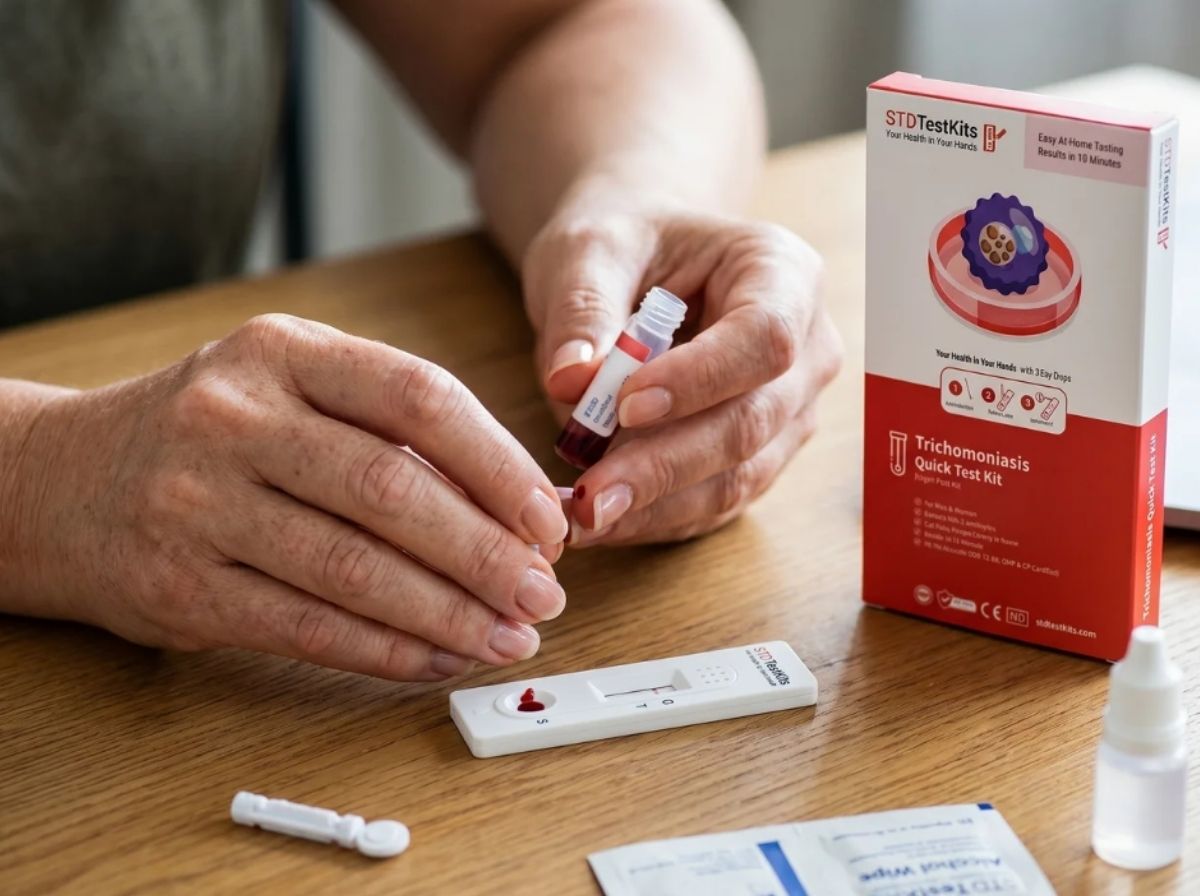
If you want a discreet first step at home, the Trichomoniasis At-Home STD Test Kit is the most direct match for this situation. Like any NAAT-based test, it gives its most reliable result when used after the detection window, not immediately after sex. Timing is what turns a test result into actual information rather than a premature guess.
Why Trichomoniasis Symptoms Are Not a Reliable Timeline During Pregnancy
Symptoms are a lousy stopwatch for trichomoniasis in pregnancy, and that's not an exaggeration. The body can carry the parasite for weeks without producing obvious changes. Pregnancy already alters discharge and vaginal tissue. And the two situations, normal pregnancy and early trichomoniasis, can look identical from the outside. Someone might notice more discharge and assume an infection when it's completely routine. Or brush off trichomoniasis symptoms as "just pregnancy." Neither guess helps. Only a well-timed test does.
When trichomoniasis symptoms do appear, they come from irritation and inflammation in the vaginal or urethral lining. The parasite damages surface cells and triggers a local inflammatory response, which can produce the yellow-green frothy discharge, itching, irritation, burning with urination, or pain during sex described in the section above. But roughly 70 to 80% of infections produce no obvious symptoms at all. The infection can be quietly present for weeks without giving anyone a clear signal, which is exactly why symptoms can't be used to time a test reliably.
During pregnancy, ordinary discharge changes are often stronger than usual, which makes the visual cues people typically rely on for self-diagnosis even less reliable than they already were. A burning sensation doesn't confirm trichomoniasis. The absence of itching doesn't rule it out. Trying to time a test based on when symptoms started gives you an unreliable answer, because symptoms don't tell you when exposure happened, when the organism reached detectable levels, or when the test is actually worth taking.
The more useful mental model: count from exposure, not from symptoms. If you know when the potential exposure occurred, that date gives you a timeline you can trust. Anchor to it. Test at 4 weeks. Let the biology, not the anxiety, drive the plan.
What Happens If Trichomoniasis Is Detected During Pregnancy?
A positive trichomoniasis result during pregnancy ends the guessing and starts a clear next step. The parasite was found in your sample, which means infection is present in the lower genital tract and needs medical follow-up. That's not a reason to spiral, it's actually the most useful outcome of testing, because it gives you something concrete to act on instead of ongoing uncertainty. The pregnancy is not automatically harmed by detection. What matters is what happens next.
The reason prompt follow-up matters is real. As the World Health Organization notes in its trichomoniasis fact sheet, trichomoniasis during pregnancy is associated with adverse birth outcomes, including preterm delivery, low birth weight, and pre-labour rupture of membranes. These associations are why confirmed trichomoniasis during pregnancy warrants clinical attention, not panic, but action. Your OB-GYN or midwife needs to know, both to manage the infection appropriately and to advise on partner treatment and follow-up testing.
Partner management is a non-optional part of this. Trichomoniasis spreads through sexual contact, and an untreated partner can reintroduce the parasite even after your own infection has been addressed. The CDC notes that reinfection is common, which is why one clean test doesn't close the story if exposure continues through an untreated partner. A positive result means the next step is coordinated care, not solo management.
If the result is negative but the test was taken very early, the interpretation is different. It may simply mean the sample was collected before the organism reached detectable levels. That's why retesting at the appropriate 4-week window makes sense when exposure was recent, and the first test was taken too soon. A properly timed negative is genuinely reassuring. A premature negative is just an open question with a temporary answer attached.
What to Do After Trichomoniasis Exposure When You're Pregnant
You're lying in bed, it's late, and you're running through the timeline of what happened and when. The instinct is to test immediately, to do something right now that feels like taking control. That instinct is completely understandable. But with trichomoniasis, testing too early doesn't give you control. It gives you a false sense of it. The protective move is to anchor yourself to the exposure date and give the biology enough time to make your result meaningful.
If the exposure was very recent, within the last day or two, the most useful thing you can do is note the date, plan a trichomoniasis test for the 4-week mark, and monitor for any symptoms that need earlier clinical evaluation. If the exposure was a week or more ago, you're already partway into the detection window. A test at or after 4 weeks post-exposure gives you the strongest negative predictive value, meaning a negative result at that point is actually worth something.
Stopping the reinfection loop matters just as much as testing yourself. If a partner hasn't been tested or treated, new sexual contact can reintroduce trichomoniasis after your result, regardless of whether that result was negative or positive. The CDC states that reinfection after treatment is common, and partner management is a key part of preventing it. In practical terms, protecting yourself during pregnancy means treating the exposure timeline and the partner timeline as one conversation, not two separate ones.
If you need discreet testing at home, the Trichomoniasis At-Home STD Test Kit is the most direct match for this concern. If the exposure involved broader STI risk, a new partner, unclear testing history, or multiple possible exposures, a more comprehensive option like the Women's 10-in-1 At-Home STD Test Kit covers multiple infections that each follow their own detection windows. Either way, testing at the right time is what turns anxiety into an actual answer.
FAQs
- 1. Can you test for trichomoniasis the day after sex if you're pregnant?
- Testing for trichomoniasis the day after sex during pregnancy will likely produce a false negative. The parasite needs several days to weeks to multiply in the vaginal tissue before NAAT can detect it, the most reliable window is 4 weeks post-exposure, not immediately after contact.
- 2. How soon after exposure can trichomoniasis be detected?
- Trichomoniasis can be detected as early as 5 days after exposure, but NAAT accuracy peaks at around 4 weeks post-exposure, when vaginal swab sensitivity can reach up to 96%. Testing before that window increases the risk of a false negative result, the parasite may be present but not yet at detectable levels.
- 3. Is trichomoniasis testing safe during pregnancy?
- Trichomoniasis testing is safe during pregnancy. The test requires only a vaginal swab or urine sample; nothing enters the uterus, and the process has no direct effect on the pregnancy. The diagnostic step itself carries no risk; the risk is in leaving a genuine exposure untested.
- 4. What does trichomoniasis discharge look like during pregnancy?
- Trichomoniasis discharge is typically yellow-green, frothy, and may have a strong or unpleasant odor, but it can also appear thin and watery, which makes it harder to distinguish from normal pregnancy discharge. Because roughly 70 to 80% of trichomoniasis infections produce no clear symptoms at all, discharge appearance alone cannot confirm or rule out infection. Only a properly timed test can.
- 5. What if I feel completely fine? Do I still need to test after exposure?
- Yes. Roughly 70 to 80% of trichomoniasis infections produce no obvious symptoms, and pregnancy can blur the picture further since discharge changes are already happening for other reasons. The absence of symptoms doesn't rule out trichomoniasis. A well-timed test does.
- 6. If my result comes back negative, can I stop worrying?
- A negative trichomoniasis result after the 4-week detection window is genuinely reassuring; the parasite would usually be detectable by then if it were present. A negative result taken in the first few days may just mean the test couldn't find enough of the organism yet. Same result, very different meaning depending on timing.
- 7. If it comes back positive, how worried should I be?
- Take it seriously, but don't spiral. A positive trichomoniasis result during pregnancy means you have a confirmed infection and a clear next step, not that irreversible harm has already occurred. Prompt follow-up with your OB-GYN or midwife is what matters, both to manage the infection and to make sure your partner is tested and treated so reinfection doesn't become the ongoing issue.
- 8. Do I need to involve my partner if I test positive for trichomoniasis?
- Yes, partner treatment is essential. Trichomoniasis spreads through sexual contact, and an untreated partner can reintroduce the parasite after your infection is cleared. Coordinated treatment is what stops the cycle. Getting yourself treated while your partner stays untested just sets up a reinfection situation.
- 9. Could I test too early, get a negative, and still actually have trichomoniasis?
- Yes, this is one of the most common mistakes. A trichomoniasis test taken before the organism has replicated to detectable levels can miss an active infection entirely. The result looks clean, but the biology is still catching up. This is exactly why timing matters more than speed.
- 10. What's the smartest move right now if I'm unsure?
- Note the date of the possible exposure; that's your anchor point. If you're already past the 4-week mark, test now with a NAAT from a vaginal swab for the most accurate result. If you're still in the first few days, plan ahead for the right window rather than testing immediately and getting a result you can't rely on. That's how you get a real answer instead of more questions.
Test at the Right Time, That's the Whole Strategy
If you're pregnant and dealing with a possible trichomoniasis exposure, the anxiety of not knowing is real, but testing before the biology is ready doesn't resolve it. A premature negative result just delays the question. Testing at the right point in the exposure window is what gives you a result worth acting on.
When the timing lines up, the most direct option is the Trichomoniasis At-Home STD Test Kit, discreet, designed for at-home use, and built to give you a clear answer without waiting for an appointment. For the most reliable result, use it after the detection window, not immediately after exposure. If the situation involves broader risk, a new partner, unclear testing history, or multiple exposures, the Women's 10-in-1 At-Home STD Test Kit covers multiple infections across their different detection windows, so you're not solving one question while leaving others open. You can explore all options at STD Test Kits.
Testing isn't about reacting fast. It's about reacting accurately. Anchor to the exposure date, choose the right window, and let the result do its job.
Our article was constructed based on current advice from the most prominent public health and medical organizations, and then molded into simple language based on the situations that people actually experience, such as treatment, reinfection by a partner, no-symptom exposure, and the uncomfortable question of whether it "came back." In the background, our pool of research included more diverse public health advice, clinical advice, and medical references, but the following are the most pertinent and useful for readers who want to verify our claims for themselves.