My Partner Is a Virgin. Do I Still Need to Worry About STDs?
You'll find out exactly which infections can be present in someone who has never had intercourse, why "feeling fine" is never a reliable health status, and what the smartest single step is before going any further.

Whether you're about to be intimate with a virgin partner for the first time, or you're already together and wondering whether testing still makes sense, this article gives you a straight answer, based on how STD transmission actually works, not on assumptions. You'll find out exactly which infections can be present in someone who has never had intercourse, why "feeling fine" is never a reliable health status, and what the smartest single step is before going any further.
Yes, you can still be at risk for certain STDs even if your partner has never had penetrative sex. Herpes, HPV, chlamydia, gonorrhea, and syphilis can all be transmitted through oral sex, skin-to-skin genital contact, or kissing, without intercourse ever occurring. The only way to confirm either partner's status with certainty is a test. Here's what you need to know.

What "Virgin" Actually Means, and Why It's the Wrong Question for STD Risk
There is no universal medical definition of virginity. Most people use the word to mean someone who has never had penis-in-vagina intercourse, but that's a cultural and personal definition, not a clinical one. When a sexual health clinician assesses your STD risk, they don't ask whether you or your partner are virgins. They ask about behavior: what kind of contact has occurred, with whom, and how recently.
And this is exactly where the gap opens up. Someone can genuinely and sincerely consider themselves a virgin while having had oral sex, genital rubbing without penetration, kissing, or shared objects. None of those experiences registers in their personal definition of sex. But every single one of them is a recognized transmission route for at least one common STD. This isn't about doubting your partner's honesty; it's about understanding that two people can share identical histories and describe them completely differently, based on what they've been taught and what feels true to their identity. The question that actually determines STD risk isn't "are you a virgin?" It's "what has your body been in contact with?" Those are very different questions with very different answers.
Can a Virgin Have Chlamydia, Herpes, or HPV? The Honest Answer
Yes, and the likelihood depends on exactly which infection you're asking about. Several of the most common STDs in the US can be acquired, carried, and transmitted without any penetrative sex ever occurring. Some don't even require genital contact.
| STD | Can a Virgin Have It? | How It Can Be Acquired Without Intercourse |
|---|---|---|
| Herpes HSV-1 (oral) | Very commonly yes | Kissing, oral contact, often acquired in childhood, long before any sexual experience |
| Herpes HSV-2 (genital) | Yes | Oral sex, skin-to-skin genital contact, outercourse without penetration |
| HPV | Yes | Skin-to-skin genital contact, outercourse, manual stimulation, no penetration needed |
| Chlamydia | Yes | Oral sex, infects the throat silently, then transfers to genitals |
| Gonorrhea | Yes | Oral sex, sharing sex toys without cleaning between use |
| Syphilis | Yes | Direct skin contact with a syphilitic sore during oral sex or outercourse |
| Hepatitis B | Yes | Shared razors, toothbrushes, or personal items carrying trace infected blood |
The infections at the top of that list, herpes and HPV, are the ones most realistically likely to be present in someone with no history of intercourse. According to the WHO, more than 3.7 billion people under 50 carry HSV-1 globally. The vast majority acquired it through oral contact, sometimes before they were teenagers. A single kiss from a family member with a cold sore can transmit it. It has nothing to do with "having sex" in any definition of the word.
HPV is similarly widespread. Research cited in a Wikipedia analysis of HPV infection found that 10% of women who reported only non-penetrative sexual contact tested positive for HPV, compared to just 1% of those with truly no sexual contact whatsoever. The virus travels through intimate skin-to-skin contact, which includes genital rubbing without penetration and manual stimulation. The CDC confirms that HPV can spread through close skin-to-skin contact during sexual activity, even when no penetration occurs, and that a person with HPV can transmit it even when they have no signs or symptoms at all.
As for chlamydia, while it requires mucous membrane contact to transmit, making skin-to-skin alone insufficient, oral sex is enough. Chlamydia can establish itself in the throat without causing any symptoms, then transfer to a partner's genitals during oral sex. Someone who has received oral sex from a previous partner, or given it, can carry throat chlamydia without ever knowing it, and without considering that contact to be "sex" at all.
What If My Partner Has Only Had Oral Sex? Does That Change My Risk?
It changes things considerably. Oral sex is one of the most underappreciated transmission routes for STDs, and it's the scenario most likely to catch people off guard precisely because so many people don't consider it "real" sex. But your immune system and the bacteria or viruses involved have no idea what label you're using.
Gonorrhea and herpes are the infections most readily transmitted through oral sex. Syphilis can also spread via oral contact when a sore is present. Chlamydia is less likely to be transmitted through oral sex than gonorrhea, but it does happen, and when it establishes in the throat, it almost never causes symptoms, meaning your partner could carry it indefinitely without any indication it's there. The CDC's guidance on oral sex risk is explicit: many people with throat gonorrhea or chlamydia have no symptoms whatsoever, and the only way to detect it is a throat swab test, not a standard urine or blood panel.
Consider what this looks like in reality. Your partner genuinely considers themselves a virgin. They gave oral sex to someone two years ago and haven't thought about it since, partly because nothing ever felt wrong, and partly because they don't file that in the category of "sexual history that affects their STD risk." They're not being dishonest. They simply never connected those dots. But if gonorrhea or chlamydia established itself in their throat during that encounter, it has been sitting there silently ever since, waiting to be passed to the next person who receives oral sex from them. That next person could be you.

Can You Get Herpes From a Virgin Partner? Yes, Here's How
Herpes is the infection most people in this situation most urgently need to understand, because it's the one with the most realistic transmission pathway, even in someone with minimal intimate history. HSV-1, oral herpes, is so common that most carriers acquired it before they ever thought about sex. Cold sores as a child, a kiss from a relative, sharing a drink with someone who had an active outbreak: all of these are sufficient.
The complication for you as a partner is this: if your partner carries HSV-1 orally, even without ever having an obvious cold sore, they can transmit it to your genitals during oral sex. The CDC is explicit on this point: genital herpes can be acquired when a partner with oral HSV-1 performs oral sex, even without any visible sores present, because the virus sheds asymptomatically from the skin. You'd then have genital herpes from a partner who, by any reasonable definition, had never had sex before and had no idea they were carrying anything.
HSV-2, genital herpes, is less likely in a partner with truly no genital contact history, but it's still possible if they've had outercourse or skin-to-skin genital rubbing with a previous partner. Research published via NCBI found that in heterosexual couples where one partner had genital herpes, transmission to the other partner occurred in roughly 5 to 10% of couples within a year when condoms were used inconsistently. The point is not to induce panic, it's to illustrate that even low-risk contact with an infected partner creates real transmission probability over time, and that a herpes antibody test is the only way to actually know where either of you stands.
Is It Safe to Have Unprotected Sex With a Virgin Partner?
This is the question underneath the question most people are really asking. The honest answer is: it depends entirely on what contact your partner has previously had, and whether either of you has been tested.
If your partner has had truly no intimate physical contact with anyone, no oral sex, no genital contact, no kissing with someone who had cold sores, no shared personal items, then their STD risk from that history is extremely low. That's the rare scenario where "virgin" actually functions as a rough proxy for low risk. But even in that scenario, the risk from your own history still exists. A clean-slate partner doesn't cancel out an untested status on your side.
In the far more common scenario, where your partner has had oral sex, genital rubbing, or any other intimate contact without penetration, then "virgin" offers no meaningful protection against the infections most likely to be present: herpes and HPV. And without a test, the honest answer to whether unprotected sex is safe is: you don't actually know. That's not pessimism, it's precision. And precision is what testing gives you.
Testing Before Your First Time Together, What to Screen For and When
Testing before a first sexual experience is genuinely one of the most considered things two people can do for each other. The specific window periods below matter; testing too early after any recent exposure can produce a false negative, so timing the test correctly is part of getting a reliable result.
| Infection | Test From | Why It's Relevant Even for a Virgin Partner |
|---|---|---|
| Chlamydia | 14 days after exposure | Can be carried silently in the throat; transfers genitally during oral sex |
| Gonorrhea | 3 weeks after exposure | Commonly carried orally with zero symptoms; among the top oral sex transmission risks |
| Syphilis | 6 weeks after exposure | Transmissible through sores during oral or skin contact without penetration |
| HIV | 6 weeks (first indicator); retest at 12 weeks for certainty | Low risk via oral sex, but complete screening includes it |
| Herpes HSV-1 & HSV-2 | 6 weeks after exposure | Most realistic transmission risk in a partner with oral contact history only |
| Hepatitis B | 6 weeks after exposure | Possible via shared personal items; worth ruling out |
| Hepatitis C | 8–11 weeks after exposure | Low sexual transmission risk but part of a complete panel |
Testing before a first intimate experience isn't about distrust; it's about replacing an assumption with actual information. If your partner is a true virgin with no oral contact history, and you've also tested clear, you genuinely do have a clean slate. Without the test, "clean slate" is just a feeling. And feelings, however sincere, don't show up on swabs.
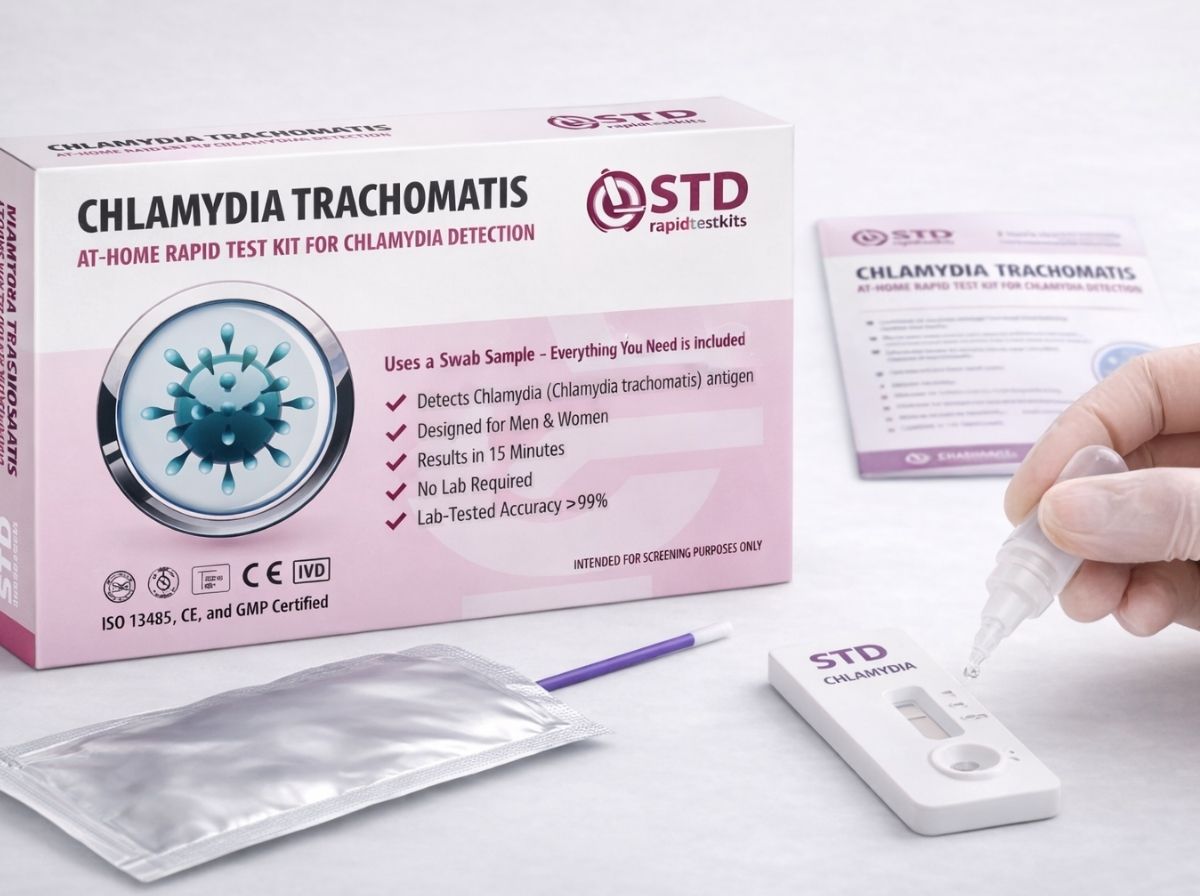
At-home rapid testing makes this easier and more private than ever before. The 8-in-1 Complete At-Home STD Test Kit covers HSV-1, HSV-2, chlamydia, gonorrhea, syphilis, HIV, hepatitis B, and hepatitis C, the full picture, at home, with results in minutes. No clinic. No waiting room. Just answers.
Why "I Feel Fine" Is Never a Reliable STD Status
One of the most frustrating biological facts about STDs is that the absence of symptoms almost never confirms the absence of infection. This is especially true for the infections most likely to be present in a virgin partner. The CDC estimates that up to 70% of women and 50% of men with chlamydia show no symptoms whatsoever. Gonorrhea carried in the throat, the most likely route in someone with an oral sex history, produces symptoms in fewer than half of all cases. HPV causes no symptoms in most people and often clears on its own, but during the time it's present, it can be passed to a partner through contact that feels unremarkable.
Herpes is arguably the starkest example. The virus sheds from the skin and can be transmitted to a partner for months or years before a first visible outbreak, and some people never have a visible outbreak at all. Your partner may have carried HSV-1 since childhood and never once experienced what they'd recognize as a cold sore. That doesn't mean the virus isn't present. It means their immune system has managed it well enough that it never announced itself. The virus, meanwhile, has been there the entire time.
The practical implication of all this is simple: "feeling fine" is not a test result. It is the absence of information. Someone who tests clear and feels fine has something far more valuable than reassurance; they have data. And data is what informed decisions about your sexual health are actually built on.
Do STD Testing Guidelines Apply If Your Partner Is a Virgin?
The CDC's approach to STD risk assessment has never involved the word "virgin." Their guidelines for who should be tested are based on behavior, age, and exposure, not self-reported sexual identity. They recommend chlamydia and gonorrhea screening for all sexually active women under 25 annually, HIV testing for everyone aged 13 to 64 at least once in their lifetime, and testing for anyone who has had oral, anal, or vaginal sex with a new partner.
Critically, the CDC explicitly acknowledges that several STDs can be transmitted through routes other than traditional intercourse. Their herpes guidance notes that the virus sheds asymptomatically from skin not covered by a condom, meaning someone can transmit it with no symptoms and no visible sores. Their HPV guidance makes clear the virus travels through close skin-to-skin contact during sexual activity, which includes contact that stops well short of penetration. In other words, CDC testing guidelines do apply to new sexual situations even when one partner is a virgin. The relevant variable is contact history, not virginity status.
According to recent provisional CDC data, despite three consecutive years of decline, more than 2.2 million cases of chlamydia, gonorrhea, and syphilis were reported in the United States in 2024 alone, and nearly half of all those cases occurred in people aged 15 to 24. Many in that age group would describe themselves as having limited sexual experience. The infections didn't care about the label.
How to Ask Your Virgin Partner to Get Tested Without Making It Awkward
You want to suggest testing before you're intimate for the first time, but you're worried it implies you don't trust your partner's history. That's a genuinely uncomfortable position to be in, and it's one more people navigate than you might think. The reframe that makes this conversation significantly easier is moving the focus from their history to your own standard practice.
"I get tested before I'm intimate with anyone, it's just something I do, and I'd love for us to both go in with full information" lands in a completely different place than "I want to test you because I'm not sure I believe you." The first is a habit and an act of care. The second is an accusation. Only one of those conversations starts something new on a good footing. Most people, once they understand that testing doesn't imply suspicion, are genuinely relieved to have the option. A partner who pushes back hard against testing, especially when it's framed this gently, is telling you something worth paying attention to, not necessarily about their status, but about how they handle conversations about transparency and mutual care.
The version that works best in practice: "I care about both of us, and I want our first time to be something we both feel completely good about. Let's both test so we're going in knowing exactly where we stand." For couples who want an easy, discreet way to test together before a first intimate experience, the HSV-2 At-Home STD Test Kit is a focused starting point, or go straight to a full combo panel for complete peace of mind. For more on navigating the conversation from the other side, see our guide on why being a virgin doesn't mean you're safe from STDs.
FAQs
- 1. Can you really get an STD from a virgin partner?
- Yes, for certain infections, the risk is real and not trivial. Herpes HSV-1, HPV, chlamydia, gonorrhea, and syphilis can all be present in someone who has never had penetrative sex, acquired through oral contact, skin-to-skin genital rubbing, or kissing. The only way to know for certain is a test, not a conversation about history, however honest.
- 2. Can a virgin have chlamydia?
- Yes. Chlamydia can be transmitted through oral sex and can establish itself in the throat with no symptoms at all. Someone who has given or received oral sex, without ever considering themselves sexually active in the traditional sense, can carry throat chlamydia without knowing it and transmit it genitally to a partner during oral sex.
- 3. Can you get herpes if both partners are virgins?
- Possibly, depending on whether either of you has had oral contact with anyone who carries HSV-1. Oral herpes is so widespread that most people who carry it picked it up before they were teenagers, from a kiss, a shared drink, or contact with a family member with a cold sore. If either of you has HSV-1 orally, it can be transmitted genitally during oral sex, even without visible sores.
- 4. My partner has only ever kissed people; is there still an STD risk?
- A small one, but a real one. HSV-1 is by far the most likely concern here, since it spreads through oral contact and is extraordinarily common. A herpes antibody test tells you exactly where things stand. For most other infections, kissing alone represents very low risk, but kissing someone with an active oral herpes outbreak is enough.
- 5. Is it safe to have unprotected sex with a virgin?
- It depends entirely on what contact your partner has previously had and whether either of you has been tested. If your partner has had oral sex with anyone, the risk from herpes, gonorrhea, and chlamydia is real. If they've had genital skin contact without penetration, herpes and HPV are both realistic possibilities. Testing is the only thing that converts "probably safe" into "actually confirmed."
- 6. What if my partner has truly never had any intimate contact with anyone?
- Then their personal STD risk from their history is genuinely very low, close to zero for most infections. But the relevant question is still whether you've been tested, and whether both of you want to start your first sexual experience together with confirmed data rather than an assumption. Most couples who test before a first intimate experience report it made them feel better, not worse, about what followed.
- 7. My partner had cold sores growing up. Should I be worried?
- Yes, this is worth knowing before oral sex. Cold sores are caused by HSV-1, and the virus can be transmitted from your partner's mouth to your genitals during oral sex, even when no sore is visible, because the virus sheds from the skin asymptomatically. An HSV test gives both of you the information you need to make an informed, comfortable decision.
- 8. Can a virgin have HPV?
- Yes, if they've had skin-to-skin genital contact with anyone, including outercourse or manual stimulation, HPV transmission is possible. One study of women who reported only non-penetrative sexual contact found 10% tested positive for HPV. The virus doesn't wait for penetration to spread; it travels through close skin contact.
- 9. How long after any oral contact should we wait before testing for accuracy?
- For herpes, the antibody test is most reliable from 6 weeks after any exposure. Chlamydia can be accurately detected from 14 days post-exposure, gonorrhea from 3 weeks. If a recent oral encounter occurred within those windows, wait it out and retest, an early negative result doesn't always mean a true negative.
- 10. Is asking a virgin partner to get tested before sex overkill?
- No, it's the one step that converts a sincere assumption into a confirmed fact. Most people who test before a new relationship report it improved the experience: less ambient anxiety, more genuine confidence, and a first time that isn't shadowed by a "what if." Testing isn't a commentary on your partner's honesty. It's the move that makes everything that follows actually feel as clean as you both hope it is.
Start Your First Time Together With Actual Clarity
Your partner's history matters, and so does yours. But neither history, however sincere, substitutes for a test result. The infections most likely to be present in someone who has never had penetrative sex are also the ones most likely to produce no symptoms and give no warning. That's not a reason for alarm. It's a reason to take the one action that gives you both real, confirmed peace of mind before things go further.
The 8-in-1 Complete At-Home STD Test Kit covers HSV-1, HSV-2, chlamydia, gonorrhea, syphilis, HIV, hepatitis B, and hepatitis C, everything worth knowing before a first sexual experience, delivered discreetly to your door with results in minutes. For women who want the most complete panel available, the Women's 10-in-1 At-Home STD Test Kit adds trichomoniasis and HPV 16 & 18. If you're starting with the two most common bacterial infections, the Chlamydia & Gonorrhea At-Home STD Test Kit is a focused, fast option.
Testing isn't a confession. It isn't an accusation. It's the move that lets both of you actually know, rather than simply hope, that you're beginning something new on genuinely solid ground. Explore the full range at STD Test Kits.
Our article was constructed based on current advice from the most prominent public health and medical organizations, and then molded into simple language based on the situations that people actually experience, such as treatment, reinfection by a partner, no-symptom exposure, and the uncomfortable question of whether it "came back." In the background, our pool of research included more diverse public health advice, clinical advice, and medical references, but the following are the most pertinent and useful for readers who want to verify our claims for themselves.