Positive Gonorrhea Test Line vs Negative: How to Read It
Quick Answer: On a gonorrhea rapid test, the control line (C) must appear to confirm the test worked. If there’s a second line, even faint, at the test (T) line area, that’s considered a positive.
Quick Answer: On a gonorrhea rapid test, the control line (C) must appear to confirm the test worked. If there’s a second line, even faint, at the test (T) line area, that’s considered a positive. One line at C = negative. No line at C = invalid test.
How Gonorrhea Rapid Tests Actually Work
At-home gonorrhea test kits work a lot like a pregnancy test, except instead of detecting hormones, they’re searching for gonorrhea antigens (pieces of the bacteria) in your sample. Most kits involve one of the following sample types:
- Urine sample (most common for people with penises)
- Vaginal swab (most accurate for people with vaginas)
- Throat or rectal swab (if exposed during oral or anal sex)
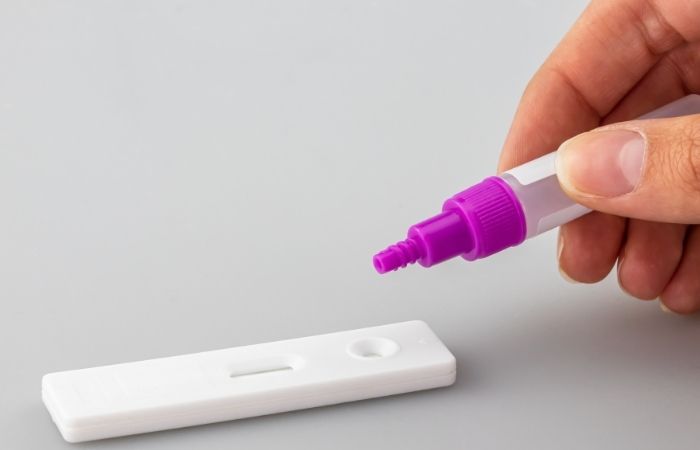
Once the sample is mixed with a reagent and dropped onto the test strip, the results appear within 10–20 minutes, depending on the brand. Your job is to read the result window correctly, and at the right time window, so you don’t misinterpret it.
Understanding the Test Window: C Line vs T Line
Every test has two potential line locations:
| Line | What It Means |
|---|---|
| C (Control) | This line must appear. It proves the test was performed correctly and the reagents are working. |
| T (Test) | This line appears only if gonorrhea antigens are detected in your sample. Even a faint line = positive. |
Table 1. Gonorrhea rapid test result areas. Always check for a visible control line before interpreting your result.
If the control line doesn’t show up, no matter what the test line is doing, your test is invalid. You’ll need to retest with a new kit.
What a Positive Gonorrhea Test Line Looks Like
A positive result means you’ll see two lines:
- One line in the Control (C) region
- One line in the Test (T) region , may be dark, faint, or even shadowy
Yes, even a faint test line is considered positive. The amount of bacteria doesn’t affect line intensity. A barely-there line still means the test detected gonorrhea antigens. Don’t second-guess it. Don’t wait for it to get darker. If it’s there, it’s there.
This is the most common moment people start Googling phrases like:
- “Is a faint line on a gonorrhea test positive?”
- “Does the test line have to match the control line?”
- “I see a shadow line, do I have gonorrhea?”
Short answer? Yes. A faint line still counts.
And remember, test lines may get clearer over time, but most test kits should be read within a strict time window (usually 10–20 minutes). Reading it too early or too late can lead to errors.
Pro Tip: Take a photo of your test within the valid window so you can track it or show it to a provider if needed.
What a Negative Gonorrhea Test Looks Like
So you took the test, flipped it over, and saw just one line at the C (control) area. No other line in sight. That’s what you want to see, this is a negative result.
Negative = one clear line at C, nothing at T. That means no gonorrhea antigens were detected in your sample at the time of testing.
But before you dance off in relief, ask yourself this:
- Did you test too soon after exposure?
- Did you use the correct sample type?
- Did you follow instructions exactly, timing, amount, storage?
Because a test can only tell you what’s present right now. If it’s early in the infection or your sample wasn’t collected well, you might get a false negative.
What Makes a Gonorrhea Test Invalid?
If your test shows no line at the control (C) area, it didn’t work. Even if there’s a line in the test (T) area, you can’t trust the result.
Here’s what can cause an invalid test:
- The sample wasn’t mixed correctly
- The test sat too long before being read
- The kit was expired or damaged
- You didn’t apply enough liquid/sample
- The test got contaminated (hello, festival porta-potties)
In any of these cases, your best move is to test again using a fresh kit. Invalid = no result. Don’t guess, don’t gamble, and definitely don’t assume it means “negative.”
Can a Faint Line Be Wrong?
This is where most people panic. You might squint and wonder, “Is that really a line or just a shadow? Am I seeing things?!” It’s not just you, faint lines cause chaos in bathrooms every day.
But here’s the rule: If there’s any visible line in the test (T) area during the read window, it counts as positive. It doesn’t have to be dark. It doesn’t have to match the control line. Line = detection. Period.
Still unsure? Consider these signs it’s a valid faint line:
- Appeared within 10–20 minutes after testing
- Is pink, red, or colored, not gray or invisible
- Stays present after drying (not a wet blur or streak)
If the line appears after the test's read window (e.g., 30 minutes later), it could be an evaporation line, which doesn’t count. Stick to the time guidelines on your kit instructions.
“I Didn’t Expect It to Be Positive…”
Jasmine, 25, had no symptoms, just some mild spotting and a little anxiety after a hookup with a partner who “seemed clean.” She took a home test just to be safe and was shocked when the second line popped up.
“I thought it was a mistake. I almost threw it out, but then the line got darker. I stared at it for twenty minutes. I had no clue what to do.”
Jasmine’s story isn’t rare. Gonorrhea is often symptomless, especially in people with vaginas. That faint line could be your only clue, and it’s better to catch it now than when it causes PID, fertility issues, or gets passed to someone else.
She ordered a second test to confirm and booked treatment the same week. “It sucked, but it also felt like power,” she said. “I knew. I acted. I’m clear now.”
You deserve that same clarity. If your line is there, even faint, take action. The test did its job. Now it’s your turn.

What to Do After a Positive Gonorrhea Test
Deep breath. You’ve got a second line. It’s not the end of the world, it’s a bacterial infection. And the good news? Gonorrhea is 100% treatable with antibiotics. You caught it early. That’s already a win.
Here’s what happens next:
- Stop having sex until you’ve completed treatment (and your partner has too).
- Confirm your result with a clinic-based test if needed. Some people prefer that extra peace of mind, especially with faint lines.
- Get treated ASAP. Your provider will likely prescribe a single injection or oral antibiotic, quick and effective.
- Tell any recent partners so they can test and treat, too. It’s awkward but vital.
Think of it this way: The longer you wait, the more likely gonorrhea can spread to your reproductive organs or get passed to someone else. Prompt treatment protects everyone.
When Should You Retest?
Most providers recommend testing again 2–3 weeks after treatment if:
- You had symptoms and want to confirm they’re gone
- You’re not sure your partner got treated
- You’re planning to hook up with someone new
This is called a “test of cure.” If your symptoms are gone and your follow-up test is negative, you’re good to go.
Note: Some people may still test positive within a few days of treatment, not because they’re still infected, but because the test is picking up residual bacterial fragments. That’s why immediate retesting isn’t recommended.
“I Thought Only Guys Got Gonorrhea”
Danny, 19, identifies as gay and took his first STD test after a Pride weekend hookup. “I didn’t feel sick, but I kept seeing TikToks about throat STDs and decided to check.” His at-home kit included a throat swab. Result? Positive for gonorrhea in the throat.
“I was so embarrassed at first. I thought, ‘Am I dirty now?’ But then I looked it up, this stuff is common. I got treated, I learned, and I’m way more confident now.”
Gonorrhea doesn’t care about gender, sexuality, or how “clean” someone looks. If you’ve had oral, anal, or vaginal contact without protection, even once, it can happen. And it doesn’t make you irresponsible. It makes you human.
Testing, treating, and moving forward? That makes you powerful.
What If You Don’t Have a Doctor?
No insurance? No clinic nearby? No problem. Here’s what you can do:
- Use a telehealth service that specializes in STI treatment. Some can prescribe medication the same day based on your at-home test results.
- Visit a local Planned Parenthood or sexual health clinic. Many offer low-cost or free treatment without insurance.
- Re-test with a combo STD kit if you’re unsure what else might be going on. Gonorrhea often travels with chlamydia or trich.
Don’t let logistics delay your care. Treating gonorrhea is usually quick, simple, and accessible, even if you’re on your own.
And if you haven’t tested yet? Start here. One discreet kit can give you answers fast, without shame, without clinic waits, and without overthinking every symptom.
Still Not Sure What You’re Looking At?
We get it, home tests don’t come with someone to peek over your shoulder and say, “Yep, that’s positive.” Reading the results alone can feel like decoding a mystery with high stakes. So before you start spiraling or texting blurry photos to your group chat, here’s a quick guide to help you feel more certain about what your test is telling you.
Take a deep breath. Lay your test on a flat, well-lit surface. Look at it straight on. Compare what you’re seeing to the reference chart below:
| Result Type | What You See | What It Means | Next Step |
|---|---|---|---|
| Positive | Line at C + Line at T (faint or dark) | Gonorrhea antigens detected | Seek treatment + notify partners |
| Negative | Line at C only, nothing at T | No gonorrhea detected at time of test | Retest in 2–3 weeks if recent exposure |
| Invalid | No line at C (regardless of T) | Test failed or was done incorrectly | Discard + retest with new kit |
| Questionable | Line at T appears late, gray, or uneven | Could be evaporation or misread | Disregard + retest for clarity |
Table 2. Visual comparison of gonorrhea rapid test results. If you’re stuck between “maybe” and “what the hell is that,” use this guide to interpret with confidence.
If you’re still second-guessing yourself, here’s a no-stress option: take a fresh test tomorrow. Sometimes just seeing a repeat result, positive or negative, gives you the clarity you need. You can order another gonorrhea test kit or go for the full Essential 6-in-1 At-Home STD Test Kit if you want to screen for more.
FAQs
- 1. Is a faint line really positive?
- Yep. Even if you have to squint, tilt it under a lamp, and ask your roommate, “Do you see that??” , if the line’s there during the read window, it’s positive. Gonorrhea doesn’t always scream its presence. Sometimes, it whispers. That faint pink whisper? Still counts.
- 2. Only one line showed up , does that mean I’m in the clear?
- If that one line is in the C (control) zone, and the T line area is completely blank, that’s a negative. Congrats. But remember , testing too early or swabbing poorly can give false reassurance. Always think about timing.
- 3. There's no line at all. Did I mess up?
- Possibly, but also... maybe not your fault. If the control line doesn’t show, the test just didn’t run correctly. That could be due to not enough sample, a faulty kit, expired reagent, or sneezing mid-swab (yes, it happens). Toss it and retest.
- 4. What if my test line showed up late, like 30 minutes after I tested?
- That’s a ghost. Most test kits have a strict read time (usually 10–20 minutes). Anything after that can be an evaporation line, and it doesn’t count. Set a timer next time to avoid the “is this real?” spiral.
- 5. I tested positive... now what?
- First off: you’re not gross, reckless, or alone. Gonorrhea is super common, especially among people under 30. Treatment is usually just one dose of antibiotics. Book it, take it, rest up. Most people feel better fast.
- 6. Do I need to tell my last partner?
- It’s the kind move. Not everyone does, but giving them the heads-up lets them treat early, too. A text like “Hey, just FYI , I tested positive for gonorrhea and thought you should know so you can check” is short, honest, and doesn’t assign blame.
- 7. Can I test again right after treatment to make sure it’s gone?
- Waiting is better. If you test too soon, you might get a false positive because of leftover bacterial fragments. Most providers say that if you need to retest, you should wait 14 to 21 days after treatment.
- 8. Can I get gonorrhea more than once?
- Unfortunately, yes. Treatment clears the infection, but it doesn’t make you immune. If you get exposed again, say from a partner who didn’t get treated, you could catch it again. That’s why follow-up testing matters.
- 9. How do I avoid catching this again?
- Short version? Use barriers (especially for oral), test regularly, and have “status talks” with new partners. Also, keep a test kit in your drawer. When you’re empowered to test early, you stay ahead of the chaos.
- 10. Where can I get a test that covers everything?
- Right here: Combo STD Home Test Kit. It screens for gonorrhea, chlamydia, and more , from home, no questions asked.
You Deserve Clarity, Not Guesswork
Gonorrhea can hide in your throat, your urethra, your cervix, and your mind. The stress of “Is this a line?” or “What does this mean?” can eat away at your confidence. But the power is in knowing. Reading your test correctly, taking the next step, and treating it fast puts you back in control.
Whether your test was positive, negative, or a confusing blur, you did the right thing by checking. You’re not dirty. You’re not alone. And you’re not the first person to overanalyze a pink line at 2 a.m.
Need a retest? Ready to check your throat, genitals, or both? Try our most trusted option: The Combo STD Home Test Kit. It’s fast, private, and designed for all bodies.
You deserve to know. And you deserve to move forward without fear.