Sore Throat After Oral Sex It Could Be an STD
Quick Answer: A sore throat after oral sex can be caused by oral gonorrhea, chlamydia, syphilis, or early HIV. When It Feels Like Strep, But Isn’t Leila, 27, thought she had strep. She’s not alone.

Quick Answer: A sore throat after oral sex can be caused by oral gonorrhea, chlamydia, syphilis, or early HIV. Many throat STDs cause mild or no symptoms, so testing 7–14 days after exposure is often recommended for accuracy.
When It Feels Like Strep, But Isn’t
Leila, 27, thought she had strep. Her throat burned when she swallowed, and the glands in her neck felt tender. She went to urgent care, tested negative for strep and COVID, and was told, “Probably viral.” She mentioned oral sex almost as an afterthought. The provider didn’t swab her throat for STDs.
Three weeks later, she tested positive for throat gonorrhea.
“I didn’t even know you could get gonorrhea in your throat,” she said. “I thought STDs meant discharge or something obvious.”
She’s not alone. According to the CDC, extragenital infections, meaning infections in the throat or rectum, are common and often asymptomatic. In some populations, throat infections account for a significant percentage of undiagnosed gonorrhea and chlamydia cases. The problem isn’t rarity. It’s under-testing.
This is the part doctors don’t always explain: oral sex can transmit bacterial and viral STDs, and the throat can carry infection silently. You might only notice mild soreness, swollen lymph nodes, or nothing at all.

What Oral STDs Actually Feel Like (When They Feel Like Anything)
If you’re searching “STD symptoms in throat” right now, you’re probably trying to decode sensations that feel frustratingly ordinary. That’s the tricky part. Oral STDs often mimic everyday illnesses.
Oral gonorrhea may cause redness, mild soreness, white patches, or swollen glands. Some people feel completely fine. Oral chlamydia is even quieter, frequently symptomless, occasionally presenting as a dull sore throat. Syphilis can cause a painless sore in the mouth that goes unnoticed. Early HIV may feel like the flu: fever, fatigue, swollen nodes, body aches.
The absence of genital symptoms does not rule anything out. You can have no discharge, no burning urination, no visible lesions, and still test positive in the throat.
| Infection | Possible Throat Symptoms | Often No Symptoms? | Typical Testing Window |
|---|---|---|---|
| Gonorrhea | Sore throat, redness, swollen glands | Yes, frequently silent | 7–14 days after exposure |
| Chlamydia | Mild soreness, irritation | Very common | 7–14 days after exposure |
| Syphilis | Painless mouth sore (chancre) | Sometimes missed | 3–6 weeks (blood test) |
| HIV | Flu-like symptoms, swollen lymph nodes | No, symptoms common early | 2–6 weeks (antigen/antibody) |
The reason this matters is simple: if you only test urine or genitals, you can miss a throat infection entirely. That’s especially important for people who primarily engage in oral sex or for queer individuals whose exposure patterns differ from standard screening assumptions.
Why Doctors Sometimes Miss It
Most routine STD screenings do not automatically include a throat swab. Many clinics test based on reported exposure, and patients don’t always disclose oral sex because they don’t think it “counts.” Others feel embarrassed. Some providers simply don’t ask.
Andre, 31, remembers telling his primary care doctor he’d had “protected sex.” He meant intercourse. He didn’t mention oral. Months later, persistent throat irritation led to testing that revealed oral chlamydia.
“I genuinely didn’t know I needed to say that part,” he said. “Nobody had ever told me throat testing was a thing.”
This gap is well-documented in medical literature. Extragenital infections are underdiagnosed because screening is inconsistent. And when throat infections are asymptomatic, people can unknowingly transmit bacteria to partners through oral sex.
If your anxiety is building as you read this, pause. Information is power, not a verdict. The solution is straightforward: test the site of exposure. If the exposure involved your mouth, a throat swab matters.
You can explore discreet testing options at STD Test Kits, including multi-panel kits that detect common infections after oral exposure. Privacy isn’t a luxury, it’s part of healthcare.
And if your sore throat is recent, fewer than seven days since exposure, timing matters. Testing too early can produce false reassurance. Accuracy improves after the typical window period, which we’ll break down clearly next.
Testing the Right Way: Site-Specific, Timed, and Calm
When anxiety spikes, people want one clean answer. But STD testing after oral sex is more like building a case. You match the test to the body part exposed. You match the timing to the biology. And you give yourself permission to retest if the first result lands too early to be definitive.
If the exposure involved your mouth, a throat swab matters. Urine alone will not detect throat gonorrhea or chlamydia. Blood testing detects infections like HIV and syphilis, which may present with systemic symptoms such as swollen lymph nodes, rash, or fever.
The key is alignment. Test the right site. Test at the right time. And if symptoms evolve, don’t cling to an early negative result as the final word.
What the Test Actually Does (So You’re Not Guessing)
Most modern testing for throat infections uses a nucleic acid amplification test, often abbreviated as NAAT. In plain language, that means the test looks for genetic material from bacteria like gonorrhea or chlamydia. It doesn’t rely on visible inflammation or guesswork. It looks for microscopic evidence.
A throat swab may feel uncomfortable for a few seconds, but it’s quick. If done at home, the instructions are straightforward: swab the tonsillar area, avoid contaminating the sample, and follow the kit timing precisely. Accuracy depends more on timing after exposure than on how dramatic your symptoms feel.
Blood tests, used for infections like HIV and syphilis, detect antibodies or antigens that develop over weeks. That’s why someone can feel flu-like symptoms and still test negative if it’s too soon. The immune system hasn’t produced measurable markers yet.
Understanding this prevents a common spiral: testing at day four, seeing negative, and assuming the story is over.
When Symptoms Spread Beyond the Throat
A sore throat after oral sex can feel isolated. But sometimes the body adds layers. Swollen lymph nodes under the jaw. A faint rash across the torso. Aching joints that feel like you’re coming down with something viral.
These systemic symptoms are uncommon but important. Early HIV can cause fever, fatigue, and sore throat within weeks of exposure. Secondary syphilis may produce a body rash that includes the palms and soles. Disseminated gonorrhea can cause joint swelling and small skin lesions.
Amara, 29, initially brushed off her symptoms as a rough cold. The sore throat faded, but joint pain followed.
“It didn’t connect in my mind,” she said. “I thought STDs meant something obvious and localized.”
Her diagnosis was disseminated gonorrhea, rare, but real. Once treated, symptoms resolved. The takeaway isn’t fear. It’s awareness. If symptoms escalate or feel unusual, clinical evaluation matters.
Retesting: Not Failure, Just Good Strategy
Retesting is not an admission of recklessness. It’s biology management. If you test at the early edge of a window period and get a negative result, repeating the test at two to six weeks provides stronger reassurance.
This is especially important if you had multiple exposures, if a partner later tests positive, or if symptoms change. Bacterial infections like gonorrhea and chlamydia are typically detectable within two weeks, but viral markers for HIV or antibody-based tests for syphilis may take longer.
The emotional part of this is harder than the logistics. Waiting feels like suspense. But retesting transforms uncertainty into clarity.
If you prefer privacy while navigating that window, at-home testing options allow you to monitor without repeated clinic visits. Many people choose a multi-panel approach so they’re not chasing symptoms one by one.
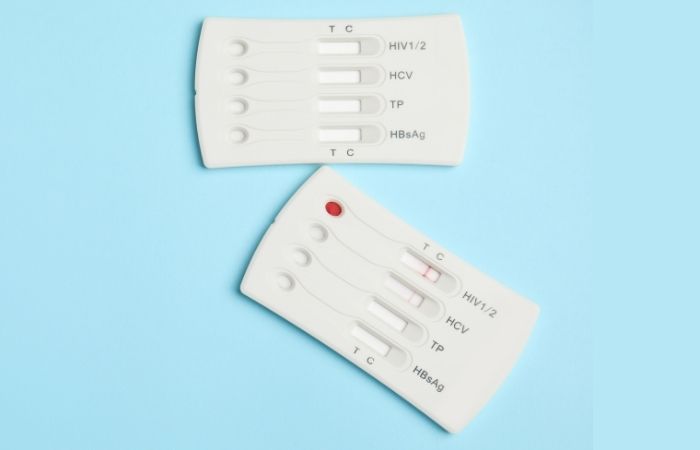
If It’s Positive: Breathe First
A positive result can land like a punch to the chest. Even when infections are treatable, stigma can feel heavier than the diagnosis. That reaction is cultural, not medical.
Most bacterial STDs, including throat gonorrhea and chlamydia, are treated with antibiotics. Treatment is straightforward. Follow-up testing may be recommended to confirm clearance. Viral infections like HIV are manageable with modern therapy, and early treatment dramatically improves long-term outcomes.
The first step is confirmation through appropriate follow-up testing if required. The second is treatment. The third is partner communication. None of these steps require shame.
“I expected judgment,” Leila later said. “Instead, it was just… medicine.”
That’s often the reality. Less drama. More antibiotics. More information. More agency.
FAQs
- 1. I gave oral sex and now my throat hurts. Be honest, how worried should I be?
- Take a breath. Most sore throats are viral, seasonal, or just plain bad luck. But if the timing lines up closely with oral sex, especially within the past one to two weeks, testing is reasonable. Not because you should panic. Because you deserve certainty instead of guessing every time you swallow.
- 2. What does an STD in the throat actually feel like?
- Frustratingly… ordinary. It can feel like mild strep, like dryness, like “maybe I slept with my mouth open.” Some people notice swollen glands. Others feel nothing at all. Oral gonorrhea and chlamydia are notorious for being subtle, which is why symptoms alone aren’t reliable.
- 3. Can I have an STD in my throat with zero genital symptoms?
- Yes. Completely. You can test positive in the throat and negative in urine. The body doesn’t “sync” infections across all sites. If exposure happened orally, that’s the site that needs testing, even if everything below the waist feels normal.
- 5. If it were serious, wouldn’t I feel really sick?
- Not necessarily. Some infections are quiet operators. Early HIV can feel like the flu. Syphilis can cause a painless mouth sore you never notice. Bacterial throat infections can sit there without dramatic pain. The absence of drama is not proof of absence.
- 5. How soon is too soon to test?
- Testing within the first five days after exposure is often too early for reliable results. For bacterial infections like gonorrhea and chlamydia, seven to fourteen days is typically more accurate. Blood tests for HIV or syphilis may take several weeks to turn positive. Timing is about biology, not impatience.
- 6. What if I test negative but still feel weird?
- Then we look at timing. If you tested early, repeat at the recommended window. If it’s been long enough and symptoms persist, see a clinician, not because it’s automatically an STD, but because ongoing symptoms deserve evaluation. Your body isn’t dramatic. It’s communicating.
- 7. Can oral STDs spread to someone’s genitals?
- Yes. Throat gonorrhea, for example, can be transmitted during oral sex even if you feel fine. That’s one reason extragenital testing is important. Silence doesn’t mean safety when bacteria are involved.
- 8. Is pink eye after sex really a thing?
- It can be. If infected fluids contact the eye, certain bacteria, especially gonorrhea, can cause conjunctivitis. It may look like standard pink eye at first but can worsen quickly. Eye pain, discharge, or vision changes after sexual exposure warrant urgent medical care.
- 9. I’m embarrassed to ask my doctor for a throat swab. What do I say?
- Keep it simple. “I had oral sex and would like throat STD testing.” That’s it. You don’t owe a backstory. You don’t owe a confession. You’re requesting appropriate medical screening.
- 10. If it is an STD, does that mean I was reckless?
- No. It means you’re human and biologically exposed to risk like everyone else who has sex. Oral sex is common. Infections are a medical event, not a character judgment. The responsible move is testing and treatment, and you’re already doing that part.
You’re Not Overreacting, You’re Paying Attention
If you’re here because you typed “sore throat after oral sex” into a search bar with your stomach in knots, let’s slow this down. A sore throat can be ordinary. It can also be an early sign of an oral STD. The difference isn’t panic, it’s information and timing.
The body doesn’t separate sex from the rest of you. If your mouth was involved, your mouth can carry infection. If your throat feels off and the timing lines up, testing isn’t dramatic. It’s rational.
And if the result is negative, that’s relief backed by evidence. If it’s positive, that’s treatable in most bacterial cases and manageable in viral ones. Either way, uncertainty doesn’t get to control the narrative anymore.
How We Sourced This Article: This article synthesizes guidance from leading medical authorities including the CDC, WHO, Mayo Clinic, and NHS, along with peer-reviewed research on extragenital sexually transmitted infections. We reviewed current testing window data, prevalence studies on oral infections, and treatment recommendations to ensure accuracy. While approximately fifteen sources informed the writing, six high-authority references are listed below for clarity and verification.