Can You Have Syphilis Without a Sore?
Here’s the part most people don’t expect: even when that sore does happen, it can disappear on its own within 3 to 6 weeks. No pain, no lingering mark, nothing that screams “infection.”

Last updated: March 2026
Here’s the part most people don’t expect: even when that sore does happen, it can disappear on its own within 3 to 6 weeks. No pain, no lingering mark, nothing that screams “infection.” But the bacteria doesn’t go away, it just moves deeper into the body. According to the CDC, untreated syphilis progresses through stages, and many people never notice the early one at all.
If you’re here, it probably means something feels off, or maybe nothing feels off, and that’s exactly why you’re worried. Both situations are valid. This is one of those infections where “I feel fine” doesn’t actually mean much. Let’s walk through what’s really happening in your body, why the sore is often missed, and what to do next so you’re not stuck guessing.
This Is Where Most People Get It Wrong
You’ve probably heard that syphilis starts with a sore. Technically true. But in real life, that detail gets people into trouble.
The sore, called a chancre, is usually small, round, and completely painless. It doesn’t itch. It doesn’t burn. It doesn’t demand your attention. So if it shows up somewhere visible, like the genitals, you might still overlook it because it feels like nothing. If it shows up somewhere hidden, like inside the mouth after oral sex or internally in the cervix, you may never see it at all.
That’s why a lot of people confidently assume, “I didn’t see anything, so I’m fine.” But biology doesn’t work like that. According to the NHS, many cases of early syphilis go unnoticed, specifically because the sore is painless and can heal without treatment. The infection doesn’t need your awareness to keep progressing.
Think about the timing. You have an encounter, you feel completely normal, maybe you check yourself once or twice, and nothing stands out. A few weeks pass, and life moves on. That’s exactly the window where syphilis quietly establishes itself.
And here’s the uncomfortable truth: by the time people start Googling symptoms, they’re often already past the stage where the sore would have been visible.
When the Sore Is There, but You Never See It
Let’s break this down in a way that actually reflects real life, not textbook diagrams.
Syphilis sores don’t just appear in obvious places. They show up wherever the bacteria entered the body. That could be external skin, but it could also be internal or harder-to-see areas.
Common places people miss chancres include the throat after oral sex, where it feels like nothing more than mild irritation or nothing at all. The cervix is another major blind spot; there’s no way to see it without a medical exam, and it doesn’t cause noticeable discomfort early on. The rectum is another location where sores can exist silently.
You might even check yourself in the mirror and feel reassured. Everything looks normal. That doesn’t mean nothing happened; it just means the infection didn’t choose a visible spot.
There’s also the issue of timing. The sore typically appears about 10 to 90 days after exposure, with an average of around 3 weeks. But it doesn’t hang around forever. It usually heals within 3 to 6 weeks, even without treatment. So if you weren’t actively looking during that exact window, you can miss it entirely.
That’s the part most people miss: the absence of a sore now doesn’t mean there wasn’t one before.
When There Are No Symptoms at All
This is where things get even more confusing, and honestly, more frustrating.
After the initial stage, syphilis moves into what’s called the secondary stage. This is where symptoms like rashes, fatigue, or flu-like feelings can show up. But not everyone experiences these clearly. Some people get very mild symptoms. Others don’t connect them to an STD at all.
You might notice a rash that doesn’t itch and assume it’s an allergic reaction. Maybe you feel a little run-down for a few days and blame stress or lack of sleep. Then it all fades. No big moment, no clear signal.
Then comes the latent stage, which is the one that really trips people up. At this point, there are no symptoms. None. You feel completely normal. But the infection is still in your body.
According to research indexed in NCBI, syphilis can remain in this silent phase for years if untreated. That means someone can carry it, feel fine, and have no visible signs, while still needing diagnosis and care.
This is why symptom-checking alone doesn’t work for syphilis. You can’t rely on how you feel. You can’t rely on what you see. The only reliable way to know is testing.
Why “I Feel Fine” Doesn’t Mean Anything Here
There’s a very human instinct to trust your body. If something were wrong, you’d feel it, right?
That logic works for a lot of things. It just doesn’t work well for syphilis.
The infection is caused by a bacterium that spreads quietly through the bloodstream. It doesn’t always trigger strong early symptoms. It doesn’t always cause pain. And it doesn’t need to stay visible on the surface to keep progressing.
You might go weeks or months feeling completely normal. You go to work, you sleep fine, nothing seems off. That sense of normalcy can be misleading. It creates a false sense of security that delays testing.
Here’s the shift to make: instead of asking “Do I feel sick?”, the better question is “Was there a possible exposure?” If the answer is yes, even if it feels low-risk, that’s when testing becomes the smartest next step.
Because with syphilis, waiting for symptoms is often how people miss it.
The Testing Part Everyone Actually Needs
If there’s one thing to take away from all of this, it’s this: you cannot confirm or rule out syphilis based on symptoms alone. Not seeing a sore doesn’t mean you’re clear. Feeling fine doesn’t mean anything here. Testing is the only way to get a real answer.
And timing matters more than most people realize.
Syphilis is detected through a blood test that looks for antibodies your body produces in response to the infection. These antibodies don’t show up immediately. Your body needs time to recognize the bacteria and respond.
Here are the exact timelines you need to follow for accurate results:
| Infection | When to Test |
|---|---|
| Chlamydia | 14 days after exposure |
| Gonorrhea | 3 weeks after exposure |
| Syphilis | 6 weeks after exposure |
| HIV | 6 weeks for the first indicator, retest at 12 weeks for certainty |
| Herpes (HSV-1 & HSV-2) | 6 weeks after exposure |
| Hepatitis B | 6 weeks after exposure |
| Hepatitis C | 8–11 weeks after exposure |
That 6-week mark for syphilis isn’t random; it’s when the test becomes reliably accurate. Testing earlier can still detect infection in some cases, but it carries a higher risk of a false negative. In other words, you could test “negative” simply because your body hasn’t produced enough antibodies yet.
This is where people get tripped up. They test too early, feel reassured, and move on, when in reality, they just tested outside the optimal window.
According to public health guidance from organizations like the WHO, accurate detection depends heavily on timing and the type of test used. It’s not just about testing, it’s about testing at the right moment.
What Your Results Actually Mean
Getting tested is one thing. Understanding the result is another.
A negative result at 6 weeks or later is generally reliable. That means your body had enough time to respond if an infection were present. If there hasn’t been any new exposure since then, that result is considered trustworthy.
A negative result before 6 weeks is not definitive. This is where confusion happens. You might feel relief, but medically, it’s more like “too early to tell.” In that case, retesting at the 6-week mark is the safest move.
A positive result means antibodies were detected. That doesn’t necessarily tell you when the infection started, but it does confirm exposure at some point. From there, the next step is follow-up care and guidance from a healthcare provider.
Here’s the part people don’t always expect: you can test positive without ever remembering a symptom. No sore, no rash, nothing obvious. That doesn’t make the result less real; it just reflects how this infection behaves.
If symptoms are present or something still feels off, even after a negative test, getting checked in person is the safest move. Testing is powerful, but it works best when paired with attention to your body and risk history.

At-Home Testing: The Most Practical Option for Most People
Let’s be honest, most people aren’t excited about going to a clinic for STD testing. There’s scheduling, waiting rooms, awkward conversations, and sometimes just the mental hurdle of walking in.
This is where at-home testing has changed things in a big way.
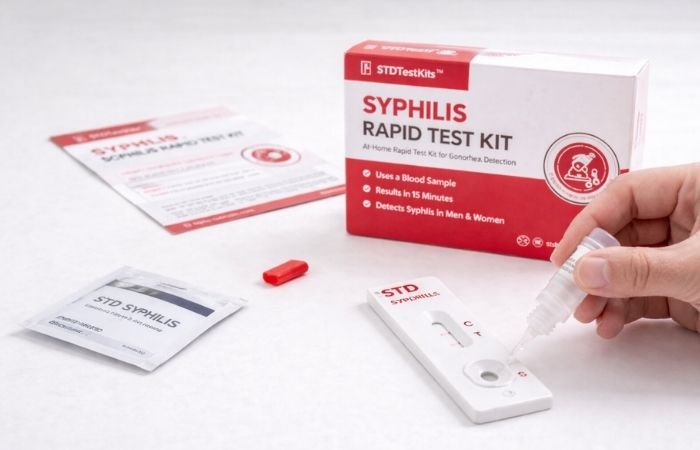
A syphilis at-home test uses a small blood sample (usually a finger prick) to detect antibodies. It’s the same principle used in many clinical settings, just adapted for privacy and convenience.
You collect your sample yourself, follow the instructions, and get results without needing to sit in a waiting room or explain your situation to anyone face-to-face.
If you’re in that space of “I don’t know, but I want to know,” this is often the easiest next step.
Take a look at this option: Syphilis Rapid Test Kit . It’s designed for exactly this situation, uncertainty after a possible exposure, especially when there are no clear symptoms to guide you.
And if you’re not sure what you might have been exposed to, a broader option like a combo kit can give you a wider picture in one go. That’s often the smarter move if your question isn’t just “Is this syphilis?” but “Am I okay overall?”
Why People Delay Testing (And Why That Backfires)
A lot of delays come down to one simple thought: “If I don’t have symptoms, it’s probably nothing.”
That assumption feels logical, but with syphilis, it’s one of the main reasons infections go undetected.
Another common hesitation is timing confusion. People aren’t sure when to test, so they either test too early or keep putting it off. That uncertainty can stretch into weeks or months.
Then there’s the mental side of it. Testing makes things real. As long as you don’t test, there’s still a chance everything is fine. That’s a very human response.
But here’s the flip side: not knowing doesn’t protect you. It just delays clarity.
The sooner you test at the right time, the sooner you stop running scenarios in your head. And if something is there, catching it earlier makes the next steps much simpler.
What Actually Puts You at Risk (Even Without Symptoms)
This is another place where people underestimate things.
Syphilis spreads through skin-to-skin contact with an infectious sore, but remember, that sore might not be visible. So transmission can happen during vaginal, anal, or oral sex, even when everything looks normal.
Oral sex is a big one that people overlook. A sore in the mouth or throat can go completely unnoticed, both in yourself and in a partner. No visible signs doesn’t mean no risk.
Even a single encounter can be enough. It doesn’t require repeated exposure or obvious symptoms. That’s why public health organizations consistently emphasize testing after potential exposure, not after symptoms appear.
If you’re replaying a situation in your head, something that felt uncertain, unprotected, or unclear, that alone is enough reason to consider testing at the right time.
Because again, with syphilis, the absence of symptoms isn’t reassurance. It’s just silence.
What Happens If Syphilis Goes Unnoticed
This is the part people don’t always hear about, but it matters.
If syphilis isn’t detected and treated early, it doesn’t just sit there quietly forever. It keeps moving through stages. And the tricky part is that those stages don’t always come with obvious warning signs.
After the initial phase (where the sore may have been missed), the infection can shift into the secondary stage. This is where symptoms can show up, but they don’t always look dramatic or alarming. You might notice a faint rash, sometimes on the palms of your hands or the soles of your feet. It doesn’t itch. It doesn’t hurt. And because of that, it’s easy to ignore.
Some people feel slightly off, fatigue, mild fever, swollen glands, but nothing that clearly points to an STD. It can feel like a passing illness, something you’d never think to connect to a sexual encounter weeks earlier.
Then, those symptoms fade. And this is where things get quiet again.
The Stage Where Everything Feels “Normal” Again
After the secondary stage, syphilis can enter what’s called the latent stage. This is essentially a symptom-free phase. No sores. No rashes. No warning signs.
You wake up, go about your day, and feel completely fine. There’s nothing pushing you to get tested. No physical reminder that anything is happening inside your body.
This stage can last for months or even years.
According to clinical data referenced by the CDC, syphilis can remain in this hidden phase for a long time without symptoms, which is exactly why testing is so important after possible exposure. It’s not about how you feel, it’s about what could be happening quietly in the background.
This is also the stage where many people unknowingly carry the infection. They assume everything is fine because nothing feels wrong. But the infection hasn’t gone anywhere.
Late-Stage Syphilis: When It Finally Shows Up Again
If syphilis continues untreated for a long time, it can eventually progress to a more serious stage. This doesn’t happen quickly; it usually takes years, but when it does, the effects can be significant.
This stage can affect different parts of the body, including the brain, nerves, eyes, and heart. Symptoms vary widely, which is part of what makes it difficult to connect back to an earlier infection.
You might not even think of an STD at that point. The connection feels too distant. But biologically, it’s the same infection that started quietly, possibly without a noticeable sore.
This is why early detection matters so much. Not because you’re expected to catch it from symptoms, but because testing interrupts that progression before it ever gets there.
And to be clear: reaching this stage is preventable. It happens when infections go undetected for long periods. The goal is to never let it get that far.
Why Timing Still Matters Even If You Feel Fine
There’s a moment a lot of people get stuck in. You think back to a possible exposure, but because nothing obvious happened afterward, you hesitate. You wonder if testing is even necessary.
This is where timing becomes your anchor.
Even without symptoms, your body follows a biological timeline. The bacteria enters, your immune system responds, and antibodies develop. That process doesn’t depend on whether you noticed anything; it happens regardless.
So instead of relying on symptoms, you rely on timing.
If it’s been at least 6 weeks since a potential exposure, that’s your window for a reliable syphilis test. That’s when you move from guessing to knowing.
If it hasn’t been that long yet, the best move is to wait until that window, or test now for a baseline and repeat at the correct time. That second test is what gives you confidence in the result.
It’s less about urgency and more about accuracy. Testing too early can mislead you. Testing at the right time gives you clarity.
When You Should Take Action (Even Without Symptoms)
You don’t need symptoms to justify testing. You just need a reason to question whether exposure could have happened.
That might look like unprotected sex, a condom breaking, or even oral sex where protection wasn’t used. It might be a situation you can’t fully assess; uncertainty is enough.
If you’re thinking about it, that’s usually your signal.
Another situation is when a partner mentions testing positive or suggests getting checked. Even if you feel completely fine, that’s a clear moment to act.
And then there’s the quiet category, people who don’t have a specific moment, but just a lingering sense of “I should probably check.” That instinct is often worth listening to.
Because again, with syphilis, waiting for symptoms doesn’t help you. It just delays the answer.
Clarity vs Guessing: The Real Turning Point
Most people don’t actually want more information; they want certainty.
They’ve already read enough to know it could be something or nothing. The real tension comes from not knowing which one it is.
That’s the turning point in this entire situation.
You can keep analyzing symptoms that may never appear. You can keep replaying scenarios and trying to estimate risk. Or you can step out of that loop by testing at the right time.
Because once you have a result, everything becomes clearer. If it’s negative at the right window, you move on. If it’s positive, you deal with it early, before it becomes something more complicated.
Either way, you’re no longer guessing.
FAQs
- 1. Can you really get syphilis and never see the sore?
- Yes. It could be painless, tiny, and not very visible, or it could be in places where you cannot see it, like the cervix, rectum, or throat. Many people do not even see the sore. This is where the test is more important than the symptoms.
- 2. If I didn’t see the sore, does this mean that I got the disease later?
- No. You could have had the sore and not seen it at all, or the sore could have disappeared before you ever noticed it. When we talk about how long you had the disease, we are not referring to when the sore appeared. We are referring to when the test shows that you were infected.
- 3. Can you get someone else sick if you do not have symptoms of syphilis?
- Yes. You are most likely to give someone else syphilis if you are in the early stages of the disease, even if you do not have symptoms. This is because syphilis is most easily passed through direct contact with the infected area, which may not be visible.
- 4. How common is it to not see the first symptom of syphilis?
- Very common. Statistics show that many people do not know they have syphilis in the early stages because they did not feel the sore and the sore went away on its own. This is one reason syphilis is often discovered so late.
- 5. If my test is negative, do I still need to worry?
- If it was not taken at least 6 weeks following exposure, then it is recommended that you retake the test at the appropriate time.
- 6. What if I feel fine but still have concerns about it?
- This is where you have to be. The only way to resolve your concerns is by getting tested at the appropriate time. Having or not having symptoms is not adequate with regard to syphilis.
- 7. Can syphilis stay in your body even if you have no symptoms?
- Yes. This is known as the latent stage. During this time, there are no signs or symptoms. However, syphilis is still in your system. This is why syphilis often goes unnoticed if not treated.
- 8. Is one test enough?
- Yes. However, it is recommended that it be done at the appropriate time, which is at least 6 weeks following exposure. If there is ongoing exposure or risk, then periodic testing is recommended.
- 9. What if I have had more than one possible exposure?
- If you have had more than one possible exposure, then timing your test correctly from your most recent exposure is what is recommended. If your exposure is ongoing, then periodic testing is recommended.
- 10. Can other conditions be mistaken for syphilis?
- Yes. Having other conditions such as skin irritation, allergic reactions, or other infections is possible. That is why it is recommended that you get tested instead of making guesses.
You Don’t Need Symptoms to Take This Seriously
Here’s the bottom line: you can absolutely have syphilis without a sore, without symptoms, and without any obvious sign something is wrong. That’s not rare, it’s part of how this infection works.
If you’ve had a situation that left you unsure, the smartest move isn’t to keep analyzing how you feel. It’s to test at the right time and get a clear answer.
If your brain keeps circling back to “what if,” that’s usually your cue. You don’t need to wait for something to appear on your skin. You don’t need proof from symptoms.
You just need clarity.
When you’re ready to move out of the guessing phase, this is the most direct next step: Get a discreet at-home syphilis test kit here. You can also find other tests, as well as combo kits, in the homepage.
It’s private, fast, and built for exactly this situation, when nothing looks wrong, but you don’t want to assume.
Our article was constructed based on current advice from the most prominent public health and medical organizations, and then molded into simple language based on the situations that people actually experience, such as treatment, reinfection by a partner, no-symptom exposure, and the uncomfortable question of whether it “came back.” In the background, our pool of research included more diverse public health advice, clinical advice, and medical references, but the following are the most pertinent and useful for readers who want to verify our claims for themselves.