HIV and STD Risk in Transgender People
Transgender people, and trans women in particular, face some of the highest HIV and STD rates of any group in the United States. This is not a matter of biology.

Transgender people, and trans women in particular, face some of the highest HIV and STD rates of any group in the United States. This is not a matter of biology. It is a direct consequence of structural failures: inadequate healthcare access, discrimination, poverty, and a medical system that has historically ignored or mistreated trans patients.
A landmark longitudinal study presented at the Conference on Retroviruses and Opportunistic Infections (CROI) in 2026, tracking more than 2,500 transgender women across the US, confirmed what community advocates have known for years: HIV incidence remains high, racial disparities are severe, and access to the most effective prevention tools is far too low. This guide breaks down what the data actually shows, explains what drives those numbers, and gives you a clear picture of how to test safely, on your terms.

The HIV and STD Numbers for Transgender People, and Why They Matter
If you have ever searched for data on HIV and transgender people and felt like the numbers couldn't possibly be right, they are. A 2022 systematic review and meta-analysis published in peer-reviewed literature found that transgender women are approximately 66 times more likely to be living with HIV than the general adult population over age 15. Transgender men, a group that has historically been excluded from this research, were found to be nearly seven times more likely. These are not marginal disparities; they are among the largest documented in modern sexual health epidemiology.
In the United States specifically, HIV prevalence among transgender women is estimated at around 14% overall. But that figure obscures enormous racial inequality within the trans community itself. Among Black transgender women, prevalence reaches 44%. Among Hispanic transgender women, it sits at approximately 26%. These numbers come from CDC surveillance and have been consistently replicated across independent studies. The CROI 2026 cohort study, one of the largest and most methodologically rigorous longitudinal analyses of trans women in the US to date, confirmed these disparities persist and are not improving at the pace that access to modern prevention tools should allow.
HIV is not the only concern. Gonorrhea and chlamydia rates among transgender women are comparable to those seen in cisgender men who have sex with men, a group already considered high priority for regular STD screening by the CDC. Syphilis rates are elevated across trans women cohorts in both US and international studies. Hepatitis B prevalence in trans women ranges from 2% to over 40%, depending on the study population and risk factors. Hepatitis C is also significantly elevated compared to the general population. Herpes (HSV-2) data from the limited studies that have included trans participants show prevalence in trans women ranging from low to extremely high, depending on population characteristics.
Research on trans men and STDs is genuinely sparse. The data that exists suggests gonorrhea and chlamydia rates among transgender men who have sex with men are similar to rates in cisgender MSM, which is to say, notably high. The honest answer is that this population has been badly underserved by researchers and clinicians alike, and that gap in knowledge should not be mistaken for a gap in risk.
This Isn't Biology. It's What Happens When a System Fails a Community.
The elevated HIV and STD rates among transgender people are not caused by anything inherent to being trans. They are caused by the conditions that transphobia creates, and understanding the difference matters both for how trans people think about their own health and for how clinicians and public health systems need to respond.
The CROI 2026 study documented strong links between high HIV incidence and poverty, homelessness, and lack of insurance. These are not background factors; they are the mechanism. When someone cannot afford a clinic visit, cannot safely present as their gender at a local health department, or is sleeping in their car, HIV prevention becomes an abstraction rather than a practical option. Transgender people, particularly trans women of color, face disproportionate rates of unemployment, housing instability, and economic exclusion, all direct consequences of discrimination in employment, housing, and social systems.
One of the most striking findings from CROI 2026 involved PrEP, the medication that can prevent HIV transmission. PrEP is highly effective and widely recommended for transgender women. Yet among PrEP users in the cohort, only 4% were on long-acting injectable PrEP, the formulation that may work better for some trans women on oestrogen therapy and that removes the challenge of daily pill adherence. The overwhelming majority remained on daily oral PrEP, if they were on PrEP at all. This is not a story about trans women not wanting protection. It is a story about a prevention infrastructure that has not adapted to the needs of a community it is supposed to serve.
Healthcare avoidance is another direct driver. Discrimination in clinical settings, being misgendered, refused care, or treated with open hostility, has been consistently documented as a reason trans people delay or avoid testing and treatment altogether. According to the Human Rights Campaign, barriers specific to transgender people include the fear of being discriminated against by healthcare professionals and the very real risk of being denied treatment based on gender identity. Those fears are not irrational; they are based on documented experiences. The practical consequence is that infections go undetected and untreated longer than they would in a population with uncomplicated healthcare access.
Sex work as economic survival, rather than a moral category, is another documented risk factor. When employment discrimination and poverty push people toward transactional sex as a means of subsistence, exposure risk increases significantly, not because of who someone is, but because of what the structural conditions around them have created. Hormone injections administered without proper sterile technique, in settings without access to medical supplies, are a further documented transmission route for HIV. And substance use, significantly elevated in trans communities compared to the general population, is not a character flaw. It is, in large part, a downstream consequence of chronic stress, stigma, trauma, and social exclusion.
Sexual violence also plays a direct role. Transgender people experience sexual violence at substantially higher rates than the general population. Because of the heightened risk of being dismissed or revictimised by police, trans people are also far less likely to access post-assault care, including post-exposure prophylaxis (PEP), which must be taken within 72 hours of a potential HIV exposure to be effective.
Trans Women, Trans Men, and Non-Binary People, the Risk Picture Isn't the Same for Everyone
HIV and STD risk among transgender people is not uniform. Anatomy, sexual practices, hormone use, and access to healthcare all shape individual risk, and the research, limited as it still is, reflects real differences between trans women, trans men, and non-binary people.
Trans Women
Transgender women carry the highest documented HIV burden of any group in global sexual health research. The mechanisms are multiple. Receptive anal sex, the highest-risk route for HIV transmission, is a primary factor. Oestrogen-based hormone therapy may interact with the active ingredient in standard daily oral PrEP, some research suggests tissue drug concentrations may be lower in trans women taking oestrogen than in cisgender gay men on the same regimen, which is one reason the long-acting injectable formulation has attracted particular attention as an alternative. The CDC and leading infectious disease researchers have flagged this pharmacokinetic question as an area requiring further investigation, and it is one reason why trans women on PrEP should discuss their specific hormone regimen with a knowledgeable provider rather than assuming one-size-fits-all guidance applies.
Racial disparities within the trans women population are severe and cannot be overstated. Black transgender women face an HIV prevalence of 44% in US data, a figure that reflects not just individual risk but the compounded weight of anti-Black racism and transphobia operating simultaneously across healthcare, housing, law enforcement, and employment systems. Hispanic trans women face a 26% prevalence. These numbers demand a response that goes far beyond telling individuals to test more often.
Trans Men
Transgender men have been systematically underrepresented in HIV and STD research. The data that does exist tells a clear story: trans men are at meaningfully elevated HIV risk compared to the general population, approximately seven times higher according to the most comprehensive global meta-analysis, and testing rates lag significantly behind. A national study found that only 71% of transgender men had ever tested for HIV, compared to 89% of cisgender men. That gap represents a large number of people who have never received a baseline reading of their status.
For trans men, anatomical considerations matter for testing. Trans men who have not had a hysterectomy retain a cervix, which means cervical cancer screening and certain STD swabs remain relevant. Testosterone therapy causes vaginal atrophy, which can increase susceptibility to STDs through tissue fragility. Trans men who have receptive anal sex are at elevated risk for rectal gonorrhea and chlamydia, infections that a standard urine test will completely miss. A trans man who only gets a urine STD screen may be walking away with a false sense of reassurance if extragenital testing wasn't included.
Non-Binary and Gender Diverse People
Research that specifically includes non-binary and gender diverse people remains extremely limited. What is clear from existing data is that STD and HIV risk in this population is driven by anatomy and sexual practice, not by identity label. Non-binary people should approach testing using the guidance that best matches their anatomy and the types of sex they have, which may overlap more with trans women guidance, trans men guidance, or elements of both, depending on the individual. Healthcare providers should ask about anatomy and sexual practices rather than making assumptions based on identity.
Which STDs Should Transgender People Test For, and When
The honest answer is that most sexually active transgender people should be testing for more than they probably are, and more frequently. The table below gives a clear overview of testing windows for the infections most relevant to trans people's sexual health. These are not conservative estimates padded with extra time. They are the windows at which tests become accurate.
| Infection | Test From | Sample Type | Frequency (High Risk) |
|---|---|---|---|
| HIV | 6 weeks (first indicator); retest at 12 weeks for certainty | Blood (finger-prick for rapid at-home) | Every 3 months |
| Syphilis | 6 weeks after exposure | Blood | Every 3 months |
| Gonorrhea | 3 weeks after exposure | Urine + throat + rectal swab (site-specific) | Every 3 months |
| Chlamydia | 14 days after exposure | Urine + throat + rectal swab (site-specific) | Every 3 months |
| Herpes HSV-2 | 6 weeks after exposure | Blood | As indicated by exposure history |
| Hepatitis B | 6 weeks after exposure | Blood | Annually (if unvaccinated and ongoing risk) |
| Hepatitis C | 8–11 weeks after exposure | Blood | Annually (if ongoing injection or high-risk exposure) |
A few points deserve emphasis. For gonorrhea and chlamydia, testing site matters enormously. A urine sample catches urogenital infections, but will miss pharyngeal (throat) and rectal infections entirely. For trans women who have receptive anal or oral sex, urogenital urine testing alone is insufficient. The same applies to trans men who have receptive anal sex. Site-specific swabs, throat and rectal, in addition to urogenital, are the only way to get a complete picture. This is not an overcautious clinical preference; CDC treatment guidelines specifically flag extragenital testing as critical for transgender women because urine testing alone misses a significant proportion of infections.
For HIV, the 6-week mark gives you a strong first indicator. A negative result at 6 weeks is reassuring, but a retest at 12 weeks provides the certainty needed to rule out infection following a significant exposure. Both timelines apply regardless of gender identity; biology here does not differ between trans and cisgender people.
How often you should test depends on your individual situation. People with multiple partners, those who have condomless sex, and those engaged in sex work should be testing every three months for HIV, syphilis, gonorrhea, and chlamydia. Annual testing is appropriate for people with lower and more consistent risk. If you are currently on PrEP, your prescribing provider should already be requiring quarterly HIV and STD screening as part of your PrEP protocol, that frequency is built into standard PrEP care for good reason.
You Have More Testing Options Than You Might Think
One of the most significant barriers to testing for many trans people is the clinical environment itself. Finding a provider who is genuinely informed about trans healthcare, who will use your correct name and pronouns without prompting, and who will not treat your gender identity as a complicating sidebar to your sexual health appointment is not a universal experience. For many people, the fear of that encounter is enough to delay testing indefinitely, which is exactly why understanding your full range of options matters.
In-clinic sexual health testing remains the gold standard for comprehensive multi-site screening. Sexual health clinics, especially those with explicit LGBTQ+ competency, can collect throat swabs, rectal swabs, urogenital samples, and blood draws in a single appointment, covering the full range of STDs in one visit. If you have a provider you trust, quarterly appointments are the most thorough approach for higher-risk periods. The challenge, as the CROI 2026 data made clear, is that structural barriers, lack of insurance, transportation, discrimination, and healthcare avoidance prevent consistent clinic access for a significant proportion of trans people.
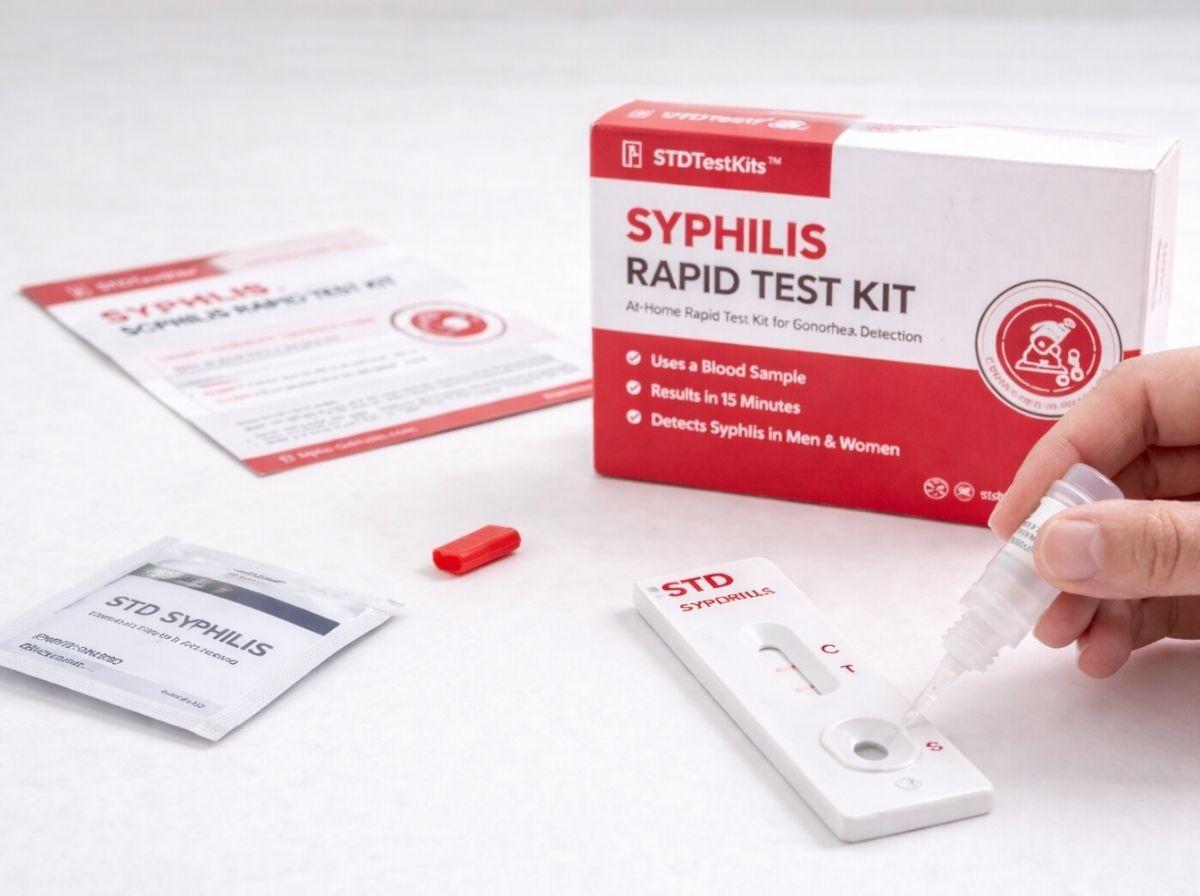
At-home testing is a legitimate, private, and clinically valid alternative for HIV and several key STDs. A finger-prick blood sample can detect HIV antibodies and syphilis. Swab-based kits cover gonorrhea, chlamydia, and herpes. At-home HIV tests are FDA-cleared and, when used within the correct testing window, deliver results you can rely on.
At-home testing does have limits worth knowing. Rectal and pharyngeal swabs for gonorrhea and chlamydia are not currently available in standard at-home rapid test kits, for those, a clinic visit or a specialist postal testing service is needed. But for HIV and syphilis in particular, at-home testing is not a compromise. It is a fully valid method that removes multiple barriers at once, and the CROI 2026 insurance data makes clear why removing those barriers matters.
| Test | At-Home Rapid Kit | Clinic/Sexual Health Service |
|---|---|---|
| HIV | ✓ (finger-prick blood, 99.8% accuracy) | ✓ |
| Syphilis | ✓ (blood) | ✓ |
| Chlamydia (urogenital) | ✓ (urine or swab) | ✓ |
| Gonorrhea (urogenital) | ✓ (urine or swab) | ✓ |
| Chlamydia/Gonorrhea (rectal/pharyngeal) | ✗ Not available in rapid at-home kits | ✓ (site-specific swabs) |
| Herpes HSV-2 | ✓ (blood) | ✓ |
| Hepatitis B | ✓ (blood) | ✓ |
| Hepatitis C | ✓ (blood) | ✓ |
Prevention Tools That Actually Work, and the Gap in Who's Using Them
PrEP, pre-exposure prophylaxis, is one of the most effective HIV prevention tools ever developed. When taken consistently, it reduces the risk of acquiring HIV through sex by over 99%. For transgender women specifically, it has been recommended by the CDC as a core prevention strategy. And yet, as the CROI 2026 cohort data showed, only a fraction of trans women who need PrEP are accessing it, and of those who are, just 4% were on long-acting injectable PrEP, the formulation that sidesteps both the daily adherence challenge and the potential pharmacokinetic concerns around oral tenofovir-based PrEP in people on oestrogen therapy.
The pharmacokinetic question around oral PrEP and oestrogen is worth understanding. Some research suggests that oestrogen may affect how the body processes the active ingredient in standard daily oral PrEP, potentially resulting in lower drug concentrations in rectal tissue. This does not mean oral PrEP doesn't work for trans women, it can and does. But it is a reason to have a specific, informed conversation with a knowledgeable provider about which PrEP formulation is most appropriate for your situation, particularly if you are on feminising hormone therapy. Long-acting injectable PrEP, which is administered every two months, avoids the absorption question entirely. The fact that only 4% of trans women in the CROI cohort were accessing it despite its potential advantages is a clear signal that access, cost, and healthcare navigation remain major barriers.
PEP, post-exposure prophylaxis, is a different tool for a different situation. If you have a potential HIV exposure and you are not on PrEP, PEP can prevent infection if started within 72 hours. The sooner, the better, efficacy drops significantly the longer you wait. PEP is available at sexual health clinics, emergency departments, and some community health centres. If you have had a potential exposure, do not wait to see if symptoms develop. There are no reliable early symptoms of HIV, and the 72-hour window does not wait.
Condoms remain the only prevention tool that reduces transmission of both HIV and bacterial STDs simultaneously. They are highly effective when used consistently and correctly. For many trans people, they are also the most immediately accessible prevention tool, which matters in settings where PrEP access is complicated by cost, insurance, or provider competency.
DoxyPEP, a dose of the antibiotic doxycycline taken within 72 hours of condomless sex, has shown significant reductions in gonorrhea, chlamydia, and syphilis in clinical trials among MSM and transgender women. It is not yet standard of care for all populations, and it requires a prescription and medical guidance. If you are seeing a trans-competent sexual health provider, it is worth asking whether it is appropriate for your situation.
Finding Healthcare That Treats You Like a Person
You deserve healthcare where your gender is not a problem to be managed, a source of confusion, or a topic that takes over the entire appointment. Gender-affirming sexual health care looks like a provider who asks for your pronouns, uses your correct name in both conversation and records, understands the anatomy relevant to your situation, and does not treat your gender identity as an obstacle to discussing your sexual health directly.
Finding that care is not always straightforward. Sexual health clinics that serve LGBTQ+ communities are generally the most experienced, Planned Parenthood locations, community health centres, and dedicated sexual health clinics in larger cities often have the highest levels of trans competency. Searching explicitly for "LGBTQ-affirming sexual health clinic" in your area is more likely to surface appropriate options than general searches. GLMA (the LGBTQ+ Medical Association) maintains a provider directory. In many areas, harm reduction organisations and community health workers connected to trans networks are also valuable sources of referral.
Self-collected samples are a clinically valid option that can reduce the discomfort of clinical encounters for trans people who experience gender dysphoria in relation to genital examinations. Self-collected vaginal and rectal swabs have equivalent sensitivity and specificity to provider-collected samples for gonorrhea, chlamydia, and trichomonas. If a clinic is not offering this option when it is available and appropriate, it is reasonable to ask for it.
If a provider refuses to use your correct pronouns, misgenders you repeatedly, or refuses to provide care based on your gender identity, you have grounds to file a complaint. In states with healthcare non-discrimination protections, refusal of care based on gender identity is often illegal. At-home testing, meanwhile, is not a workaround or a lesser option, for HIV and several key STDs, it is a fully valid, accurate, and entirely private method of staying on top of your health without requiring a clinical setting to perform correctly.
FAQs
- 1. Are transgender people at higher risk of HIV than the general population?
- Yes, significantly. Transgender women are approximately 66 times more likely to be living with HIV than the general adult population, based on the most comprehensive global meta-analysis to date. Trans men are nearly seven times more likely. These disparities are driven by structural factors, poverty, healthcare discrimination, and lack of access to prevention tools, not biology.
- 2. How often should transgender women get tested for HIV and STDs?
- At minimum, once a year. If you have multiple partners, have condomless sex, or are engaged in sex work, every three months is the appropriate frequency for HIV, syphilis, gonorrhea, and chlamydia. If you are on PrEP, quarterly testing should already be part of your PrEP protocol.
- 3. Can transgender people use at-home STD tests?
- Absolutely. At-home rapid tests are fully valid for HIV and syphilis (finger-prick blood), gonorrhea and chlamydia (urogenital swab or urine), herpes, and hepatitis B and C. The one limitation is that rectal and pharyngeal swabs for gonorrhea and chlamydia still require a clinic, a urine or urogenital swab alone will miss those sites.
- 4. Does hormone therapy affect HIV risk or PrEP effectiveness?
- Oestrogen-based hormone therapy does not increase HIV risk directly. However, some research suggests it may affect how daily oral PrEP is absorbed, potentially resulting in lower drug concentrations in some tissue types. This is one reason long-acting injectable PrEP has attracted attention as a potentially preferable option for trans women on oestrogen. Speak with a knowledgeable provider about which PrEP formulation is right for your specific situation, do not assume the standard oral guidance applies without that conversation.
- 5. What STDs are most common in transgender men?
- The research is limited, but available data shows elevated rates of gonorrhea and chlamydia among trans men who have sex with men, rates comparable to those in cisgender MSM. HIV risk is also higher than in the general population, at approximately seven times the odds. Trans men who retain a cervix are also at risk for HPV and cervical cancer.
- 6. What should I do if a clinic refuses to test me or misgenders me?
- If a provider refuses care based on your gender identity, that may constitute illegal discrimination in many states, you can file a complaint with your state health department or the Office for Civil Rights at the Department of Health and Human Services. If a provider repeatedly misgenders you despite correction, seeking a different provider is a completely reasonable response. At-home testing is also a fully valid alternative for HIV and most key STDs, and removes the need to navigate a clinical environment that is failing you.
- 7. Is the HIV risk for transgender people the same across all racial groups?
- No, and the difference is stark. Among transgender women in the US, HIV prevalence is approximately 14% overall, but reaches 44% among Black trans women and 26% among Hispanic trans women. These disparities reflect the compounded impact of anti-Black racism, transphobia, and structural inequality operating simultaneously across healthcare, employment, and housing systems.
- 8. What is the difference between PrEP and PEP?
- PrEP is taken before potential exposure to prevent HIV, either as a daily pill or as a long-acting injectable every two months. PEP is taken after a potential exposure has already occurred and must be started within 72 hours to be effective. Both require a prescription. If you are not on PrEP and have had a potential exposure, go to a sexual health clinic or emergency department immediately, every hour counts.
- 9. Do I need different tests before and after gender affirmation surgery?
- Potentially, yes. The anatomy of a neovagina created through vaginoplasty differs from natal vaginal anatomy, and standard STD swab protocols do not map directly. After surgery, testing approaches need to be adapted to your specific anatomy and sexual practices, which may include using an anoscope rather than a standard speculum for visual examination, and ensuring that providers understand the relevant anatomy.
- 10. Why are only 4% of trans women on PrEP using the injectable version?
- That figure from CROI 2026 reflects a access problem, not a preference. Long-acting injectable PrEP requires a clinical visit every two months for the injection, which means consistent, affordable, trans-competent healthcare access. For many trans women, particularly those facing poverty, housing instability, or healthcare discrimination, maintaining that kind of consistent clinical engagement is genuinely difficult. The insurance gap documented in the same cohort study is part of the same structural barrier.
Take Control of Your Sexual Health
The data on HIV and STD risk in transgender communities is not meant to frighten, it is meant to inform. Knowing where the actual risks are, what drives them, and exactly when and how to test is how you stay ahead of them. Testing is not a verdict. It is information, and information is what gives you options.
- CDC, Sexually Transmitted Infections Treatment Guidelines: Transgender and Gender Diverse Persons
- Stutterheim et al., The Worldwide Burden of HIV in Transgender Individuals: An Updated Systematic Review and Meta-Analysis (PMC)
- Prevalence of Sexually Transmitted Infections and Human Immunodeficiency Virus in Transgender Persons: A Systematic Review (PMC)
- Human Rights Campaign, Transgender People and HIV: What We Know
- World Health Organization, Transgender People and HIV
- CDC, Fast Facts: HIV and Transgender People