





Last updated: March 2026
Why "Once a Year" Is the Wrong Answer for Most People
There's a widespread assumption that getting tested once a year is enough, that it's the responsible thing sexually active adults do, like an annual physical or a dental cleaning. The problem is that this idea doesn't come from science. It comes from a general health habit that was never designed specifically around STD biology.
Here's what actually happens in most routine checkups: your doctor runs a blood panel, checks your blood pressure, and maybe asks about your diet. STD screening is not automatically included unless you ask for it, and in many healthcare settings, it isn't offered unless you flag a concern. According to the CDC, many STDs go undiagnosed simply because people don't know they need to ask for a test, not because they aren't accessing healthcare.
The biology makes annual testing insufficient for a lot of people. Chlamydia, the most commonly reported bacterial STD, often produces no symptoms at all. Gonorrhea can be completely silent in both men and women. HIV can take weeks before it registers on a test. If you're sexually active with more than one partner across a year, waiting twelve months between tests means you could be carrying, and potentially transmitting, an infection for a long stretch of time without knowing. That's not a moral failing. It's just what happens when testing frequency doesn't match exposure frequency.
The goal of this guide is to match your testing schedule to your actual life, not to a calendar. Some people genuinely only need to test once or twice a year. Others need to be tested every three months. The difference is in the details of how you're having sex, with whom, and what protections you're using.
People are also reading: No Symptoms but Worried? When to Get an STD Test Anyway
The Baseline: What Every Sexually Active Person Should Test For
Before getting into frequency, it helps to know what the baseline actually looks like, the minimum set of tests that makes sense for any sexually active adult, regardless of how many partners they have or what kind of sex they're having. Most sexual health guidelines converge on four core infections: chlamydia, gonorrhea, syphilis, and HIV. These are the infections most likely to be present without symptoms, most likely to cause long-term health consequences if missed, and most commonly transmitted through sexual contact.
Chlamydia and gonorrhea are bacterial infections that are easily treated when caught, but capable of causing significant complications, including infertility, when they go undetected for months or years. Syphilis has been surging in many countries over the past decade, and it moves through stages, becoming harder to recognize and more damaging to the body the longer it goes untreated. HIV remains a critical test for anyone sexually active, not because most people are at high risk, but because early detection is what makes modern management of the virus possible.
Beyond the core four, several other infections deserve a place on your screening list depending on your situation. Herpes (both HSV-1 and HSV-2) is extraordinarily common and frequently absent from standard panels; most routine tests don't check for it unless you request it specifically. Hepatitis B and C can be transmitted sexually and often cause no symptoms for years. HPV testing is recommended for women as part of cervical screening. Trichomoniasis, one of the most common non-viral STDs, is often overlooked because it's so easily treated that many providers don't emphasize it.
The key takeaway from this table is that no single test covers everything. A standard STD test at a clinic often checks for chlamydia and gonorrhea, sometimes adds HIV and syphilis, and leaves everything else off the panel unless you ask. Knowing what you're actually being tested for, and what's being left out , is the first step toward building a screening routine that actually protects you.
How Often to Test If You Have Multiple or New Partners
If you're dating actively, having casual sex, or regularly meeting new partners, every-three-months testing is the standard recommendation from most sexual health guidelines, and there's a solid biological reason for it. Most of the common bacterial STDs can be detected within a few weeks of exposure. If you're potentially being exposed through different partners across a year, quarterly testing means the longest an infection goes undetected is roughly twelve weeks. That's a meaningful difference from waiting twelve months.
The three-month schedule applies most directly to chlamydia, gonorrhea, syphilis, and HIV, the core four. Research published in the National Library of Medicine has consistently shown that more frequent testing in higher-activity groups leads to earlier detection, faster treatment, and reduced onward transmission. This isn't about judgment; it's about the math of how these infections move through populations.
One thing worth understanding clearly: testing immediately after a new encounter is not the same as testing at the right time. Every infection has a window period, the gap between exposure and when the test can reliably detect it. Testing too soon after a sexual encounter can give you a falsely reassuring negative result. Chlamydia needs 14 days after exposure before a test is reliable. Gonorrhea needs 3 weeks. Syphilis needs 6 weeks. HIV needs at least 6 weeks for a first indicator result, and a full 12 weeks for a conclusive answer. Herpes, hepatitis B, and hepatitis C each have their own windows, too. Building your testing schedule around these windows , rather than around when you feel anxious, is what makes the results actually meaningful.
If you're having sex with new partners regularly, the practical approach is to treat testing as part of your routine rather than something you do in response to a scare. Think of it the way you'd think of any other recurring health habit. Every three months, at a predictable interval, covering the core infections plus whatever else is relevant to your specific situation. At-home rapid test kits make this significantly easier: no appointment, no waiting room, results in minutes from your own bathroom.
Testing Frequency for People in Monogamous Relationships
Here's where a lot of people make a quiet assumption that doesn't hold up under scrutiny: once you're in a committed, monogamous relationship, you don't need to worry about STD testing anymore. The logic seems reasonable on the surface. If neither person is having sex outside the relationship, what's the risk? But the reality is more layered than that, and skipping testing entirely based on relationship status is one of the most common ways infections go undetected for years.
The first thing to understand is that "entering a monogamous relationship" is the exact moment when testing matters most. Both partners bringing a full STD screening to the start of a new relationship, before or shortly after becoming sexually active together, is the baseline that makes exclusivity actually meaningful from a health perspective. Without that initial screen, you're both operating on trust rather than information. And trust is not a diagnostic tool.
For established monogamous couples who have both tested negative and genuinely have no outside exposure, annual testing for the core four (chlamydia, gonorrhea, syphilis, HIV) is a reasonable baseline. Some couples choose to test together once a year simply as a health habit; it normalizes the conversation, removes the stigma, and gives both partners clarity. That's a smart approach. The infections that need more attention in long-term monogamous relationships are the ones that may have been present before the relationship started: herpes, hepatitis B, and hepatitis C can all persist quietly for years before being identified. If neither partner has been screened for these, it's worth adding them to an initial full panel.
The other scenario worth addressing plainly: relationships are complicated. Circumstances change, and people don't always disclose exposure when it happens. This isn't a judgment, it's an acknowledgment that sexual health decisions are best made on the basis of regular testing, not solely on assumptions about a partner's behavior. Annual screening for people in monogamous relationships is not a sign of distrust. It's just sensible health maintenance.
STD Testing Schedules by Lifestyle, Your At-Home Testing Guide
The clearest way to think about testing frequency is to match it directly to your lifestyle. The table below breaks this down into five common situations, with recommended test types, frequency, and the window periods you need to respect for accurate results. At-home rapid test kits from STD Test Kits make it straightforward to follow any of these schedules without clinic visits or appointments.
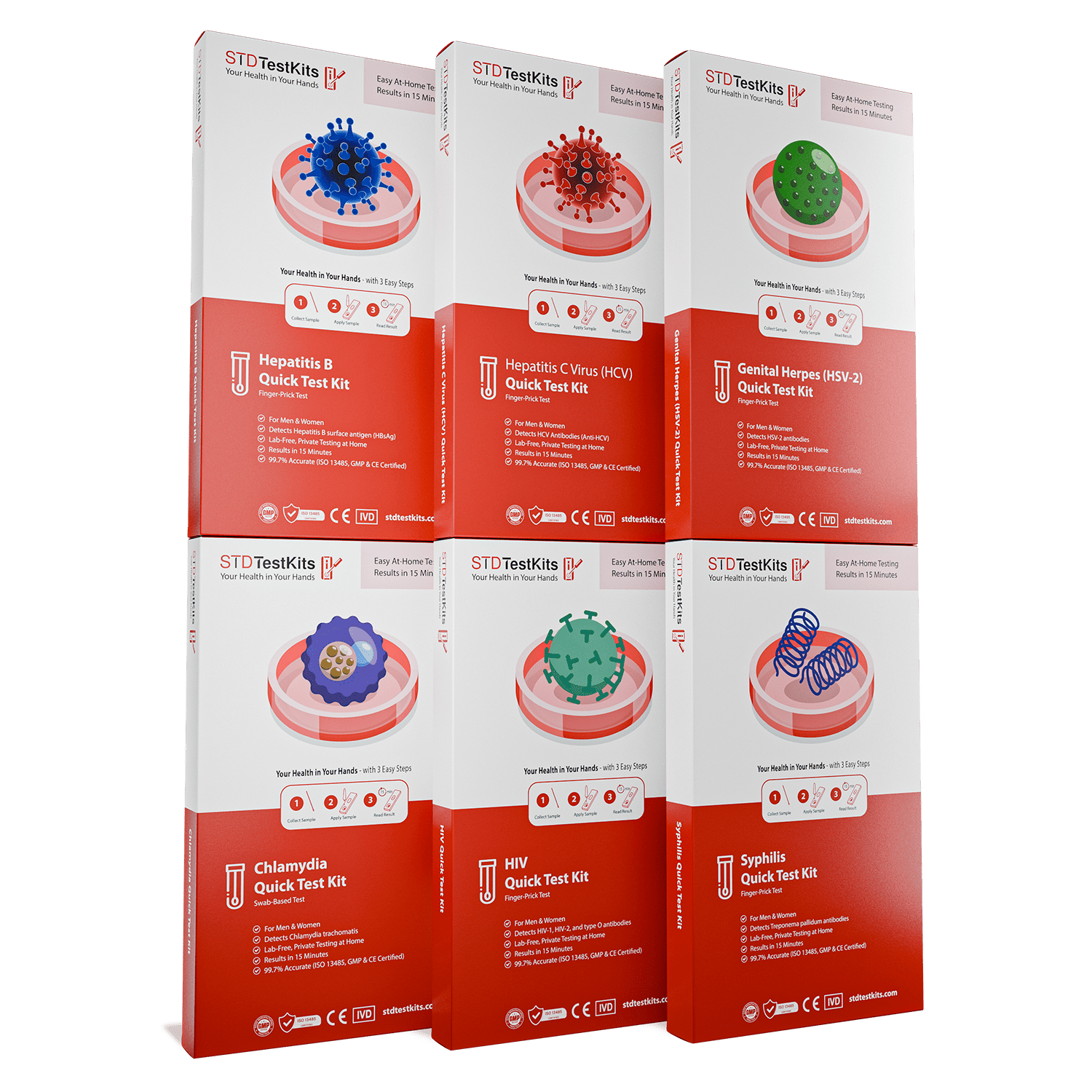
For people dating casually or with multiple partners, the 7-in-1 Complete At-Home STD Test Kit covers HSV-2, Chlamydia, Gonorrhea, Syphilis, HIV, Hepatitis B, and Hepatitis C in a single test, which makes it the most practical option for a quarterly screening routine. For anyone wanting the most comprehensive screen available, the 8-in-1 Complete At-Home STD Test Kit adds HSV-1 to the panel. Women who want full coverage, including HPV and trichomoniasis, can use the Women's 10-in-1 At-Home STD Test Kit, which is the most thorough single-kit screening option available.
The at-home format matters more than people sometimes realize. The biggest barrier to regular STD testing isn't cost or access for most people; it's the friction of making an appointment, taking time off work, and sitting in a waiting room. When testing is something you can do at home in fifteen minutes and get results on the same day, the excuses for skipping it largely disappear. Peace of mind is one test away , and when it becomes a habit rather than a crisis response, it changes how you feel about your sexual health entirely.
Infections That Need Special Attention on Your Schedule
Some infections get left off the default STD screening panel more often than they should, not because they're rare, but because they're either difficult to test for in a clinical setting, frequently asymptomatic, or simply not prioritized in routine checkups. If you're building a real screening routine, these are the ones that deserve specific attention.
Herpes is the clearest example. HSV-1 (oral herpes) and HSV-2 (genital herpes) are among the most common infections globally, yet most standard STD panels don't include herpes testing unless you specifically ask for it. Many people carry herpes without ever having a recognizable outbreak, which means they've never had a reason to ask for the test, and many healthcare providers don't volunteer it. The test window for herpes is 6 weeks after exposure, and the at-home rapid test option means you can check for both HSV-1 and HSV-2 privately without navigating that conversation in a doctor's office.
HIV deserves its own note on timing. The 6-week mark after potential exposure gives you a strong first indicator of your status, but it's not the final word. A full 12 weeks after exposure is when you can be conclusively certain of a negative result. This two-stage window is something a lot of people misunderstand; they test at 6 weeks, get a negative result, and consider the question closed. For most people in most situations, the 6-week result is accurate. But for complete certainty, the 12-week retest is what the science supports.
Hepatitis C is worth including in any comprehensive screen, especially for adults who may have had exposure before the current era of widespread testing awareness. Hep C can be present for decades without symptoms, and the test window is 8–11 weeks after exposure. Hepatitis B has a 6-week window and remains sexually transmissible. If you haven't been vaccinated, testing and vaccination together are the smart combination. HPV is relevant primarily for women, where it connects directly to cervical health and is best detected through cervical screening that includes HPV testing every 3–5 years.
Trichomoniasis rounds out the list of commonly missed infections. It's the most prevalent non-viral STD in the world, it's extremely treatable, and it's frequently absent from routine panels. Women are more likely to have symptoms, discharge, irritation, odor, but men can carry it silently. If you're a woman who tests regularly, adding trichomoniasis to your panel is a simple step that covers an infection most people don't think about until they have a reason to.
People are also reading: Tested Positive for Trichomoniasis: What to Do Next
How to Build a Testing Routine That Actually Sticks
The science of how often to test is only half the picture. The other half is human nature, specifically, the fact that even people who know they should test regularly don't always do it. Building a routine that actually holds requires linking testing to something concrete rather than leaving it as a vague intention to "get checked sometime."
One of the most effective approaches is to anchor testing to life events rather than arbitrary calendar dates. Testing at the start of a new relationship is an obvious trigger point. So is the end of one. If you've had a period of higher sexual activity, a string of dates, a trip, a stretch of casual encounters, that's a natural prompt to schedule a screen once the relevant window periods have passed. Some people choose a personal "testing birthday" , the same month every year, no matter what, to make annual screening automatic. Others sync quarterly testing to the seasons. The specific system matters less than having one.
At-home testing removes the biggest practical obstacle for most people. You don't need to schedule an appointment weeks in advance, travel to a clinic, or discuss your sex life with a provider who makes you feel judged. You order a kit, follow the instructions at home, and get your results privately. For a quarterly routine, that means four fifteen-minute sessions a year, a genuinely low ask for the peace of mind and health protection it provides. Take control of your sexual health today: browse the full range of at-home test kits at STD Test Kits and find the right kit for your lifestyle.
The final piece of building a routine that sticks is letting go of the idea that testing is a response to something going wrong. Testing isn't a punishment for risky behavior, a sign of distrust toward a partner, or evidence that something is probably wrong. It's a health habit, the same category as brushing your teeth or going for a run. The people who test regularly aren't the people who are more reckless. They're the people who understand that information is what lets you make good decisions, and that not knowing isn't the same as being safe.
FAQs
How often should I get tested for STDs if I'm not in a relationship?
If you have sex outside of a committed relationship, even if it is infrequently, then it is recommended that you get tested for the primary four STDs every three months. This is because if you get tested every three months, then no STD will go undetected for more than a quarter of a year. This is significant because it reduces the time that complications or unknowing transmission could occur.
Does being in a monogamous relationship mean I don't need to get tested for STDs?
While being in a monogamous relationship is good, it is still recommended that both individuals get tested for STDs. Both individuals should get tested for STDs before or at the beginning of a new relationship. Once in a relationship, both individuals should get tested for STDs on an annual basis. Some STDs, such as herpes or hepatitis, could have been contracted prior to meeting your partner. Therefore, even if you have been in a relationship with your partner for some time, you could still be infected with herpes or hepatitis but not even know it.
How soon after sex can I get an accurate STD test?
Chlamydia is detectable in 14 days. Gonorrhea is detectable in 3 weeks. Syphilis is detectable in 6 weeks. Herpes is also detectable in 6 weeks. HIV is detectable in at least 6 weeks for the first indicator. However, HIV is not detectable until at least 12 weeks. If you get tested too soon, then you could get false results, which is more dangerous than waiting. Waiting until at least 12 weeks is more beneficial than getting false results at an inappropriate time.
Are at-home STD tests as accurate as clinic tests?
Yes, when used correctly. The rapid test kits offered by STD Test Kits utilize the same antibody and antigen detection principle used in clinical tests. Accuracy rates of these tests vary from 98% to 99.8%, depending upon the disease. What is important is observing the window period. It is the right time following exposure to infection that makes these tests accurate, not whether it is done in a clinic or at home.
What are the kinds of STDs I should get tested for if I only have oral sex?
Gonorrhea can infect your throat. It is also one of the most common oral sex infections that are frequently missed. Herpes, HSV-1, is an orally transmitted disease. Syphilis can also be transmitted orally. Although it is low, HIV can also be transmitted through oral sex. If oral sex is part of your regular sexual activities, then it is best to get tested for throat gonorrhea, herpes, and syphilis.
I don’t have any symptoms. Do I really need to get tested regularly?
Most especially then. A large percentage of Chlamydia cases, a significant number of gonorrhea cases, and almost all herpes cases are symptom-free. In addition, HIV can also be symptom-free for years. Symptoms are not indicative of your status. Regular testing is precisely what catches infections that would otherwise have gone unnoticed until it is too late and health consequences are much more severe.
How often should gay and bisexual men get tested for STDs?
Every three months for men who have sex with men (MSM), all of the above infections are included, i.e., chlamydia, gonorrhea, syphilis, HIV, hepatitis B, and hepatitis C. It should be noted that for gonorrhea, not only should a sample be taken from the genitals but also from the throat and rectum, as all of these may be infected. The reasoning behind this frequent testing for MSM is that this group has a higher rate of transmission and early detection of these diseases is imperative.
What is the most comprehensive at-home STD test that I can take?
For most individuals, the 7 in 1 or 8 in 1 STD Test Kits provided by STD Test Kits will be the most comprehensive. However, if you're a woman, then you should make sure that you get the Women's 10 in 1 STD Test Kit, which is the most comprehensive STD test that you can get. If you're interested in getting individual tests for each STD, then that is also possible.
Should I get tested after each new partner?
This is definitely something that you should do, but there is one thing that you have to remember: you have to allow time for what is known as the window period. If you get tested the next day, then you won't get accurate results. If you've just met somebody new, then it is recommended that you get tested at the appropriate window time, which is usually 3 or 6 weeks from the time that you had sex. If you're seeing multiple people on a regular basis, then it is recommended that you get tested quarterly.
Can I get tested for STDs while I am on my period?
Yes. Your menstrual cycle will not interfere with your STD tests. Most STD tests work by using your blood, which is not affected by your menstrual cycle. If you're concerned about whether or not your menstrual cycle will interfere with your STD tests, then all you have to do is check your STD test package.
Ready to Build Your Testing Routine? Start Here.
Now that you know how often you should be testing, and why the answer is different depending on your lifestyle, the next step is making it real. The most common reason people fall behind on regular STD screening isn't that they don't care. It's that testing feels like a production: appointments to schedule, waiting rooms to sit in, awkward conversations to navigate. At-home rapid testing removes all of that friction, which means your quarterly or annual routine can happen on your schedule, in your own home, in about fifteen minutes.
STD Test Kits carries a full range of at-home rapid test options built around every lifestyle and screening need. If you're dating actively or want quarterly coverage for the most important infections, the 7-in-1 Complete At-Home STD Test Kit covers HSV-2, Chlamydia, Gonorrhea, Syphilis, HIV, Hepatitis B, and Hepatitis C in a single screen with 98.5% accuracy. Want to add HSV-1 to your panel? The 8-in-1 Complete At-Home STD Test Kit has you covered. For women who want the most thorough screen available, including HPV 16 & 18 and Trichomoniasis, the Women's 10-in-1 At-Home STD Test Kit covers all ten of the most common STDs in one kit.
If you're starting with a single infection test or want to build your own panel, individual kits are available for Chlamydia, Gonorrhea, Syphilis, HIV, Herpes HSV-2, Hepatitis B, Hepatitis C, and more. Browse the full range of single and combo kits at stdtestkits.com and find the right fit for your routine. Your results, your privacy, your power.
How We Sourced This: Our article was constructed based on current advice from the most prominent public health and medical organizations, and then molded into simple language based on the situations that people actually experience, such as treatment, reinfection by a partner, no-symptom exposure, and the uncomfortable question of whether it "came back." In the background, our pool of research included more diverse public health advice, clinical advice, and medical references, but the following are the most pertinent and useful for readers who want to verify our claims for themselves.
Sources
1. CDC , STD Screening Recommendations
2. National Library of Medicine , Frequency of STI Testing in Higher-Risk Populations
3. WHO , Sexually Transmitted Infections (STIs) Fact Sheet
4. NHS , Sexually Transmitted Infections: Overview and Screening
5. CDC , HIV Testing: When and How Often
6. CDC , Genital Herpes: Fact Sheet
About the Author
Dr. F. David, MD is a board-certified infectious disease specialist focused on STI prevention, diagnosis, and treatment. He writes with a direct, sex-positive, stigma-free approach designed to help readers get clear answers without the panic spiral.
Reviewed by: Rapid STD Test Kits Medical Review Team | Last medically reviewed: March 2026
This article is for informational purposes and does not replace medical advice.