Latex Allergy or STD Rash? How to Tell After Sex
Quick Answer: Latex allergy rashes usually appear within minutes to hours after condom use and cause itching, redness, or swelling without blisters. I watched her open it. I thought I’d ruined my life.” He hadn’t slept.

Quick Answer: Latex allergy rashes usually appear within minutes to hours after condom use and cause itching, redness, or swelling without blisters. STD rashes, including herpes or syphilis, typically appear days to weeks later and may include sores, blisters, or systemic symptoms. If symptoms worsen, blister, or last beyond a few days, testing is recommended.
The Morning After: Why This Panic Is So Common
Arjun, 27, told me, “We used protection. I watched her open it. But the next morning my penis felt raw and looked red. I thought I’d ruined my life.” He hadn’t slept. He’d zoomed in with his phone camera. He’d convinced himself the tiny irritated patch was the beginning of something permanent.
This reaction is more common than most people admit. Condoms reduce STI risk dramatically, but they don’t eliminate all risk, and they can irritate sensitive skin. When friction, sweat, lube ingredients, and latex combine, the result can look dramatic. Redness on genitals always feels bigger than it is.
Before you diagnose yourself, slow down. The first clue is timing.

Timing Is the First Clue
A true latex allergy or latex sensitivity reaction usually happens fast. Within minutes to a few hours after contact, skin can become red, itchy, puffy, or irritated. This is called contact dermatitis, and according to guidance from the CDC and allergy specialists, it is a localized immune response, not an infection spreading through your body.
By contrast, most STIs do not appear overnight. Herpes typically causes symptoms 2 to 12 days after exposure. Syphilis sores may appear around 3 weeks later. Chlamydia and gonorrhea often cause discharge or burning urination within 7 to 14 days, and many people have no symptoms at all.
If your rash showed up the same night or the morning after condom use, infection is statistically less likely. Not impossible. But less likely.
| Condition | Typical Onset After Sex | Common Appearance | Other Clues |
|---|---|---|---|
| Latex Contact Dermatitis | Minutes to 24 hours | Redness, itching, mild swelling | Improves in 1–3 days if avoided |
| Herpes | 2–12 days | Painful blisters → open sores | Tingling before outbreak, flu-like symptoms sometimes |
| Syphilis | 10–90 days | Single painless sore | Firm, round lesion |
| Friction Burn | Immediately or next day | Raw, shiny, irritated skin | Often follows longer or dry sex |
Table 1. Timing and appearance comparison between latex irritation and common STI rashes.
What Latex Allergy Actually Feels Like
When people search “latex allergy symptoms genital,” what they’re usually describing is irritation, not a life-threatening allergy. Severe latex allergies exist, but they are rare and typically include hives, breathing difficulty, or widespread swelling. That is a medical emergency.
More commonly, the reaction is localized. The penis may feel warm or slightly swollen. The labia might appear puffy and itchy. The skin can look blotchy or feel tender, especially in areas that experienced more friction. Sometimes there’s a mild burning sensation when you urinate because irritated skin is sensitive.
Lucía, 24, described it this way: “It wasn’t blisters. It was like my whole vulva was irritated and tight. By day three it was almost gone.” That pattern, intense but short-lived, leans toward contact dermatitis rather than an STI.
Latex reactions also tend to improve quickly once exposure stops. If you avoid latex condoms and symptoms resolve within a few days, that’s another clue.
When It’s Not Just Irritation: Signs You Shouldn’t Ignore
Here’s where the investigator in me steps in. If you see fluid-filled blisters, open sores, crusting lesions, or a single firm ulcer that doesn’t hurt, pause. Those are not classic allergy signs. Those require evaluation and likely STI testing.
Painful grouped blisters are strongly associated with herpes. A solitary, painless sore that feels firm could indicate early syphilis. Thick discharge, painful urination, or pelvic pain may point toward chlamydia or gonorrhea.
Another clue: worsening instead of improving. Latex irritation usually peaks quickly and then fades. STI symptoms often evolve over days.
“But We Used a Condom” Understanding Residual Risk
Condoms are extremely effective at preventing infections transmitted through fluids, including HIV, chlamydia, and gonorrhea, when used correctly. However, skin-to-skin infections like herpes and HPV can still spread from areas not covered by the condom.
This doesn’t mean condoms don’t work. They absolutely reduce risk. It just means they are not 100% coverage against every infection. That nuance is often missing from late-night panic searches.
If your concern is based solely on seeing redness the morning after protected sex, infection is less likely. If your partner had visible sores, disclosed an STI, or symptoms appear days later, testing becomes more important.
How Long Does a Latex Rash Last?
In the vast majority of cases, mild latex contact dermatitis will clear up in one, two, or three days after the offending exposure is avoided, although the skin may flake slightly in the process.
If the symptoms do not go away in more than a week, or if they spread beyond the initial site of contact, or if they become painful rather than itchy, then they are no longer indicative of mere condom irritation.
"The human body is a very predictable machine. Allergic reactions go away when the allergen is removed. Infections do not."
When Testing Makes Sense (Even If You Think It’s Allergy)
If anxiety is keeping you up at night, testing can be grounding. Even if symptoms strongly suggest irritation, some people choose an at-home screening for reassurance, especially if there was any doubt about condom integrity.
You can explore discreet options at STD Test Kits, including combo panels that check for multiple common infections. For example, the 6‑in‑1 At‑Home STD Test Kit offers private screening without a clinic visit.
Testing too early can produce false negatives. Most bacterial infections are best tested 7 to 14 days after exposure. Blood-based infections like syphilis or HIV require longer windows. Timing matters more than panic.
Herpes Panic vs Contact Dermatitis: The Detail That Changes Everything
When people type “condom rash vs herpes” into Google, what they’re really asking is: is this permanent? That fear deserves a calm answer.
Herpes lesions usually begin with a tingling, burning, or nerve-like sensation before anything appears on the skin. Then small fluid-filled blisters form, often clustered together. Those blisters break open and create shallow, painful sores before crusting and healing. The entire process unfolds over several days, not hours.
Latex irritation does not form true blisters filled with clear fluid. It does not ulcerate into crater-like sores. It looks inflamed, not infected. The difference is subtle in description, but obvious in progression.
Saraí, 31, shared: “I convinced myself it was herpes because it burned. But there were no blisters. Just red irritated patches. By the third day, it faded.” That resolution pattern matters. Herpes does not typically vanish in 48 hours without progressing.
Friction Burn: The Overlooked Third Option
Sometimes it’s not allergy or STI. Sometimes it’s mechanical. Longer sessions, less lubrication, certain positions, or condoms without enough external lube can cause what people search as “friction burn vs STD.”
Friction irritation often appears as shiny, tender skin. It may sting when showering. It can look dramatic under bright bathroom lighting. But it stays localized to high-contact areas and improves with rest and moisture.
If sex was vigorous, prolonged, or slightly dry, friction is statistically more likely than infection, especially if symptoms showed up the next morning.
Discharge, Fever, and Systemic Symptoms: Big Red Flags
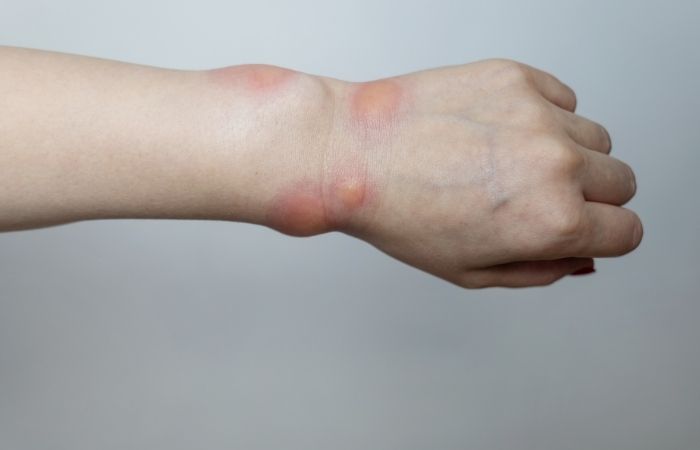
Allergic reactions stay on the skin. They do not cause fever. They do not cause body aches. They do not produce thick discharge from the penis or unusual vaginal discharge with odor.
If you experience burning urination, yellow or green discharge, pelvic pain, testicular pain, swollen lymph nodes, or flu-like symptoms, those signs lean toward infection. Chlamydia and gonorrhea can cause urinary discomfort. Initial herpes outbreaks can sometimes feel like the flu. Secondary syphilis can produce a rash beyond the genitals.
When symptoms extend beyond surface irritation, testing is not optional. It’s smart.
Texture Matters More Than Color
Redness alone doesn’t tell you much. Genital skin is vascular and sensitive. It turns red easily. What matters more is texture.
Allergic irritation feels flat or slightly raised but smooth. It may feel itchy or warm. It does not feel like individual fluid-filled bubbles.
Infections often change texture. Blisters feel dome-shaped. Syphilis sores feel firm and indurated. Warts from HPV feel rough or cauliflower-like. Texture is information your body is giving you.
How Long Should You Wait Before Testing?
If your only symptom is redness within 24 hours of condom use, you can monitor for a couple of days. If symptoms fade quickly, testing may not be necessary unless there was another risk factor.
If symptoms appear days later, or if you’re unsure about exposure risk, testing at the right time gives you clarity. Most urine-based tests for chlamydia and gonorrhea are most reliable around 7 to 14 days after exposure. Blood tests for syphilis are more accurate after 3 to 6 weeks. HIV antigen/antibody tests typically detect infection within 2 to 6 weeks.
Testing too soon can create false reassurance. Waiting strategically increases accuracy.
| Exposure Concern | Earliest Useful Test Window | Best Accuracy Window |
|---|---|---|
| Possible Chlamydia / Gonorrhea | 7 days | 14 days |
| Possible Herpes (blood test) | 3 weeks | 6–12 weeks |
| Possible Syphilis | 3 weeks | 6 weeks+ |
| Possible HIV (Ag/Ab test) | 2 weeks | 6 weeks |
Table 2. General testing windows after potential exposure. Individual timing may vary.
If It Is Latex Sensitivity, Here’s What To Do Next
First, breathe. Latex sensitivity is manageable. Switching to non-latex condoms, such as polyurethane or polyisoprene, typically resolves the issue. Many people discover sensitivity only after a new brand or lubricant change.
Second, let the skin heal fully before sexual activity again. Irritated skin is more vulnerable to microtears, which can increase susceptibility to infections.
Third, patch-test new products on inner arm skin before genital use if you suspect recurring reactions. The body often gives small warnings before bigger ones.
If You’re Still Unsure, Clarity Beats Guessing
Anxiety can distort perception. Under bathroom lighting, every pore looks like a lesion. Every bump feels catastrophic. If you cannot confidently identify the rash type after 72 hours of observation, testing offers control.
Discreet at-home panels allow screening without sitting in a waiting room replaying the encounter in your head. The Combo STD Home Test Kit screens for multiple infections at once, reducing the mental back-and-forth of “what if it’s this.”
Peace of mind is not overreacting. It’s informed self-care.
What About Tiny Red Bumps? When Anxiety Zooms In Too Far
Genital skin has hair follicles, oil glands, and natural texture. After sex, especially protected sex, those structures can look more pronounced. Sweat, friction, and latex contact can temporarily inflame follicles, leading to what people search as “red bumps after sex.”
Follicle irritation tends to be scattered and superficial. It does not form painful ulcers. It does not leak clear fluid. It may feel mildly tender but not sharply painful. Within a few days, the bumps flatten.
By contrast, infectious lesions typically follow a predictable arc. They don’t just sit there unchanged. They evolve. If what you’re seeing looks identical on day three as it did on day one, and is already fading, infection becomes less likely.
The Role of Lubricants, Spermicides, and Additives
Not every “latex allergy” is actually latex. Many condoms contain lubricants, flavoring agents, warming or cooling additives, or spermicides like nonoxynol-9. These ingredients can irritate delicate genital tissue.
Some people tolerate latex perfectly but react strongly to specific lubricants. Others are sensitive to certain preservatives. If you experienced burning after condom use, especially with a new brand, consider what changed.
Omar, 29, realized his reaction only occurred with ultra-thin flavored condoms. “The regular ones were fine. The flavored ones made everything sting.” That pattern points to ingredient sensitivity, not STI transmission.
Can You Get an STI Even If the Rash Is Allergy?
This is the layered reality: yes, it is possible to have both irritation and an infection. They are not mutually exclusive. Skin irritation can coexist with an asymptomatic STI.
That’s why risk context matters. Was the condom used from start to finish? Was there any slippage or breakage? Did your partner disclose an infection? Are you within a testing window for something previously untested?
If the only “evidence” is redness appearing within hours of condom use and resolving quickly, infection risk is low. If there were other risk factors, screening can still be wise even if the rash itself was allergic.
When to Seek In-Person Medical Care
There are some instances when home monitoring is not enough. When there are severe swelling problems, breathing difficulties, hives outside the genital areas, or severe pain, immediate medical attention should be given.
When there are painful blisters, a rash outside the areas of contact, high fever, or ulcers, a clinical examination should be set up. Some of these may need to be visually checked or treated.
Mild reactions can be treated on their own without medical intervention. This helps to avoid panic in some instances when the situation can be treated on its own.
Switching to Non-Latex Without Sacrificing Protection
In the event that latex sensitivity is suspected, it is not necessary to forego the use of condoms. Polyurethane or polyisoprene condoms offer the same STI and pregnancy protection without the presence of proteins found in the material of the latex condoms.
These have a slightly different feel but offer the same safety when used properly. Most people who search the internet for “non latex condoms allergic” discover that the solution is to switch totally from the condoms that cause the recurring irritation.
Protection should never hurt. If it does, it is not the standards that need to be changed, but the method.
The Emotional Spiral Is Real, But So Is Data
After sex, especially with someone new, the brain scans for threats. A minor change in skin tone becomes catastrophic. The thought pattern often goes: redness → herpes → lifelong infection → shame → regret. It happens fast.
But infections follow biological timelines. Allergies follow inflammatory timelines. They are not interchangeable. When you line up symptom onset, texture, progression, and duration, the picture becomes clearer.
The goal is not to minimize risk. It’s to interpret it accurately.
A Simple Decision Framework
If redness appeared within hours and is already fading, monitor. If new blisters or sores appear days later, test. If discharge, fever, or systemic symptoms show up, test promptly. If anxiety persists despite improving skin, test for peace of mind.
Testing is not an admission of guilt. It’s a form of control. If you're within the appropriate window period, a discreet screening through STD Test Kits can provide answers without waiting weeks for a clinic appointment.
The body sends signals. Your job is not to panic, it’s to interpret.
FAQs
1. I used a condom. Why do I have a rash anyway?
The thing about condoms is that they protect you from infection; they do not protect you from friction, sweat, heat, or sensitivity. Your genitals are very sensitive areas of skin. When you put a condom on them, you are putting friction on them as well. This friction can cause them to protest.
2. How do I know if this is herpes or just irritation?
Usually, herpes does not show up as redness. Usually, there are tingling sensations or nerve-like sensations before small blisters show up. Those blisters then break open to create sores on the genitals over the course of a few days. If what you are experiencing is just redness that goes away on its own, then that would not be herpes.
3. It hurts a little when I pee. Is that an STD?
Yes, that can be an STD. However, if what you are experiencing is redness around the urethra or vagina that irritates you when you pee, then that would not be an STD. That would be irritation.
4. Can I develop a latex allergy even if I have used condoms before?
Yes, you can develop an allergy to latex even if you have used condoms before. Sometimes it’s not even the latex; sometimes it’s the type of condom or the type of lubricant used in condoms that irritates you. Your body can change; its tolerance can change.
5. The redness went away on its own after two days. Do I still have to get tested?
Yes, you still have to get tested even if the redness went away on its own after two days.
If the irritation started within hours of condom use and goes away quickly, infection is unlikely. STIs do not simply go away in 48 hours and then stay away forever. If you didn’t have any other risk factors and the symptoms go away, you may not need to be tested. If you’re still nervous, you should be tested anyway to get your mind at ease.
6. What if my partner says they’re clean?
Most people don’t show any symptoms of STIs until they’ve already been infected for a while. This means that your partner could feel perfectly fine and still be infected. “Clean” simply means “I don’t have any symptoms right now.” This does not necessarily mean they don’t have an STI. If you’re unsure, you should both be tested, and this can actually strengthen your relationship.
7. Could this just be friction?
Yes, this could be friction irritation, especially after a long session, not using a lot of lube, and/or having anal sex in certain positions. This irritation should appear on the surface of your skin and go away quickly after resting and taking care of yourself. This is not a sign of an STI; this is just your body being physically irritated.
8. Are non-latex condoms just as safe?
Yes, they are. Polyurethane and polyisoprene condoms are safe and effective in protecting you from STIs and pregnancy, and they should be used consistently and correctly to do so. If you have a problem with latex, you should definitely consider trying another kind of condom to see if this solves your problem.
9. When should I stop looking and start testing?
Well, when you see fluid-filled blisters, open sores, discharge, swollen lymph nodes, and/or a fever and symptoms showing up days after you were exposed, this is your cue to start looking for a test and to get yourself tested right away. If your symptoms get worse instead of better, this is also your cue to start looking for a test and to get yourself tested right away.
10. Why does this feel so scary even if it’s probably nothing?
Because sexual health anxiety is an issue that reaches deep inside us. It’s an issue of shame, trust, permanence, and consequences. A small patch of red skin can lead to big stories. The point is not to minimize the fear, but rather to slow it down and measure it against the science of biology. Your body is made of patterns, and when you grasp those patterns, the fear is muted.
You Deserve Clarity, Not Catastrophic Thinking
Redness after protected sex is frightening because it feels like betrayal, you did the responsible thing. But most next-day irritation is exactly that: irritation. The body reacts to friction, materials, and ingredients long before it reacts to infection.
If symptoms follow an allergic pattern, switch condom types and allow healing. If symptoms follow an infectious timeline, test within the proper window. And if anxiety is louder than the rash itself, choose clarity over spiraling.
Don’t wait and wonder. This at-home combo test kit screens for common infections discreetly and quickly, so you can move forward with information instead of fear.
How We Sourced This Article: This guide was built using current clinical guidance from the CDC, WHO, and Mayo Clinic, alongside peer-reviewed infectious disease literature and dermatology research on contact dermatitis. We reviewed approximately fifteen sources in total, including STI treatment guidelines and allergy response data, and selected the most reader-relevant references below. All external links were verified for accuracy and open in a new tab for transparency.