What Does Green or Yellow Discharge Mean?
Quick Answer: Green or yellow discharge can signal an infection, including gonorrhea, chlamydia, or trichomoniasis. It changes across your cycle. It thickens before a period. That’s biology doing its thing.

Quick Answer: Green or yellow discharge can signal an infection, including gonorrhea, chlamydia, or trichomoniasis. If the color change is sudden, strong-smelling, paired with pain, or follows a new sexual partner, testing right away is recommended.
Some Colors Aren't Just “Normal Variation”
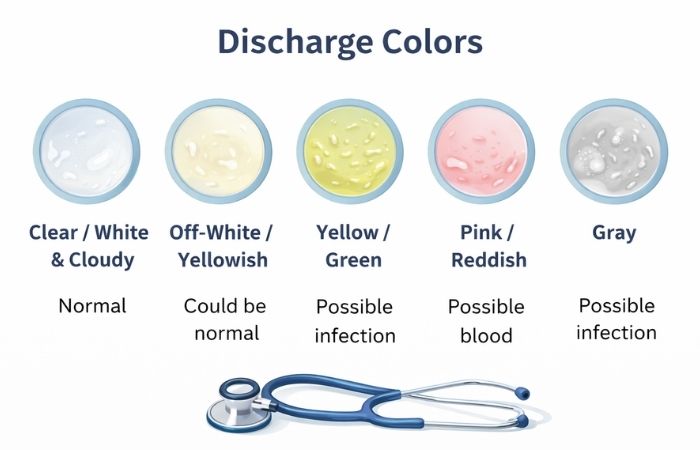
Healthy vaginal discharge can range from clear to milky white. It changes across your cycle. It thickens before a period. It stretches like egg whites around ovulation. That’s biology doing its thing. But bright yellow, neon green, gray, or frothy discharge? That’s your body waving a flag.
Penile discharge follows similar logic. Clear pre-ejaculate is normal. Thick, cloudy, white, or yellow fluid that appears outside of arousal is not. Especially if it shows up in your underwear or when you urinate. That’s not something to “wait out.”
The key difference is sudden change. If your discharge looks, smells, or feels dramatically different than your baseline, your body is signaling that something has shifted. And infections , both common and sexually transmitted , are high on the list.
People are also looking for: STD Shame Almost Killed Me, Here’s What I Wish I Knew
Why Is My Discharge Green?
Green discharge most often points to infection. The green tint usually comes from white blood cells mixing with fluid as your immune system responds to bacteria or parasites. In plain language: your body is fighting something.
The most common sexually transmitted cause of green discharge is gonorrhea. According to the CDC, gonorrhea can cause thick green or yellow discharge from the vagina or penis, often paired with burning during urination or pelvic pain. But here’s the tricky part , not everyone has pain. Some people only notice color.
Another common cause is trichomoniasis, a parasitic infection that often produces frothy, yellow-green discharge with a strong odor. It can also cause itching or irritation, but again, some people have minimal symptoms. That’s why testing matters more than guessing.
If the discharge is green and you’ve had a new sexual partner in the last 2–4 weeks, testing should move from “maybe” to “now.” Waiting increases the risk of spreading infection or developing complications.
What Does Yellow Discharge Mean?
Yellow discharge sits in the gray zone between “maybe normal” and “likely infection.” Pale yellow without odor or discomfort can sometimes be harmless. But darker yellow, mustard-colored, or thick discharge is more suspicious.
Chlamydia often causes yellow discharge that’s lighter than gonorrhea’s typical greenish hue. It may also cause pelvic pain, bleeding after sex, or pain during urination. The difficult truth? Up to 70% of women and 50% of men with chlamydia have no symptoms at all. That means discharge changes may be the only visible clue.
Yellow discharge can also appear with bacterial vaginosis (BV), which is not technically an STD but is often triggered by sexual activity. BV discharge is typically grayish or thin with a strong fishy smell. The smell is often the giveaway.
If the yellow color is paired with odor, itching, pain, bleeding between periods, or discomfort during sex, testing should not be delayed.
STD Discharge vs. BV vs. Yeast , A Side-by-Side Look
It’s easy to spiral when you Google discharge colors. Everything starts to look like everything else. So let’s ground this in something concrete.
| Condition | Discharge Color | Texture | Odor | Other Clues |
|---|---|---|---|---|
| Gonorrhea | Green or yellow | Thick | Mild to strong | Burning urination, pelvic pain |
| Chlamydia | Yellow or cloudy | Thin to slightly thick | Usually mild | Often no symptoms |
| Trichomoniasis | Yellow-green | Frothy | Strong, unpleasant | Itching, irritation |
| Bacterial Vaginosis | Gray or yellow | Thin | Fishy | Often worse after sex |
| Yeast Infection | White | Thick, cottage cheese | Usually none | Severe itching |
Figure 1. Discharge color comparison across common infections.
No table can diagnose you. But if you see green or yellow paired with risk exposure, this stops being a “watch and wait” situation. It becomes a “get tested” moment.
Penile Discharge: When It’s Not Just Irritation
Penile discharge can be easier to ignore because it’s less discussed. A small amount of clear fluid during arousal is normal. But cloudy, white, yellow, or green discharge , especially if it appears without sexual stimulation , is a red flag.
Men with gonorrhea often describe it as “pus-like.” Men with chlamydia may notice milky discharge that’s subtler but persistent. Sometimes there’s burning during urination. Sometimes there’s nothing except the discharge itself.
If discharge appears after a new partner, condom break, or unprotected encounter, testing should happen as soon as symptoms begin. Waiting increases risk of epididymitis and transmission.
When to Get Tested Right Away
Here’s the no-nonsense investigator voice: green or yellow discharge is not something to self-diagnose with over-the-counter yeast treatments. If symptoms started suddenly or follow a recent exposure, testing should happen immediately.
Test right away if:
- Discharge is green, thick yellow, gray, or frothy
- There is burning during urination
- There is pelvic or testicular pain
- You’ve had a new or multiple partners recently
- A partner told you they tested positive
If you’re within 7–14 days of exposure, most gonorrhea and chlamydia tests are reliable. Earlier testing may require a retest to confirm. The important part is starting the process.
If getting to a clinic feels overwhelming, you can use a discreet at-home STD test kit to get clarity quickly and privately. Not because you’re in trouble. Because you deserve answers.
How Soon Is Too Soon to Test?
This is the part most people get wrong. You notice green or yellow discharge on a Tuesday. You had sex the previous Friday. You panic and test the next morning. The result comes back negative. Relief floods in , but it might be premature.
Every infection has a window period. That’s the time between exposure and when a test can reliably detect the infection. Testing too early can produce a false negative, even if symptoms are beginning.
For the infections most associated with green or yellow discharge, gonorrhea, chlamydia, and trichomoniasis, detection is usually reliable between 7 and 14 days after exposure. Some tests may detect earlier, but if you’re inside that first week, a retest is often recommended.
| Infection | Earliest Likely Detection | Most Reliable Testing Window | Retest Recommended? |
|---|---|---|---|
| Gonorrhea | 5–7 days | 7–14 days | If tested before day 7 |
| Chlamydia | 5–7 days | 10–14 days | If tested early or ongoing risk |
| Trichomoniasis | 5–7 days | 7–21 days | If symptoms persist |
| Bacterial Vaginosis | Not STI-timed | Test when symptoms appear | Only if symptoms recur |
Figure 2. General testing window estimates for infections associated with green or yellow discharge.
If you’re symptomatic now, test now , even if it’s early. Just understand that a follow-up test may be needed to confirm.
“I Thought It Was Just BV”
Alice, 27, noticed grayish-yellow discharge about a week after starting to see someone new. “It smelled weird, but not unbearable,” she said. “I assumed it was BV because I’ve had that before.”
She tried over-the-counter treatment. The smell improved, but the discharge turned more yellow-green. Two weeks later, she tested and learned she had trichomoniasis. “I felt embarrassed. But honestly, I was more upset that I waited.”
This is common. BV, yeast, and STDs overlap in presentation. Self-treatment without testing can delay real diagnosis. And untreated infections can increase risk of pelvic inflammatory disease, infertility, and transmission to partners.
The takeaway isn’t shame. It’s speed. If discharge changes color dramatically or doesn’t respond to typical treatments, escalate to testing.
What If There’s No Pain?
One of the most dangerous myths online is that STDs always hurt. They don’t. In fact, chlamydia is often called the “silent infection” because most people have mild or no symptoms. Discharge may be the only visible clue.
Green discharge without pain can still be gonorrhea. Yellow discharge without itching can still be chlamydia. Frothy discharge without severe irritation can still be trichomoniasis.
Pain is not the requirement for testing. Change is.
Discharge After a New Partner: Coincidence or Connection?
If discharge changes within two to four weeks of a new sexual partner, that timing matters. It doesn’t mean someone cheated. It doesn’t mean anyone lied. It simply means bacteria or parasites may have been exchanged.
Many STDs are asymptomatic in carriers. A partner can feel completely healthy and still transmit infection. That’s not betrayal. That’s biology.
If your discharge changed after a new partner, even if condoms were used, testing is the responsible next step. Condoms significantly reduce risk but do not eliminate it entirely.
If privacy or stigma is holding you back, discreet options exist. You can order a Combo STD Home Test Kit that screens for multiple common infections at once. It’s fast, private, and designed for exactly this kind of uncertainty.
When It’s Urgent, Don’t Wait
Some warning signs require immediate medical care and cannot be managed at home.
Go to urgent care if the discharge is associated with any of the following:
- Severe pain in the lower abdomen or pelvis
- Fever above 101°F
- Vomiting
- Fainting
- Swelling of the testicles
- Pain during pregnancy
These symptoms can imply complications such as pelvic inflammatory disease or a more serious infection. Whereas home testing is helpful, these emergency signs require in-person assessment.
What Happens If You Ignore It?
This is the uncomfortable part. Untreated gonorrhea and chlamydia can ascend into the reproductive organs. In women, that can mean pelvic inflammatory disease and infertility. In men, epididymitis and chronic pain are risks. In all genders, ongoing transmission remains possible.
Trichomoniasis increases susceptibility to HIV and can cause pregnancy complications if left untreated. BV, while not an STD, can also raise vulnerability to sexually transmitted infections if chronic.
The point isn’t to scare you. It’s to remind you that discharge is information. And information is power , but only if you act on it.
Testing Options: Clinic vs At-Home
Clinic testing offers comprehensive evaluation and treatment prescriptions in one visit. It’s ideal if symptoms are severe or complicated. But barriers exist , cost, location, scheduling, privacy.
At-home testing offers privacy and speed. Modern rapid tests and mail-in kits use highly sensitive methods to detect common STDs. For many people, this option removes the biggest obstacle: fear of being seen.
If green or yellow discharge is causing anxiety right now, don’t sit with it alone. Visit STD Test Kits to explore discreet testing options. You don’t need to justify wanting clarity.
Can a Test Be Wrong? Understanding False Negatives and Accuracy
Let’s talk about the fear underneath the fear. You test. It’s negative. But the discharge is still there. Now you’re spiraling: What if the test missed it?
No diagnostic tool is perfect. But modern testing for gonorrhea and chlamydia , especially nucleic acid amplification tests (NAATs) , is highly accurate when used inside the proper window period. Accuracy drops when timing is too early or when samples aren’t collected properly.
If you test within five days of exposure, your result may not reflect reality yet. If you wait 7–14 days, accuracy improves significantly. If symptoms persist despite a negative result, retesting or confirmatory clinic testing is smart, not paranoid.
The mistake isn’t testing. The mistake is assuming one early negative is the final word.
“I Feel Dirty” , The Shame Layer No One Talks About
Unusual discharge hits more than the body. It hits identity. People whisper it in message boards: “I feel gross.” “I feel ashamed.” “I feel like I did something wrong.”
Let me be clear in the investigator voice: infections are biological events, not moral verdicts. Bacteria and parasites do not care about your relationship status, your gender, your orientation, or whether it was your first time or your fiftieth.
In the confidant voice: you are not reckless for having sex. You are human. And getting tested is an act of responsibility, not confession.
Talking to a Partner Without Spiraling
If you’re seeing green or yellow discharge and testing is on your radar, you may also be wondering how to bring this up. The anxiety isn’t just about results , it’s about the conversation.
Here’s something grounded: you don’t need to accuse. You don’t need to dramatize. You can say, “I’ve noticed some symptoms, so I’m getting tested to be safe. I just wanted to give you a heads-up.” That’s not blame. That’s maturity.
Many STDs are asymptomatic in one partner and symptomatic in another. That means no one may have known. Framing it as shared health care keeps the conversation constructive.
If It’s Positive: What Happens Next?
Most infections associated with green or yellow discharge are treatable. Gonorrhea and chlamydia are treated with antibiotics. Trichomoniasis is treated with oral medication. Bacterial vaginosis has its own prescription options.
Treatment is usually straightforward. The harder part is the waiting and the anxiety before you know. Once you have a result, the plan becomes clear. And clarity reduces fear dramatically.
If you test positive using an at-home kit, follow-up care can be arranged through telehealth or a local clinic for prescriptions and confirmatory guidance. Testing is the first step, not the last.
Preventing Reinfection: What Actually Works
After treatment, it’s important to avoid sexual contact until you and your partner(s) have completed medication and any recommended waiting period. Reinfection is common when only one partner is treated.
Using condoms consistently reduces risk significantly. Regular screening , especially after new partners , catches infections early before symptoms escalate. And yes, routine testing even without symptoms is normal and recommended for sexually active adults.
Testing is not something you do only when something looks alarming. It’s something you do because your sexual health deserves maintenance, just like dental checkups or physical exams.
FAQs
- 1. Okay, be honest. Why is my discharge green?
- Green discharge usually means your immune system is in fight mode. That color often shows up when white blood cells mix with fluid while battling an infection like gonorrhea or trichomoniasis. It’s not your body being “gross.” It’s your body responding. If it’s bright green, thick, or paired with a new partner in the last couple weeks, that’s your cue to test, not to spiral.
- 2. What does green discharge mean if I feel totally fine?
- Here’s the twist: feeling fine doesn’t cancel out infection. Chlamydia is famous for being quiet. So is early gonorrhea. Discharge might be the only clue you get. No pain. No fever. Just a color shift. When your baseline changes and nothing else explains it, testing is the smart move, even if you’re not doubled over in discomfort.
- 3. Is yellow discharge always bad?
- Not always. Pale yellow around your period? Probably harmless. Thick mustard-colored discharge that showed up suddenly after a new hookup? Different story. The context matters. Color plus odor, burning, pelvic discomfort, or timing after exposure turns “maybe normal” into “let’s check this.”
- 4. It smells weird after sex. Is that automatically an STD?
- Not necessarily. It’s possible for semen to briefly alter the pH of the vagina, causing a slight odor. However, if the odor is heavy, fishy, or persists for several days, especially with a gray or yellow discharge, it could be BV or a possible STI. A one-night smell is not the same as a lingering odor. Duration is what matters.
- 5. Can discharge really be the only symptom?
- Yes. And that’s what throws people off. Many STDs don’t announce themselves with dramatic pain. They whisper. A little color change. Slight texture difference. Maybe spotting after sex. If discharge is the only clue, that’s still enough reason to test. You don’t need a full-body alarm to justify taking care of yourself.
- 6. I already treated it like a yeast infection. Did I mess up?
- You didn’t “mess up.” You made the best guess with the info you had. But yeast infections usually cause thick white discharge and intense itching, not green or bright yellow fluid. If symptoms didn’t improve, or the color looks off, stop self-treating and test. Switching gears quickly is strength, not failure.
- 7. What about penile discharge? I thought that only happened in health class horror stories.
- It happens in real life. Cloudy, white, yellow, or green discharge from the penis, especially outside of arousal, often signals gonorrhea or chlamydia. Sometimes it’s subtle and shows up only in the morning. If it’s new, unexplained, and not pre-ejaculate, it deserves attention. Quiet symptoms are still symptoms.
- 8. We used condoms. So how could this happen?
- Condoms reduce risk dramatically, but they’re not magic force fields. Slippage, breakage, or skin-to-skin contact can still transmit infection. Also, many people carry STDs without knowing it. This isn’t about someone being reckless. It’s about biology doing what biology does. Testing isn’t an accusation, it’s a check-in.
- 9. How soon should I test after noticing the color change?
- If you’re symptomatic now, test now. Most infections linked to green or yellow discharge are detectable within 7–14 days after exposure. If you test very early, you may need a retest for confirmation. Think of it as building certainty, not doubting yourself.
- 10. I’m embarrassed. Is it weird to get tested over discharge?
- Not even a little. Clinics see this every single day. At-home testing exists because so many people feel exactly like you do. There’s nothing dramatic about wanting answers. In fact, getting tested when something feels off is one of the most grounded, responsible things you can do for yourself and your partners.
Color Isn’t the Diagnosis, Timing Is
Green discharge doesn’t automatically mean gonorrhea. Yellow discharge doesn’t automatically mean chlamydia. Gray discharge doesn’t automatically mean BV. But color change paired with exposure risk means it’s time to stop guessing.
The real decision isn’t “Is this definitely an STD?” The real decision is “Do I want certainty or do I want to keep worrying?”
If uncertainty is draining your sleep, discreet answers are available. A Combo STD Home Test Kit screens for multiple common infections at once, giving you clarity without waiting rooms or awkward conversations. Your results are private. Your body is yours.
How We Sourced This Article: This guide was built using current clinical guidelines from the CDC, peer-reviewed infectious disease research, and patient education resources from major health institutions. We reviewed approximately fifteen references to ensure accuracy around symptom presentation, testing windows, and treatment standards. Below are six of the most reader-accessible and authoritative sources that informed this article.