Endometriosis or an STD? Why the Symptoms Feel So Similar
Quick Answer: STDs do not cause endometriosis. Endometriosis is a chronic inflammatory condition driven by hormonal and immune factors, not infections. That overlap creates a predictable pattern. The pain continues.

Quick Answer: STDs do not cause endometriosis. Endometriosis is a chronic inflammatory condition driven by hormonal and immune factors, not infections. STD testing is often used to rule out other causes of pelvic pain, not because STDs create endometriosis.
Why Pelvic Pain So Often Gets Labeled “Maybe an STD”
Endometriosis symptoms don’t announce themselves clearly. They overlap with common sexual health complaints in ways that feel unfair and deeply confusing. Pain during sex, pelvic cramping, abnormal bleeding, urinary pressure, and lower abdominal discomfort all sit at the crossroads between gynecologic conditions and sexually transmitted infections.
That overlap creates a predictable pattern. Someone feels pain, assumes infection, gets tested, receives a negative result, and is told everything looks “normal.” The pain continues. Months pass. Sometimes years. Endometriosis remains undiagnosed, not because it is rare, but because it hides behind symptoms we’ve been taught to associate with STDs.
This confusion is not a personal failure. It’s a system problem, fueled by incomplete education, stigma around sexual health, and the historical minimization of chronic pelvic pain.

What Endometriosis Pain Actually Feels Like (And Why It’s Misread)
Endometriosis occurs when tissue similar to the uterine lining grows outside the uterus, often on the ovaries, fallopian tubes, pelvic walls, or bowel. These lesions respond to hormonal cycles, triggering inflammation, nerve irritation, and pain that can be cyclical or constant.
The problem is that inflammatory pain does not care about categories. To the body, irritation is irritation. The nervous system registers discomfort without labeling its origin. That’s why endometriosis pain can feel sharp, burning, heavy, or sore in ways that resemble infection-related symptoms.
Many people describe the pain as “deep,” especially during or after sex. Others feel pressure that radiates into the lower back or thighs. Some experience urinary urgency or bowel discomfort that mimics bladder or gastrointestinal infections. None of these sensations are specific to endometriosis, which is exactly why confusion happens.
The STD Myth: Where the Fear Comes From
The idea that an STD might have “caused” endometriosis doesn’t come from science. It comes from fear layered on top of delayed answers. When someone lives with unexplained pelvic pain for years, the mind searches for a concrete cause. Infections feel tangible. They have names. They feel blameable.
Sexual health stigma amplifies this fear. People are subtly taught that pain tied to sex must be punishment for something. That narrative is powerful, and it sticks even when test results say otherwise.
In clinical reality, STDs and endometriosis are separate conditions. They can coexist in the same body, but one does not transform into the other. In rare cases, untreated infections can lead to pelvic inflammatory complications that also cause pain, but that process is distinct from endometriosis and does not create endometrial lesions.
Why Doctors Still Order STD Tests During Endometriosis Workups
For many patients, one of the most emotionally confusing moments is being tested for STDs while seeking answers for chronic pelvic pain. It can feel accusatory, dismissive, or irrelevant. But in most cases, the intent is procedural, not judgmental.
Clinicians are trained to rule out common, treatable causes of pelvic pain first. Sexually transmitted infections are on that list because they are diagnosable through relatively simple tests. A negative result does not mean the pain is imagined. It means one possibility has been responsibly excluded.
For patients, this step can still sting. That emotional response matters. Testing should be framed as clarity, not suspicion. As a step toward answers, not away from them.
No, STDs Do Not Cause Endometriosis, Here’s the Science Behind That
This needs to be said plainly, because so many people have never heard it said clearly: sexually transmitted infections do not cause endometriosis. There is no biological mechanism by which an infection turns into endometrial-like tissue growing outside the uterus.
Endometriosis is classified as a chronic inflammatory condition with hormonal, immune, genetic, and possibly developmental origins. It behaves more like an autoimmune-adjacent disorder than an infectious disease. That distinction matters, especially for people who have spent years wondering if something they did caused what their body is doing.
In medical literature, endometriosis is not described as infectious, contagious, or sexually transmitted. It does not originate from bacteria or viruses. It cannot be “caught,” and it cannot be prevented by condoms or antibiotics. The pain may show up during sex, but sex is not the cause.
What Actually Causes Endometriosis (What We Know So Far)
Despite how common endometriosis is, its exact cause is still being studied. What researchers do know is that it develops through internal biological processes, not external infections. Several overlapping theories help explain how endometriosis forms and why it behaves the way it does.
One leading explanation involves retrograde menstruation, where menstrual fluid flows backward through the fallopian tubes into the pelvic cavity. While this happens in many people, only some develop endometriosis, suggesting that immune system response plays a major role in whether displaced cells implant and grow.
Other research points to immune dysfunction, where the body fails to recognize and clear misplaced endometrial-like cells. Hormonal sensitivity, particularly to estrogen, fuels inflammation and lesion growth. Genetic predisposition also appears significant, as endometriosis often runs in families.
None of these pathways involve infection. They are internal, systemic processes. That distinction is critical for separating medical reality from cultural myths.
Inflammation Does Not Mean Infection
One of the biggest reasons endometriosis is confused with STDs is the word inflammation. In everyday language, inflammation is often associated with infection. In medicine, that association is incomplete.
Endometriosis causes inflammation because misplaced tissue triggers an immune response. This response leads to swelling, nerve sensitization, scarring, and pain. It is sterile inflammation, meaning no pathogen is involved. Antibiotics do not treat it, and tests for infection often come back negative.
This is also why some people feel dismissed after repeated STD tests show nothing wrong. The pain is real, but the tool being used to look for it is the wrong one. Inflammation without infection is harder to diagnose, slower to validate, and historically easier to ignore.
Where Fertility Fear Enters the Story
For many people, the fear that an STD caused endometriosis is deeply tied to fertility anxiety. The thought pattern often goes like this: pelvic pain leads to fears of infection, infection leads to fears of damage, and damage leads to fears of infertility.
This mental chain feels logical, but it collapses under scrutiny. While endometriosis can affect fertility for some people, it does so through inflammation, adhesions, and altered pelvic anatomy, not through infection-related scarring caused by STDs.
Importantly, many people with endometriosis conceive without intervention. Others need support. Both realities can exist at the same time without blame attached. Fertility outcomes in endometriosis are variable, and they are not moral verdicts on past sexual health decisions.
Why the “Old STD Ruined My Body” Narrative Is So Harmful
The belief that a past infection permanently damaged the body is emotionally heavy. It can lock people into cycles of shame, regret, and self-surveillance. For those with endometriosis, this narrative often replaces a more accurate understanding with unnecessary guilt.
Endometriosis is not evidence of neglect, promiscuity, or failure to protect oneself. It is a medical condition that often begins silently, long before symptoms prompt testing or concern. Many people are diagnosed years after their first symptoms appear, regardless of their sexual history.
Letting go of the infection narrative does not mean ignoring sexual health. It means placing responsibility where it belongs: on biology, not behavior.
Testing as Clarity, Not Confession
STD testing still plays a role in pelvic pain evaluation, and that role can be valid without being accusatory. Testing helps clinicians rule out treatable conditions and narrow the diagnostic path. It is a tool, not a verdict.
For patients, reframing testing as information rather than implication can be powerful. A negative test result does not close the case. It opens space to push for deeper investigation, imaging, referrals, and ultimately, an endometriosis-informed approach.
Knowing what something is not can be just as important as knowing what it is.
Why Endometriosis Is So Often Missed, Delayed, or Dismissed
Endometriosis has one of the longest diagnostic delays of any common medical condition. Many patients wait years between their first symptoms and an official diagnosis. During that time, pain is frequently minimized, normalized, or attributed to less complex explanations.
Pelvic pain that doesn’t show up clearly on routine exams creates uncertainty. When imaging looks normal and infection tests are negative, clinicians sometimes default to reassurance rather than escalation. The absence of an obvious cause becomes, incorrectly, evidence that the pain is not serious.
This gap between symptoms and validation is where endometriosis hides. Not because it is invisible, but because it does not fit neatly into fast diagnostic pathways.
How STD Assumptions Become a Diagnostic Detour
When pelvic pain overlaps with sexual health symptoms, the clinical pathway often starts with STD testing. That step is reasonable. The problem arises when the process stops there.
A negative test can be treated as closure rather than information. Patients are sometimes told everything is fine because nothing infectious was found. Meanwhile, the underlying inflammatory condition continues to progress unchecked.
This is not about blaming providers or patients. It is about recognizing how limited frameworks can slow recognition of complex conditions. Endometriosis does not announce itself through a single lab result. It requires persistence, pattern recognition, and often, patient advocacy.
“All Your Tests Are Normal”, And Why That Can Be Misleading
Few phrases feel as invalidating to someone in chronic pain as “all your tests are normal.” What that usually means is that the tests performed did not detect infection, tumors, or structural abnormalities visible on standard imaging.
Endometriosis lesions are often small, scattered, or located in places that are difficult to visualize. Ultrasounds and MRIs can miss them entirely. Blood tests rarely show anything definitive. This leads to a false sense of reassurance that everything must be fine.
Normal test results do not negate lived experience. They simply signal that a different investigative approach may be needed.
How Long Diagnosis Delays Really Last
Many people are shocked to learn that the average delay for an endometriosis diagnosis spans several years. Symptoms often begin in adolescence or early adulthood, long before anyone considers a chronic inflammatory explanation.
During this time, patients may cycle through explanations: stress, digestive issues, infections, anxiety, hormonal fluctuations. Each explanation feels plausible in isolation. Together, they form a pattern that is easy to overlook without continuity of care.
Sexual health stigma compounds this delay. When pain is linked to sex, patients may hesitate to push for deeper answers, fearing judgment or dismissal. Silence becomes another barrier.
Advocating for Yourself Without Being Labeled “Difficult”
Self-advocacy does not require confrontation. It requires clarity. Keeping track of symptom patterns, cycle timing, pain triggers, and response to treatments can transform a vague complaint into a compelling clinical picture.
Using specific language helps. Describing pain as cyclical, deep, worsening over time, or interfering with daily function communicates urgency more effectively than simply saying it hurts. Naming how symptoms affect work, relationships, and mental health reframes the issue as functional, not emotional.
Requesting referrals, second opinions, or specialist evaluations is not an overreaction. It is a reasonable response to persistent pain without explanation.
Letting Go of Blame to Make Room for Answers
Many people arrive at endometriosis diagnosis carrying years of internalized blame. They wonder if they missed something, waited too long, or caused their condition through past choices. This emotional weight can make advocacy harder, not easier.
Releasing the idea that pain must have a moral origin creates space for curiosity instead of shame. Endometriosis is not something you earn. It is something that happens.
Understanding that STD testing was a step, not a verdict, can help reframe the journey. Each ruled-out cause brings you closer to the right explanation, even if the path feels unfairly long.
Where STD Testing Fits (And Where It Doesn’t)
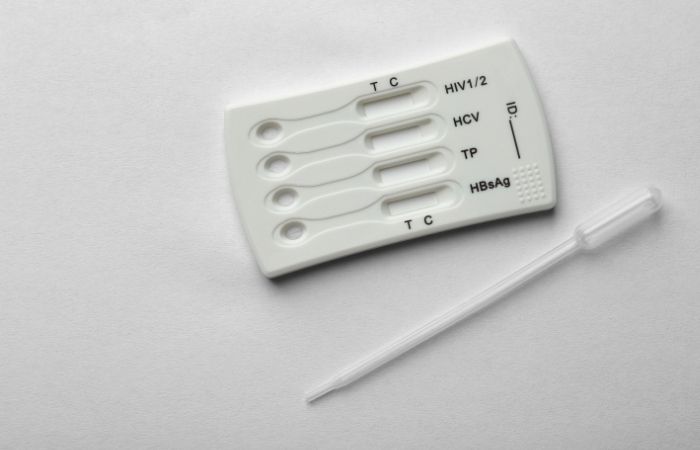
STD testing has a limited but legitimate role when someone presents with pelvic pain, painful sex, or abnormal bleeding. It helps rule out infections that can be treated quickly and prevents clinicians from missing time-sensitive conditions. What it cannot do is explain chronic, cyclical, or progressive pain when results are consistently negative.
If you’ve had STD testing and your pain persists, that information matters. Negative results are not the end of the conversation. They are evidence that the cause likely lies elsewhere, and endometriosis should move higher on the list of possibilities.
Testing is not an accusation. It is a filter. Once infection is filtered out, deeper investigation is not only appropriate, it is necessary.
What to Do If Your Tests Are Negative but the Pain Continues
Persistent pelvic pain deserves follow-up, regardless of test results. If symptoms repeat month after month, worsen over time, or interfere with daily life, they warrant escalation.
This escalation may include referral to a gynecologist familiar with endometriosis, advanced imaging, or discussion of diagnostic laparoscopy in select cases. None of these steps require you to prove that your pain is real. The duration and pattern of symptoms are evidence enough.
If you feel stuck, it can help to clearly state what has already been ruled out. Saying “infection has been ruled out, but the pain is ongoing and cyclical” reframes the conversation and redirects attention toward inflammatory and hormonal causes.
FAQs
- 1. Can chlamydia or gonorrhea turn into endometriosis?
- No. And this is one of those fears that sticks around because it sounds like it could be true. Chlamydia and gonorrhea are infections. Endometriosis is not. One does not morph into the other, no matter how long ago an infection happened or how bad the pain feels now.
- 2. If STDs don’t cause endometriosis, why do the symptoms feel so similar?
- Because pain doesn’t come with labels. Deep pelvic pain, burning, pressure, spotting, painful sex, your nervous system reports distress, not its origin story. Endometriosis causes inflammation and nerve irritation, which can feel eerily similar to infection, even when no infection is present.
- 3. My STD tests were negative. Why does my doctor still seem unsure?
- Because ruling something out isn’t the same as ruling everything out. A negative test tells you what the problem is not. Endometriosis doesn’t show up on standard labs, and it often hides from imaging. Uncertainty here isn’t incompetence, it’s a sign the case needs a different lens.
- 4. Why did I feel embarrassed when my doctor ordered STD tests?
- Because sexual health still carries unnecessary baggage. Even when testing is routine and medically appropriate, it can feel personal. That reaction is emotional, not irrational. Testing is supposed to clarify the picture, not cast judgment on how you live your life.
- 5. Can endometriosis really cause pain during or after sex?
- Yes, and it’s one of the most common reasons people start questioning STDs in the first place. Endometriosis pain is often described as deep, internal, or lingering. It’s not surface irritation. It’s tissue reacting where it shouldn’t be.
- 6. If antibiotics didn’t help my pain, does that mean it’s not an infection?
- Usually, yes. Antibiotics don’t touch endometriosis. If symptoms stayed the same after treatment, that’s a clue, not a failure. It suggests inflammation rather than infection.
- 7. I had an STD years ago. Could that still be affecting me now?
- It’s understandable to wonder, but endometriosis does not work that way. Past infections do not “seed” endometriosis later in life. The timing overlap is coincidence, not cause.
- 8. Does endometriosis always mean infertility?
- No. This is one of the most damaging myths out there. Some people with endometriosis struggle to conceive. Many do not. Fertility outcomes vary widely, and they are not punishments for delayed diagnosis or past health issues.
- 9. Why does it take so long to get an endometriosis diagnosis?
- Because the condition doesn’t play fair. Symptoms overlap with many others. Pain is often normalized. Imaging can miss lesions. And historically, chronic pelvic pain hasn’t been taken as seriously as it should be. None of that is your fault.
- 10. Is it okay to push for more answers even if tests keep coming back normal?
- Yes. Persisting pain deserves persistence in care. Asking for referrals, second opinions, or deeper evaluation isn’t being dramatic. It’s responding appropriately to a problem that hasn’t been solved yet.
You Deserve Answers Without Blame
If you came to this question carrying fear that an STD caused your pain, you are not alone. That fear is common, understandable, and reinforced by how pelvic pain is often discussed. But it is not supported by science.
Endometriosis is real. Its pain is real. And it does not require a story of fault to justify care. Testing can be part of the process without defining it. Ruled-out causes are not failures. They are steps toward clarity.
You deserve to be believed, investigated thoroughly, and supported without shame.
This article was informed by current gynecologic guidelines, peer-reviewed research on endometriosis, and patient-centered reporting on diagnostic delay and stigma. Around fifteen reputable sources shaped the analysis; below, we’ve highlighted some of the most relevant and reader-friendly sources.