Watery Discharge: Is It Normal, BV, or an STD?
Quick Answer: Watery discharge is generally considered a normal condition that is associated with ovulation or hormone changes. In order to be certain, testing is necessary.
Quick Answer: Watery discharge is generally considered a normal condition that is associated with ovulation or hormone changes. However, in cases where there is a strong odor, unusual color, pain in the pelvic area, or recent exposure to sex, it could be a symptom of bacterial vaginosis or an STD, including chlamydia or trichomoniasis. In order to be certain, testing is necessary.
This Might Be Completely Normal (Even If It Feels Alarming)
Your vagina is not supposed to be dry. It’s a self-cleaning, hormone-responsive organ that shifts texture and volume throughout your cycle. Around ovulation, estrogen rises and cervical mucus becomes thinner, stretchier, and more fluid. That “watery discharge before period” search you typed? It’s often ovulation discharge doing exactly what it’s meant to do.
According to guidance from the NHS on vaginal discharge, clear or white discharge without strong odor, itching, or pain is typically normal. It may increase after exercise, during pregnancy, when starting birth control, or even during stress. Yes, stress can shift your vaginal ecosystem. Bodies are dramatic like that.
Here’s the part no one tells you: normal discharge can sometimes be surprisingly watery. It can soak underwear. It can feel like you started your period early. That alone does not equal infection.

When Watery Discharge Is Hormone-Driven
Think of discharge as a monthly weather report. Around ovulation, it becomes thinner to help sperm travel. After ovulation, progesterone rises and discharge may thicken. Right before your period, it can become lighter or slightly watery again. These shifts are cyclical and predictable once you start paying attention.
Ovulation discharge is usually:
| Feature | Hormonal (Normal) Discharge |
|---|---|
| Color | Clear or milky white |
| Texture | Watery to stretchy |
| Odor | Mild or neutral |
| Itching/Burning | None |
| Pelvic Pain | None (aside from possible mild ovulation twinge) |
Figure 1. Typical features of hormone-driven watery discharge.
If you read that and exhaled, good. That’s your nervous system realizing this might not be catastrophic. But we’re not done. Because watery discharge can also show up when the vaginal microbiome gets disrupted.
When It’s Bacterial Vaginosis (BV), The Subtle Shift
Bacterial vaginosis isn’t technically an STD, but it is linked to sexual activity. It happens when the balance of “good” lactobacilli bacteria in the vagina drops and other bacteria overgrow. The discharge can be thin. Sometimes watery. Sometimes grayish. Often with a noticeable fishy smell, especially after sex.
The CDC’s BV fact sheet explains that BV may cause discharge that is thin and gray or white, with a strong odor. Some people have no itching at all. That’s what makes it confusing. You can have watery discharge but no irritation and still have BV.
Here’s a real-world scenario I hear constantly:
“It wasn’t chunky like yeast. It wasn’t green. It was just thin and smelled… off. I kept telling myself it was normal until my partner mentioned it.”
BV discharge often differs from normal discharge in subtle but important ways.
| Feature | Normal | Bacterial Vaginosis |
|---|---|---|
| Color | Clear/white | White or gray |
| Texture | Watery to stretchy | Thin, sometimes watery |
| Odor | Mild | Fishy, stronger after sex |
| Itching | None | Usually minimal |
| Triggered After Sex? | No consistent pattern | Often yes |
Figure 2. Comparison of normal discharge and bacterial vaginosis.
BV is treatable. But here’s why it matters beyond discomfort: BV can increase susceptibility to STDs like chlamydia and gonorrhea. So if watery discharge appears alongside a new sexual partner, testing becomes more important, not because you did something wrong, but because you deserve certainty.
When Watery Discharge Could Be an STD
Now let’s talk about the part that makes your chest tighten. Certain STDs can cause increased discharge that may appear thin or watery, especially in early stages. The frustrating reality? Many STDs cause very mild or no symptoms at all.
Chlamydia is notorious for being quiet. According to the CDC chlamydia overview, most women have no symptoms. When symptoms do appear, they can include abnormal discharge that may be thin and increased in amount.
Gonorrhea may cause yellowish or slightly watery discharge, sometimes paired with pelvic pain or bleeding between periods. Trichomoniasis, on the other hand, more often causes frothy or yellow-green discharge, but mild cases can appear thinner and less obvious.
This is why symptom-checking alone isn’t enough. Watery discharge plus any of the following increases suspicion:
- New sexual partner within the last 2–8 weeks
- Pelvic or lower abdominal pain
- Burning with urination
- Bleeding after sex
- Strong odor change
Even then, none of these signs confirm anything. They simply shift the probability.
If you’re in that gray zone, watery discharge but no smell, no itching, just anxiety, the most stabilizing move is data. Not guesswork. Not Reddit threads. Actual testing.
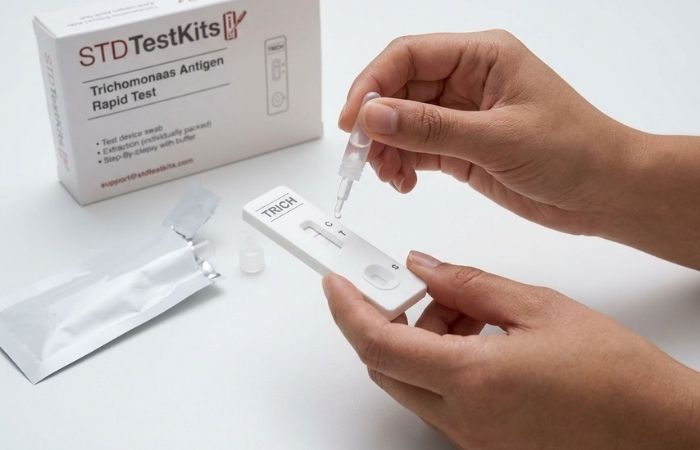
You can explore discreet, at-home options at STD Test Kits. For broader screening, a combo test kit can check for multiple common infections at once, giving you answers without a waiting room or awkward conversation.
The Timing Tells a Story Your Discharge Alone Can’t
Here’s what most symptom checkers miss: discharge without context is almost meaningless. Timing is what sharpens the picture. When did you last have sex? Was it protected? Was there a condom slip? Did symptoms start three days later, or three weeks later?
Hormonal discharge follows a cycle. STD-related discharge follows exposure. Those are two very different timelines, and confusing them is what keeps people spiraling.
Let’s break that down in a way your nervous system can actually use.
| Scenario | More Likely Hormonal | More Concerning for Infection |
|---|---|---|
| Mid-cycle (10–16 days before period) | Yes, common ovulation discharge | Unlikely unless other symptoms present |
| 2–7 days after new sexual partner | Possible but less likely | Consider gonorrhea or trichomoniasis |
| 1–3 weeks after exposure | Unlikely hormonal shift | Consider chlamydia or early pelvic infection |
| No recent sexual activity | Very likely hormonal | More likely BV than STD |
| Strong odor change | Rare | Common with BV or some STDs |
Figure 3. Discharge timing patterns: hormone-driven vs infection-related.
The body leaves breadcrumbs. You just have to line them up properly.
“But I Have Watery Discharge and No Smell”
This is the most common 2AM search phrase. Watery discharge but no smell. No itching. No pain. Just more wetness than usual. And the fear that you’re ignoring something important.
If there is no odor change, no pelvic pain, no burning with urination, and no recent high-risk exposure, the probability leans heavily toward normal hormonal variation. That’s not dismissive. That’s statistical reality. According to epidemiological data summarized in the World Health Organization STI fact sheet, many STIs are asymptomatic, but when symptoms do occur, they often involve pain, bleeding changes, or odor shifts in addition to discharge.
Watery discharge alone, without other red flags, is usually not how infections introduce themselves.
But here’s the nuance: anxiety doesn’t respond to “usually.” It responds to certainty. And certainty comes from testing, not guessing.
“I Thought It Was Just Ovulation”
Marissa, 24, noticed increased watery discharge about two weeks after a new partner. It didn’t smell. It didn’t itch. She assumed it was ovulation. She almost ignored it.
“I kept telling myself I was overreacting. It was clear. No odor. I felt fine.”
But something nagged at her. She ordered a discreet combo panel online instead of waiting weeks for a clinic appointment. Her test came back positive for chlamydia. No dramatic symptoms. Just subtle discharge.
The lesson here isn’t panic. It’s pattern recognition. Hormonal discharge follows predictable timing. Infection-related discharge often follows exposure. If you overlay your cycle with your sexual timeline and something doesn’t match, that’s your cue to test.

How Soon Should You Test for STD-Related Discharge?
This is where people accidentally sabotage themselves: testing too early. If you test before the window period closes, you can get a false negative. That doesn’t mean you’re safe. It means your body hasn’t produced detectable markers yet.
Here’s a simplified window guide for common infections linked to discharge:
| Infection | Earliest Reliable Testing Window | Peak Accuracy |
|---|---|---|
| Chlamydia | 7 days after exposure | 14 days+ |
| Gonorrhea | 5–7 days after exposure | 14 days+ |
| Trichomoniasis | 7–14 days after exposure | 2–4 weeks |
| BV (not an STD) | When symptoms appear | Anytime symptomatic |
Figure 4. Testing windows for discharge-associated infections.
If it’s been less than five days since exposure, you may need to wait before testing for accuracy. If it’s been over two weeks, you’re in a more reliable window for common bacterial STDs.
This is where proactive action feels grounding instead of frantic. Instead of obsessing over toilet paper checks, you set a date. You test. You get answers.
At-Home Testing vs Clinic Testing for Discharge Concerns
Some people prefer a clinic because they want an exam. Others want privacy, speed, and zero small talk. Both are valid.
At-home testing has become increasingly accurate, especially for infections like chlamydia and gonorrhea, which are commonly detected using nucleic acid amplification testing (NAAT), considered highly sensitive according to the CDC STI treatment guidelines.
If watery discharge is your only symptom and you want clarity quickly, a multi-panel option can rule out the most common bacterial causes in one go. A discreet combo STD home test kit allows you to screen for several infections privately, which can reduce the emotional drag of waiting.
This isn’t about assuming the worst. It’s about reducing uncertainty. Because uncertainty is what actually keeps you up at night.
When Discharge Is Paired With Pain or Bleeding
If watery discharge comes with lower abdominal pain, fever, pain during sex, or bleeding between periods, that’s no longer a casual watch-and-wait scenario. That constellation of symptoms can suggest ascending infection, including pelvic inflammatory disease (PID), which can develop from untreated chlamydia or gonorrhea.
That doesn’t mean this is happening to you. It means symptoms cluster for a reason. When multiple red flags show up together, urgency increases. Clinic evaluation becomes more important.
Most watery discharge cases are not emergencies. But discharge plus systemic symptoms deserves faster action.
If Your Test Is Positive, Here’s What Actually Happens Next
First: breathe. A positive result for chlamydia, gonorrhea, or trichomoniasis is not a moral verdict. It’s a medical diagnosis. These are common, treatable infections. According to the CDC STI surveillance reports, millions of new bacterial STI cases are reported each year in the United States alone. You are not rare. You are not reckless. You are human.
Most bacterial STDs that cause watery or increased discharge are treated with antibiotics. Treatment is typically short-course and highly effective when taken as prescribed. The key is completing medication fully and avoiding sexual contact until cleared, even if symptoms disappear quickly.
“I expected it to be this huge dramatic ordeal,” one patient told me. “But it was literally a prescription, a follow-up reminder, and that was it.”
The emotional buildup is often worse than the treatment itself.
BV vs STD Treatment, Why It Matters
Bacterial vaginosis is treated differently than STDs. It’s usually managed with antibiotics like metronidazole or clindamycin, but partner treatment isn’t always required unless symptoms recur. By contrast, infections like chlamydia and gonorrhea require partner notification and treatment to prevent reinfection.
The CDC treatment guidelines emphasize retesting three months after certain infections like chlamydia because reinfection rates are significant. That’s not about distrust. It’s about biology and exposure patterns.
Here’s the high-level difference:
| Condition | Treated With | Partner Needs Treatment? | Retest Recommended? |
|---|---|---|---|
| Bacterial Vaginosis | Antibiotics | Not routinely | If symptoms return |
| Chlamydia | Antibiotics | Yes | 3 months |
| Gonorrhea | Antibiotics (specific regimen) | Yes | 3 months |
| Trichomoniasis | Antibiotics | Yes | 3 months (especially women) |
Figure 5. Treatment and retesting differences between BV and common discharge-related STDs.
This is why guessing based on discharge alone is risky. The management paths diverge quickly once you know what you’re dealing with.
How to Tell a Partner Without Imploding
This is the part that keeps people frozen. Not the antibiotics. Not the follow-up. The text message. The phone call. The awkward pause.
You do not need a dramatic speech. You need clarity and neutrality. Something like:
“Hey, I tested positive for something that’s treatable. You should get tested too so we both stay healthy.”
That’s it. No blame. No interrogation. Just information. Many public health departments even provide anonymous partner notification tools if you prefer not to have that conversation directly.
Testing isn’t an accusation. It’s maintenance. Just like dental cleanings or blood pressure checks.
If Your Test Is Negative, But the Discharge Continues
First, that negative test is important in that it significantly lowers your chances of getting common bacterial STDs, especially if you took it within the proper window period. That alone should help calm your fear response.
If there is discharge, but no infection, then it could be caused by:
- Changes in hormones
- Changes in birth control
- Changes in your body related to stress
- The presence of mild BV that was not detected in your test
- Non-infectious irritation in your vagina
The vagina is a sensitive environment, and soap, new lubricants, exposure to semen, or even strenuous exercise can affect fluid production.
If your symptoms persist past one full cycle or worsen, then it is advisable to seek medical attention to check for less common infections. Watery discharge, however, with negative test results for STDs, should work itself out on its own.
When You’re Not Sure Whether to Test Again
Retesting depends on three factors: timing, exposure, and symptom evolution.
If you tested too early (under 7 days for bacterial STDs), retesting at the 14-day mark provides stronger reassurance. If you completed treatment, retesting at three months ensures reinfection hasn’t occurred. If new exposure happened, the clock resets.
If you want broader peace of mind rather than chasing one infection at a time, you can explore multi-infection screening through STD Test Kits. A discreet panel allows you to step out of the guessing cycle and into actual data.
Peace of mind isn’t dramatic. It’s practical.
FAQs
- 1. Okay, seriously, is watery discharge actually normal?
- Most of the time? Yes. Especially if it’s clear, doesn’t smell strong, and shows up mid-cycle. Your body increases fluid around ovulation on purpose. It’s not random. It’s biology doing logistics. If nothing else feels off, your vagina may just be running its usual monthly program.
- 2. But what if it’s way more than usual and soaking my underwear?
- Volume alone doesn’t equal infection. Some cycles are just wetter. Stress, arousal changes, starting or stopping birth control, all of that can shift output. The red flags aren’t “a lot.” The red flags are odor, pain, bleeding between periods, or recent exposure that doesn’t line up with your cycle.
- 3. I have watery discharge but zero smell. Doesn’t BV always smell?
- Classic bacterial vaginosis often has a fishy odor, especially after sex. If there’s no scent shift at all, BV becomes less likely, not impossible, but less likely. Odor is one of BV’s calling cards. When that’s missing, hormones move higher up the suspect list.
- 4. Can chlamydia really be that subtle?
- Unfortunately, yes. Chlamydia is quiet. Sometimes almost annoyingly so. Some people feel nothing at all. Others notice a slight increase in discharge and assume it’s ovulation. That’s why timing matters. If watery discharge appears one to three weeks after a new partner, that’s when testing becomes smart, not dramatic.
- 5. If I just had sex yesterday and now I’m noticing discharge, is that too fast for an STD?
- Usually, yes. Most bacterial STDs have a window period of several days to a couple of weeks before symptoms show. Discharge the next day is more likely semen mixing with natural fluids or simple friction-related changes. If anxiety is loud, set a testing reminder for the appropriate window instead of spiraling immediately.
- 6. What if my test is negative but I still feel “different” down there?
- A negative test taken at the right time is powerful information. It dramatically lowers the likelihood of common bacterial STDs. If discharge continues, it’s often hormonal or mild microbiome imbalance. Track it for one full cycle. Patterns are revealing. Bodies love patterns.
- 7. Can stress really make discharge change, or is that just something people say?
- Stress absolutely messes with hormones. Hormones influence cervical mucus. So yes, indirectly, stress can increase watery discharge. It doesn’t create infection, it just tweaks the environment. Think of it as your nervous system tugging on your endocrine system, which then taps your reproductive system on the shoulder.
- 8. When should I stop Googling and just test?
- If it’s been more than 7–14 days since a new or unprotected sexual encounter and you’re still unsure, test. If discharge is paired with pelvic pain, burning when you pee, bleeding after sex, or a noticeable odor shift, test. Testing replaces guesswork with data. And data is calmer than speculation every single time.
- 9. Is it overkill to use a combo STD test if I only have one symptom?
- Not at all. Many infections overlap in presentation, and discharge alone can’t pinpoint the cause. A combo panel simply checks the common possibilities at once. It’s efficient, not paranoid. Think of it like running multiple labs instead of testing one vitamin at a time.
- 10. Am I overreacting for even worrying about this?
- No. You’re paying attention to your body. That’s not overreacting. That’s self-awareness. The goal isn’t to eliminate concern, it’s to convert it into informed action. Watch for patterns. Line up timing. Test when appropriate. Then move forward with facts instead of fear.
You Deserve Answers, Not Assumptions
Watery discharge lives in that uncomfortable gray space between normal and maybe-not. And gray spaces are where anxiety grows. But your body is not betraying you. It’s signaling, adjusting, cycling, responding.
If your discharge follows your cycle, has no odor, and isn’t paired with pain, it’s likely hormonal. If it follows exposure, smells different, or comes with other symptoms, testing brings clarity. You don’t need to guess. You don’t need to spiral.
Don’t wait and wonder, get the clarity you deserve. 6‑in‑1 At‑Home STD Test Kit checks for the most common STDs discreetly and quickly, so you can move from fear to facts.
How We Sourced This Article: This guide was built using current guidance from the CDC, WHO, NHS, and peer-reviewed research on vaginal discharge and sexually transmitted infections. We reviewed approximately fifteen medical and clinical sources, along with lived-experience reporting, to ensure accuracy, clarity, and emotional relevance. Only the most authoritative and reader-friendly sources are listed below. All external links open in a new tab for verification.