Can You Get Affordable STD Testing Without Insurance in the US?
Yes, and for most Americans, the cost is far lower than they expect. Costs range from $0 at public facilities to $18.
Yes, and for most Americans, the cost is far lower than they expect. The three main routes are: free public clinics through county health departments, Title X programs, and Federally Qualified Health Centers; sliding-scale facilities like Planned Parenthood, where cost is based on income; and at-home rapid test kits with fixed pricing and no hidden fees. Costs range from $0 at public facilities to $18.99 and up for at-home kits, a fraction of what urgent care charges without insurance; for a broader breakdown of every route, see our guide to STD testing costs in the US.
The assumption that STD testing requires a doctor's visit, a co-pay, and a health insurance card is one of the most persistent myths in American sexual health. The reality is that according to Planned Parenthood, STD testing in the US can cost anywhere from completely free to around $250, and for people without insurance, the path to the lower end of that range is more straightforward than most expect. This article lays out every real option available to uninsured Americans, what each one actually costs, and how to choose the right one based on your situation, your location, and how quickly you need answers.
If cost or lack of insurance has ever made you put off STD testing, this is the article to read. The decision to test is the right one. The question is just where to go.
Why So Many Uninsured Americans Skip STD Testing, And Why That's Changing
You get a notification from a recent partner. Or you notice something slightly off after a hookup and spend three days convincing yourself it's probably nothing. Eventually, the question becomes unavoidable: you need to get tested. Then comes the second thought: you don't have insurance, and you assume that means you can't afford it. That assumption leads a significant number of Americans to delay or skip testing entirely, and the downstream consequences are real.
Cost is consistently cited as one of the top barriers to STD testing in the United States. The fear isn't entirely irrational; urgent care visits for STD panels routinely run $200–$400 without insurance before lab fees hit. But the urgent care center is only one slice of the testing landscape, and it happens to be the most expensive one. The rest of the map looks very different.
The good news is that the infrastructure for affordable and free STD testing in the US is genuinely extensive. The federal government funds thousands of clinics specifically to serve people without insurance. State and county health departments offer testing at little or no cost. And at-home rapid test kits have entered the picture as a clinically validated, fixed-price option that eliminates the clinic entirely. According to the CDC's 2024 provisional STI surveillance data, more than 2.2 million cases of chlamydia, gonorrhea, and syphilis were reported in the US that year, and the overall STI burden remains 13% higher than it was a decade ago. That scale makes accessible testing not a luxury but a public health necessity. The system has responded accordingly, even if it doesn't always advertise itself well.
The shift happening right now is that at-home rapid testing has made the question of where to go for testing genuinely competitive. For many uninsured Americans, a rapid test kit ordered online, with results in fifteen to twenty minutes and no clinic visit, now represents not just the most private option but often the most affordable one too. Understanding the full landscape means understanding all of it: public programs, safety net clinics, and at-home options side by side, including the real cost difference between clinic and at-home STD testing.
Where to Get Free STD Testing Without Insurance Near You
There is a layered system of federally and state-funded facilities in the US that exists specifically to make STD testing accessible to people without insurance. Most Americans have never had to use it, which means most Americans don't know it's there. Here's how the main tiers break down.
County and state health departments are the most consistently overlooked resource. Public health departments in most US counties offer STD testing at significantly reduced cost or completely free, regardless of insurance status. HIV and syphilis testing are frequently offered free to anyone who walks in. Testing for chlamydia, gonorrhea, and hepatitis is typically available on a sliding scale, meaning your cost is calculated based on your household income. In many cases, someone with a low income will pay nothing at all. Wait times and appointment availability vary considerably by location, and some health departments have limited hours, but the price point is unmatched.
Federally Qualified Health Centers (FQHCs) operate under a federal mandate to serve patients regardless of ability to pay. There are over 1,400 FQHC organizations operating more than 14,000 service delivery sites across the US, in urban, suburban, and rural areas. They use a sliding fee scale tied directly to federal poverty level guidelines: patients at or below 100% of the federal poverty level receive care at no cost, and fees scale up from there for higher income levels. For a single person earning around $15,000 a year or less, STD testing at an FQHC is effectively free. You can find the nearest FQHC using the Health Resources and Services Administration's clinic finder at findahealthcenter.hrsa.gov.
Title X family planning clinics are the third major pillar of the free-and-low-cost testing system. Title X is the only federal program in the US dedicated solely to family planning and related preventive health services, including STI and HIV testing. According to the HHS Office of Population Affairs, there are more than 4,000 Title X clinics operating across all 50 states, providing services on a free or sliding-scale basis with priority given to low-income and uninsured patients. According to the Guttmacher Institute, 27% of all Title X clients in 2023 were uninsured, and 60% qualified for free services because their income fell at or below 100% of the federal poverty level. You can locate the nearest clinic at reproductivehealthservices.gov.
| Facility Type | Typical Cost (No Insurance) | Income-Based? | How to Find One |
|---|---|---|---|
| County / State Health Department | Free – $30 | Yes, sliding scale | Search "[your county] health department STD testing" |
| Federally Qualified Health Center (FQHC) | Free – $40 | Yes, federal poverty scale | findahealthcenter.hrsa.gov |
| Title X Family Planning Clinic | Free – $50 | Yes, free below 100% FPL | reproductivehealthservices.gov |
| Planned Parenthood | Free – $130 | Yes, sliding scale at most locations | plannedparenthood.org/get-care |
| AHF Wellness Center | Free (HIV + STD) | No, free for all | freestdcheck.org |
| At-Home Rapid Test Kit (STD Test Kits) | From $18.99, fixed price | No, flat rate, no hidden fees | stdtestkits.com |
It is worth noting that Title X funding has faced administrative uncertainty in 2026 as part of broader federal health agency restructuring. Services remain available at the time of writing, but calling ahead to confirm availability before visiting is always a smart move regardless of the program.
What Planned Parenthood Actually Costs Without Insurance
Planned Parenthood deserves its own section because it sits in a category of its own: it is simultaneously more widely available than most public health clinics, more consistent in the quality of its testing menu, and more often misunderstood in terms of what it actually costs for uninsured patients.
The short version is that Planned Parenthood uses a sliding-scale fee structure at most of its locations, which means the price you pay is calculated based on your income, not a fixed rate card. If your income falls below a certain threshold, typically around 100% to 150% of the federal poverty level, testing can cost very little or nothing. At higher income levels, costs increase but generally remain below what you would pay at an urgent care center. The exact fee structure varies by state and by health center, which is why calling ahead with a general sense of your income is always worth doing before you walk in.
It is also worth understanding what Planned Parenthood can test for. Most locations test for chlamydia, gonorrhea, syphilis, HIV, hepatitis B and C, and herpes. Not every location offers the full menu, and some tests may be ordered through a partner lab rather than administered in-house, which can affect turnaround time. For uninsured patients who want comprehensive screening in a clinical setting, Planned Parenthood is often the most accessible and best-value option available, particularly in areas where county health departments have limited hours or long appointment lead times. If you are paying cash and no clinician is telling you what to order, our guide to self-pay STD testing and how to decide what to test for can help you avoid paying for the wrong panel.
One note on Medicaid: Planned Parenthood accepts Medicaid at most US locations, and Medicaid expansion under the ACA covers STD testing for qualifying recipients in most states. If you think you might be eligible for Medicaid, particularly in a state that has expanded coverage, it is worth checking your eligibility before your visit, as it could cover your testing entirely.
At-Home Rapid STD Testing: The Uninsured Option That Changes the Math
Imagine it is late on a weeknight. The county health department is closed. The nearest Planned Parenthood has a two-week appointment backlog. You need answers and you need them soon, not because of a dramatic emergency, but because uncertainty is genuinely exhausting and you have been putting this off long enough. This is the moment at-home rapid testing was built for.
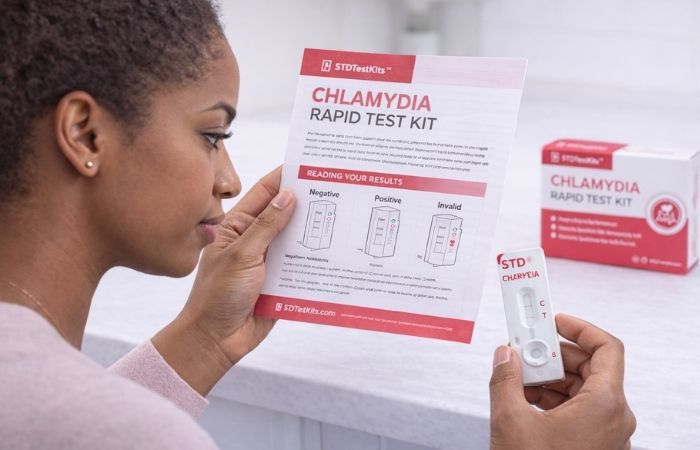
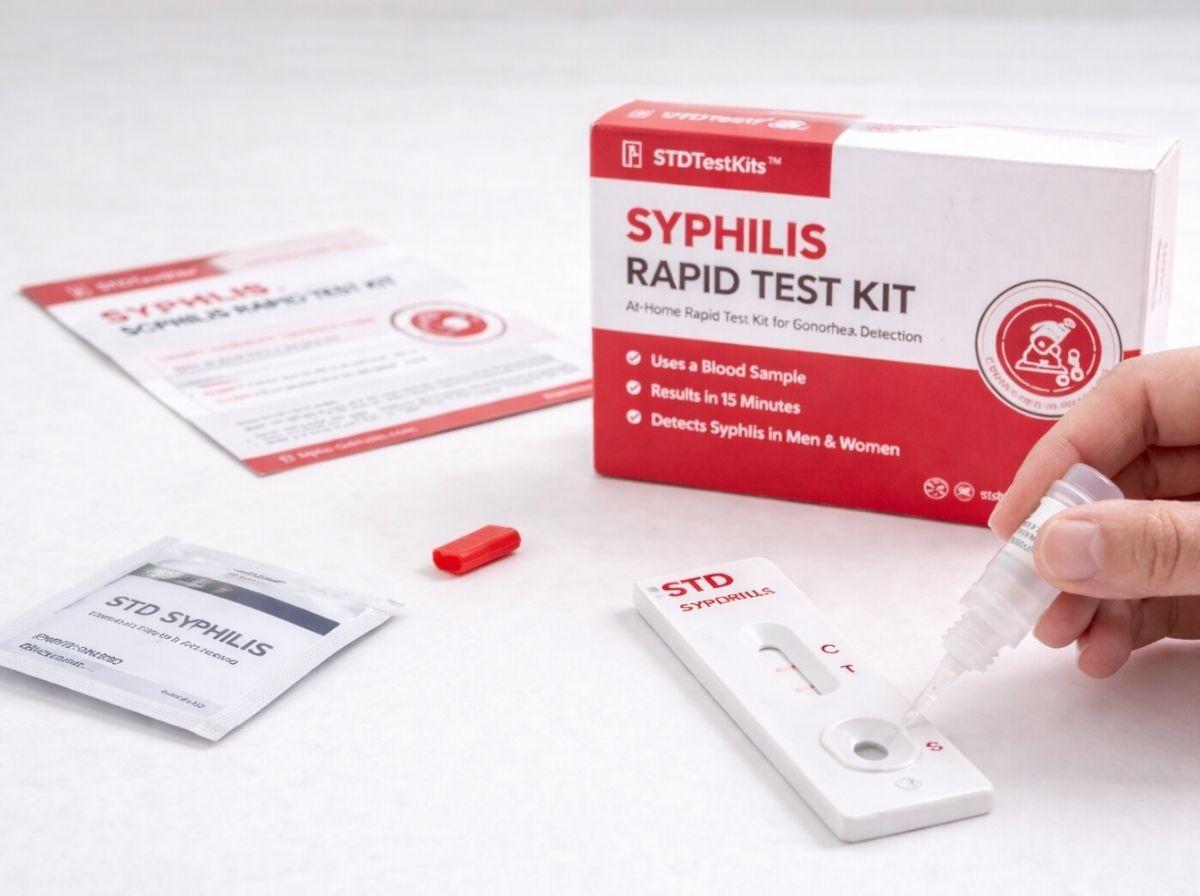
At-home rapid test kits from STD Test Kits use clinically validated lateral flow immunoassay technology, the same method used in many clinical settings, and deliver results in fifteen to twenty minutes from your own home. No appointment. No waiting room. No lab bill arriving weeks later. And critically for uninsured Americans: no hidden fees. The price on the product page is the complete price.
For people paying out of pocket, the value comparison is stark. A single chlamydia test at an urgent care center without insurance typically runs $75–$185 before the consultation fee and the separate lab bill. The equivalent at-home rapid test kit costs a fraction of that, with accuracy rates validated at 99% or above. For anyone weighing the cost of a clinic visit without insurance against the cost of a rapid test kit, the math is not subtle.
| Infection | Accuracy | STD Test Kits, At-Home Price | Urgent Care (No Insurance) |
|---|---|---|---|
| Chlamydia | 99%+ | From $18.99 | $75 – $185 |
| Gonorrhea | 99%+ | From $18.99 | $75 – $185 |
| Syphilis | 99% | From $18.99 | $80 – $185 |
| HIV 1/2 | 99.8% | From $18.99 | $80 – $200 |
| Herpes HSV-1 | 98%+ | From $18.99 | $100 – $220 |
| Herpes HSV-2 | 98.3% | From $18.99 | $100 – $220 |
| Hepatitis B | 99%+ | From $18.99 | $90 – $190 |
| Hepatitis C | 98%+ | From $18.99 | $90 – $190 |
The accuracy question is the one that comes up most often, and it deserves a direct answer. A common assumption is that at-home tests trade accuracy for convenience. The data does not support that. STD Test Kits products are CE-certified and FDA-cleared with validated accuracy rates consistently in the high 90s across all infections. A positive result should prompt follow-up with a healthcare provider for confirmation and treatment guidance, that is true of any screening test, regardless of where it is administered. A negative result inside the correct testing window provides genuine, reliable reassurance. Testing accurately at home is still testing accurately.
For comprehensive screening, the combo kits dramatically improve the value case. The 7-in-1 Complete At-Home STD Test Kit covers HIV, chlamydia, gonorrhea, syphilis, herpes HSV-2, hepatitis B, and hepatitis C in a single kit, seven infections that would cost several hundred dollars at a clinic without insurance. The 8-in-1 Complete At-Home STD Test Kit adds oral herpes HSV-1 to that panel. For women wanting the most complete screening available, the Women's 10-in-1 At-Home STD Test Kit adds trichomoniasis and HPV 16 and 18 to the full panel. Each of these represents a fraction of what an equivalent clinical panel costs without insurance.
When to Use Each Option: A Practical Decision Guide
The right testing option depends on your specific situation. Not everyone needs the same thing, and the cheapest option is not always the right one. Here is how to think through it.
If your income is at or below the federal poverty level and you have time to wait for an appointment, a county health department, FQHC, or Title X clinic is the right call. For a tighter comparison of low-cost routes, see our breakdown of the cheapest way to get tested for STDs in the US. Testing will likely be free or very close to it, and you will have access to a provider who can discuss results and next steps with you in person. The tradeoff is time; appointment availability at public health facilities varies enormously by location, and in some areas, lead times can stretch to several weeks.
If you have some income but no insurance and need clinical care in a reasonable timeframe, Planned Parenthood or a community health clinic on a sliding-scale fee schedule is probably your best bet. The cost will be meaningfully lower than an urgent care visit, you will have provider access, and the testing menu is typically comprehensive.
If you need results quickly, want complete privacy, or are doing routine screening between clinical visits, at-home rapid testing is the right option. There is no appointment to book, no explanation to give anyone, no waiting room, and no insurance record created. You test at home, read your result in minutes, and know exactly where you stand. If you are comparing what you would pay at an urgent care center without insurance against the cost of a combo kit, the at-home option is almost always cheaper and faster.
One scenario worth addressing directly: if you are experiencing active symptoms, discharge, sores, significant pain, or other signs that something may be wrong, a clinical visit is the right first step, regardless of cost. Symptoms need examination and potentially treatment, not just a test result. In that case, head to a community health clinic or Planned Parenthood on the sliding scale rather than an urgent care center. Save urgent care for emergencies; it is the most expensive option and rarely the most appropriate one for STD testing specifically.
Does STD Testing Without Insurance Show Up on Your Record?
There is a dimension to the insurance question that goes beyond cost, and it matters to a significant portion of people seeking STD testing: privacy. When insurance pays for clinic-based testing, the test and its results appear on your Explanation of Benefits, a document that is typically mailed to the policyholder. If you are on a parent's plan, a spouse's plan, or any shared policy, your testing activity may not stay private.
For young adults, people in complicated relationship situations, or anyone who simply prefers to keep their sexual health decisions to themselves, this is a real consideration. Public health clinics and Title X programs are confidential by policy, they do not report test results to insurance companies and do not share information with third parties. But they do create a patient record, and in some states there are specific rules about what information can be shared with parents for minors seeking testing.
At-home rapid testing sits in a different category entirely. There is no insurance claim. There is no patient record created at a clinic. No explanation of benefits mailed anywhere. You purchase the kit, test at home, read your result, and that is the end of it. For many people, this is not a secondary benefit; it is the primary reason they choose the at-home route. The CDC has consistently identified privacy concerns as a meaningful barrier to STI testing, particularly among young adults. The ability to test without any record being created removes that barrier entirely.
What Testing Windows Mean for Uninsured Patients
One of the most common reasons people test too early and get a false sense of reassurance is not knowing the testing window, the minimum time that needs to pass after an exposure before a test can reliably detect an infection. This applies regardless of whether you are testing at a clinic or at home, and it is worth understanding before you go anywhere.
For uninsured patients who may be choosing between clinic options based on availability, the testing window also has a practical implication: if you are within the window period, there is no urgency to pay more for a faster appointment. A negative result before the window closes does not clear you. Waiting until the window passes and then testing, whether at a free clinic or with an at-home kit, gives you a result you can actually rely on.
| Infection | Test From | Notes |
|---|---|---|
| Chlamydia | 14 days after exposure | Most common reportable STI in the US |
| Gonorrhea | 3 weeks after exposure | Often presents without symptoms |
| Syphilis | 6 weeks after exposure | Primary sore may be painless or unnoticed |
| HIV 1/2 | 6 weeks (first indicator); retest at 12 weeks for certainty | Two-step confirmation recommended |
| Herpes HSV-1 & HSV-2 | 6 weeks after exposure | Antibody-based; wait for reliable result |
| Hepatitis B | 6 weeks after exposure | Vaccine-preventable; testing still recommended after exposure |
| Hepatitis C | 8–11 weeks after exposure | Longest window; patience matters here |
The practical takeaway: if you had an exposure last week and you're deciding whether to spend $200 at urgent care right now for peace of mind, the answer is no. That result will not be reliable regardless of where you test. Wait until the window passes, then use the most affordable, accurate option available to you, whether that is a free clinic appointment or a rapid test kit at home.
What Happens If You Can't Afford STD Testing and Skip It?
There is a financial argument for STD testing that tends to get overlooked in conversations about cost, and it is a compelling one: the cost of an untreated STI, to your health, to your future medical bills, and to any partners who might be affected, is almost always far higher than the cost of testing today.
Untreated chlamydia can progress to pelvic inflammatory disease in women, which can lead to chronic pelvic pain, ectopic pregnancy, and infertility, conditions that require far more extensive (and expensive) medical treatment than a $0 chlamydia test at a health department ever would have. Research published on NCBI has consistently found that higher rates of uninsurance are directly associated with higher rates of untreated STIs, not because people want to skip testing, but because the cost barrier goes unaddressed. Untreated syphilis progresses through stages, and later-stage treatment, while still possible, involves more involved medical care. Untreated HIV, caught late rather than early, limits treatment options and increases long-term health costs significantly.
The uncomfortable reality is that cost-based delays in testing do not actually save money in any meaningful long-term sense. They defer a small, solvable problem into a potentially large, complicated one. The good news, and the core point of this article, is that for most Americans, the cost-based barrier to STD testing is more perceived than real. If you are at the point where even a low-cost kit or clinic fee feels out of reach, read what you actually have access to when you cannot afford STD testing before deciding to skip it. Free and low-cost options exist across all 50 states. At-home rapid testing has created a genuinely affordable, private alternative that does not require a clinic visit or an insurance card. Testing is the responsible, intelligent, cost-effective choice. The options are there. The question is just knowing where to look.
FAQs
- 1. Can I get STD testing completely free without insurance in the US?
- Yes, county health departments, Title X clinics, FQHCs, and AHF Wellness Centers all offer free or near-free STD testing for qualifying patients, typically based on income. HIV testing, in particular, is frequently free to everyone regardless of income level.
- 2. How do I find a free STD testing clinic near me?
- The CDC's GetTested tool at gettested.cdc.gov lets you search by zip code for free and low-cost STD testing locations. The HHS Office of Population Affairs clinic finder at reproductivehealthservices.gov lists Title X clinics specifically. Either is a solid starting point.
- 3. What is a sliding-scale fee, and how does it work for STD testing?
- A sliding-scale fee means the amount you pay is based on your household income relative to the federal poverty level. If your income is at or below 100% of the federal poverty level, care is typically free. Between 100% and 250%, your fee scales up proportionally. Above 250%, you pay closer to the standard rate. You will typically be asked to self-report your income and bring a recent pay stub or tax document to speed up the process.
- 4. Is Planned Parenthood free without insurance?
- Not automatically, but it can be. Planned Parenthood uses a sliding-scale fee structure, and patients with low enough incomes pay very little or nothing. Call your nearest location and give them a general sense of your income, they can tell you upfront what you would likely pay before you make the trip.
- 5. Are at-home STD test kits as accurate as clinic tests?
- Yes. At-home rapid test kits from STD Test Kits are CE-certified and FDA-cleared with accuracy rates in the high 90s, comparable to the lateral flow testing used in many clinical settings. A positive result should be confirmed with a healthcare provider, the same expectation that applies to any screening test, regardless of where it is performed.
- 6. Does ACA insurance have to cover STD testing?
- Most private health plans are required to cover preventive STI screening at no cost, no copay, no deductible, when ordered as a preventive service. The catch is the billing code: if the visit is coded as diagnostic because you have symptoms, cost-sharing may apply. Call your plan before the visit and ask specifically whether the test will be billed as preventive.
- 7. What if I test positive at home? What do I do next without insurance?
- A positive rapid test result should prompt a follow-up clinical visit for confirmation and treatment. Head to a community health clinic, FQHC, or Planned Parenthood on a sliding-scale basis; all of these can handle the follow-up affordably. Bring your test result with you. Treatment for most bacterial STIs, like chlamydia, gonorrhea, and syphilis is straightforward and effective once diagnosed.
- 8. Can I use an HSA or FSA to pay for at-home STD tests?
- Yes, STD test kits qualify as a medical expense and are generally eligible for HSA and FSA funds. Confirm with your plan administrator, but this is a standard use of those accounts.
- 9. Is STD testing confidential at public health clinics?
- Yes. Public health clinics, Title X programs, and FQHCs are bound by confidentiality policies; they do not report results to insurance companies or share information with third parties. For minors, parental notification rules vary by state, so check your state's specific policy if that matters to your situation.
- 10. How soon after a hookup can I test for STDs?
- The answer depends on the infection. Chlamydia can be reliably detected 14 days after exposure. Gonorrhea requires 3 weeks. Syphilis, HIV, herpes, and hepatitis B need a minimum of 6 weeks. Hepatitis C requires 8–11 weeks. Testing before these windows pass can produce false negatives, a negative result that does not actually clear you. Wait until the window closes, then test.
Get Tested Today, No Insurance Required
Knowing your status is one of the most straightforward acts of self-care and partner care you can take. And the good news is that not having insurance in the US does not mean putting that off. Between free and sliding-scale clinics, Title X programs, and at-home rapid test kits with fixed transparent pricing, the options are real, accessible, and more affordable than most people assume.
- Planned Parenthood, Does Getting Tested for STDs Cost Money?
- CDC, Sexually Transmitted Infections Surveillance, 2024 (Provisional)
- HHS Office of Population Affairs, What Are Title X Family Planning Clinics?
- Guttmacher Institute, Features and Benefits of the Title X Program
- NCBI Bookshelf, Paying for and Structuring STI Services
- CDC NCHHSTP, CDC Releases 2024 National STI Data