Can You Get an STD from a Happy Ending Massage
A happy ending massage sits in a grey zone that most sexual health resources don't address directly; it's not intercourse, but it's not zero-risk either.
A happy ending massage sits in a grey zone that most sexual health resources don't address directly; it's not intercourse, but it's not zero-risk either. The actual risk depends heavily on what happened, which infections are in play, and a few biological factors most people don't know about. This article maps it all out clearly so you can stop guessing and start making an informed decision about whether and when to test.
The reality is that manual stimulation, a handjob, body-to-body contact, or skin-on-skin friction without penetration, carries a genuinely low risk of STD transmission for most infections. But "low" is not "zero," and two infections in particular deserve honest attention: herpes and HPV. Both spread through skin contact, not just fluids, which changes the calculation compared to what most people assume. A third, syphilis, also warrants a mention. Understanding exactly why these three behave differently from HIV, gonorrhea, and chlamydia is the key to assessing your real risk accurately, especially when so many common STD myths blur the difference between possible, likely, and wildly exaggerated.
What actually happened during a happy ending, and why it matters for STD risk
The phrase "happy ending massage" covers a wide spectrum of actual contact, and that spectrum matters enormously when you're thinking about infection risk. A handjob with no other contact is a fundamentally different exposure scenario than a body-to-body massage with oral sex added. Most of the anxiety people feel after this kind of encounter comes from lumping everything together, as if all sexual contact carried identical risk. It doesn't.
STDs need a route. They're not floating in the air waiting to ambush you. The three main transmission routes are: direct contact with infected bodily fluids (semen, vaginal secretions, blood), direct skin-to-skin contact with infected tissue, and mucous membrane exposure. Different infections rely on different routes, which is why the type of contact matters so much. A handjob without fluid exchange is a low-risk event for most bacterial infections. The same encounter with oral sex adds considerably to the risk profile.
Think about it this way: someone who received a handjob with massage oil and nothing else is in a very different situation from someone who also received unprotected oral sex. The second scenario introduces mucous membrane contact and saliva, which opens the door to chlamydia, gonorrhea, herpes, and syphilis in ways that manual stimulation alone does not. Before you spiral, it helps to be precise about what actually happened, because biology is, too. The same logic applies when comparing a happy ending to a broader spa massage STD risk scenario: the route of exposure matters more than the setting.
| Activity | Transmission Route | Overall STD Risk Level |
|---|---|---|
| Handjob only (no fluids, no sores) | Skin contact | Very low |
| Handjob with saliva as lubricant | Oral fluids + skin contact | Low to moderate (chlamydia, gonorrhea possible) |
| Body-to-body massage with genital contact | Skin-to-skin | Low (herpes, HPV possible) |
| Oral sex (fellatio/cunnilingus) without a condom | Mucous membrane + fluids | Moderate (chlamydia, gonorrhea, herpes, syphilis) |
| Penetrative vaginal or anal sex | Mucous membrane + fluids | High (full STD risk profile) |
Which STDs can actually spread from a handjob or sexual massage?
Here's where most online resources either overstate or understate the risk. The truth is nuanced: some infections essentially cannot spread through manual stimulation under normal circumstances, while others, particularly herpes and HPV, have a documented, if low, transmission pathway through skin contact alone. Understanding the difference is what separates informed caution from unnecessary panic.
In this case, herpes (HSV-1 and HSV-2) is the infection that is most important to know about. Both strains can be passed on through direct contact with infected tissue, and it's important to note that this can happen even when there are no visible sores, which is known as asymptomatic shedding. If the person giving the massage had an active herpes outbreak on their hands (a condition called herpetic whitlow) or genitals, and there was direct skin contact, transmission is theoretically possible. That being said, studies on how HSV-2 spreads show that hand-to-genital contact is less common than genital-to-genital contact, and the risk goes down even more when there are no sores present.
Syphilis can spread through direct contact with a syphilitic sore (chancre). This requires the infected person to have an active, visible sore that makes contact with the skin or mucous membranes. A review of syphilis transmission evidence published in NCBI confirms that transmission via casual hand contact without visible sores is very unlikely, but if there were open lesions present during the massage, the risk is real enough to test for. The window period matters: a syphilitic chancre is painless, which is exactly why people often don't notice it on themselves or others.
Molluscum contagiosum, less discussed but worth knowing about, is a skin infection that spreads readily through direct skin-to-skin contact. It's not technically classified as an STD in all contexts, but it transmits easily during sexual massage scenarios involving body contact. Small, dome-shaped bumps appearing weeks after an encounter can be a sign. It's treatable and not dangerous, but it's a realistic outcome of skin-to-skin contact that most articles on this topic skip entirely. That skin-contact logic is also why questions about whether you can get an STD from a tattoo or piercing need a different risk map than questions about penetrative sex.
What is the actual HPV risk from a sexual massage, and why is it harder to assess than you think
HPV deserves its own section because it behaves differently from every other infection on this list, and because most people dramatically underestimate both how common it is and how it spreads. Human papillomavirus is the most prevalent sexually transmitted infection in the United States, with the CDC estimating that nearly every sexually active person will acquire it at some point if unvaccinated. The issue with HPV in the context of sexual massage is that it spreads through skin-to-skin contact with infected tissue, not fluid exchange, which means a handjob creates a theoretical transmission route that gonorrhea and HIV simply do not.
A 2019 cohort study published in NCBI examined hand-to-genital HPV transmission specifically and found that while the route is possible, the overall probability is lower than direct genital-to-genital contact. The key biological mechanism: HPV needs contact with living skin cells, specifically the microabrasions and epithelial cells that are present during genital contact. Hands that have touched infected genital tissue and then immediately contact another person's genitals can, in principle, transfer the virus. The probability increases if there are small cuts, hangnails, or abrasions on the hand involved.
Here's the genuinely difficult part about HPV: there is currently no approved test for HPV in people without a cervix. There's no blood test, no swab, no at-home kit that will tell a person with a penis whether they have HPV. The only way HPV usually becomes known in this population is through the appearance of genital warts, which are caused by low-risk HPV strains (types 6 and 11) that don't cause cancer, or through an abnormal pap smear in a partner. High-risk strains that cause cancer are entirely invisible without cervical screening. This is worth knowing, not to cause alarm, but because it means HPV is not something you can simply "test and clear" after a massage encounter. The practical response is vaccination if you haven't already. The HPV vaccine is effective up to age 45 and covers the strains most likely to cause warts and cancer, and regular sexual health check-ins with a provider.
If you're concerned about genital warts specifically after a sexual massage, watch for small, flesh-colored or gray bumps appearing on or around the genitals or anus within 3 weeks to 3 months of exposure. They may appear alone or in clusters. If you notice anything like this, see a provider rather than attempting self-diagnosis; several common skin conditions look similar.
What STDs are unlikely to spread from a sexual massage?
HIV, gonorrhea, and chlamydia are the three infections people most commonly worry about after any sexual encounter, and they're also the three least likely to transmit through a handjob or non-penetrative sexual massage. Understanding why helps replace fear with actual biology.
HIV requires direct access to the bloodstream or mucous membranes via infected fluids. Intact skin, like the skin on your hands or genitals, without open wounds, is an effective barrier. According to the CDC, HIV transmission requires a specific biological pathway, and manual stimulation without open cuts or sores on both parties creates no meaningful route. A handjob, even with semen contact on unbroken skin, is considered a negligible risk for HIV transmission by infectious disease specialists. This is the same reason viral claims about HIV and nail salons can miss the real issue: HIV risk is about a viable route into the bloodstream, not the mere presence of hands, tools, or anxiety.
Gonorrhea and chlamydia are bacterial infections that primarily live in mucous membranes, the inner lining of the urethra, cervix, rectum, and throat. They don't survive well on skin surfaces or in open air. For either to transmit through a handjob, infected fluid would need to be transferred directly to a mucous membrane, most commonly if saliva from an oral infection was used as lubricant, or if someone touched their own infected genitals and then immediately touched another person's. Under standard massage conditions with no oral involvement, the risk is extremely low.
Hepatitis B and C can technically be transmitted through blood contact, but this would require a specific scenario: open wounds on both parties simultaneously coming into contact. A routine sexual massage without broken skin creates no meaningful hepatitis transmission pathway. These are not infections to worry about after a non-penetrative encounter, though they belong in a full panel if oral sex was also involved. The same blood-route distinction explains why modern questions about blood transfusions and STDs are handled differently from everyday skin-contact fears, and why a nail salon hepatitis risk depends on blood exposure rather than casual touch.
| Infection | Can It Spread via Handjob? | Key Condition for Transmission | Risk Level |
|---|---|---|---|
| Herpes (HSV-1 / HSV-2) | Yes | Active sores or shedding + skin contact | Low |
| HPV | Yes | Skin-to-skin contact with infected tissue | Low |
| Molluscum contagiosum | Yes | Direct skin-to-skin contact | Low to moderate |
| Syphilis | Rarely | Direct contact with active chancre | Very low |
| Chlamydia | Unlikely | Saliva as lubricant or fluid-to-mucous-membrane contact | Very low |
| Gonorrhea | Unlikely | Saliva as lubricant or fluid-to-mucous-membrane contact | Very low |
| HIV | No (under normal conditions) | Would require open wounds + fluid transfer | Negligible |
| Hepatitis B / C | No (under normal conditions) | Would require blood-to-blood contact | Negligible |
Should I get tested after a happy ending massage?
This is the question most people are actually asking, and the honest answer is: it depends on what happened, not just that something happened. Testing after a genuinely low-risk encounter, a handjob with no oral sex, no visible sores, no broken skin, is unlikely to turn up anything, and a negative result three days after the fact mostly tells you what you already knew. That said, if you're sexually active and not testing regularly, any moment of reflection is a good reason to get a baseline panel done.
The situation where testing is genuinely warranted: oral sex was involved, you noticed sores or unusual skin on the provider, saliva was used as lubricant, or there was skin-to-skin genital contact beyond manual stimulation. In those cases, the exposure profile is meaningfully different, and a targeted test makes sense, not because something definitely happened, but because something could have. At-home STD test kits make this easy and private. The 8-in-1 Complete At-Home STD Test Kit covers HSV-1, HSV-2, chlamydia, gonorrhea, syphilis, HIV, hepatitis B, and hepatitis C, the full picture for this kind of encounter, handled entirely at home.
One thing worth knowing: testing too soon after exposure gives inaccurate results. Every infection has a window period, the time between exposure and when a test can reliably detect it. Testing on day two because you're anxious is understandable, but it won't give you reliable information. If you're going to test, test at the right time. Peace of mind is only real if the result is actually accurate. If your concern is that one exposure could involve more than one infection, this breakdown of whether you can test positive for multiple STDs at the same time explains why full-panel testing can be more useful than chasing one suspected infection.
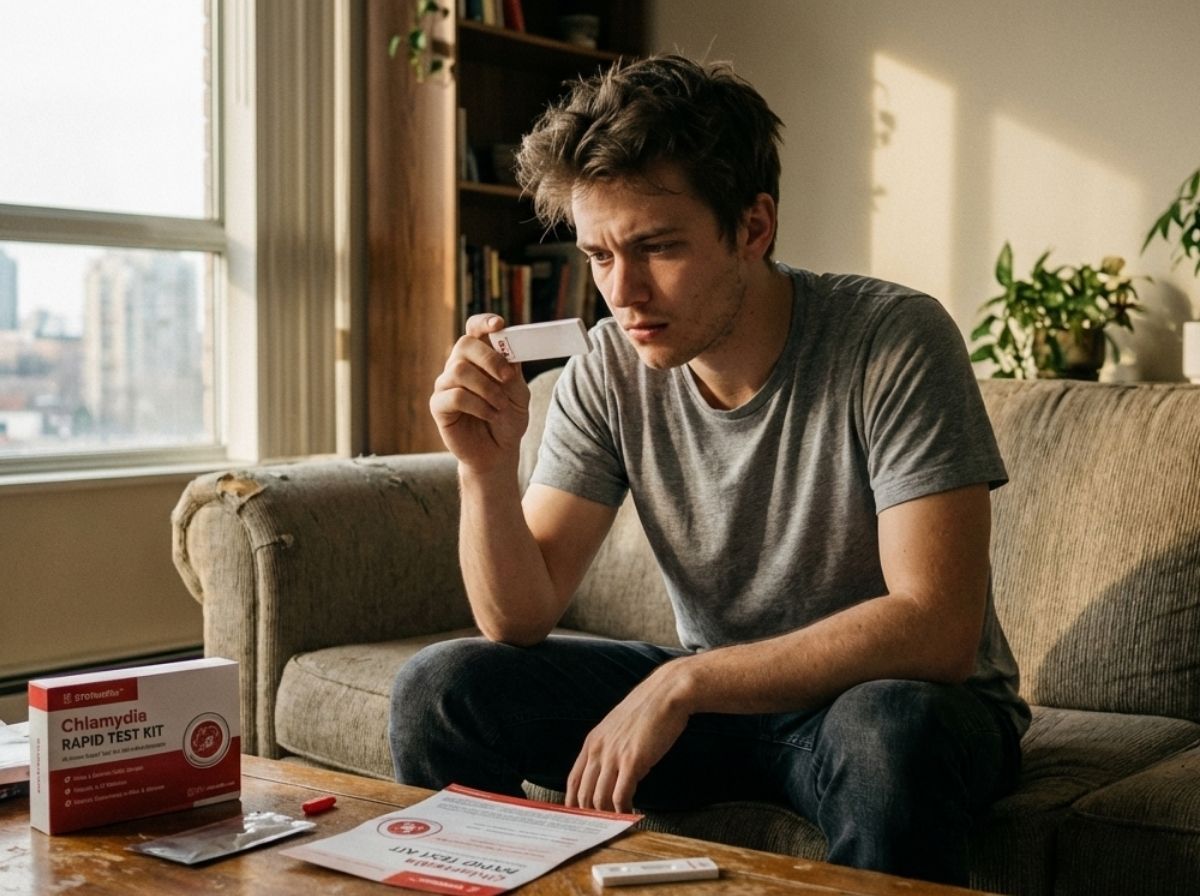
When should you test after a sexual massage, exact timing by infection
Timing your test correctly is the difference between a result you can trust and a false negative that leaves you no better informed than before. Most people test too early, get a negative, and assume they're clear, when in reality the infection just hasn't reached detectable levels yet. Here are the exact windows for each infection relevant to this kind of encounter.
For herpes (HSV-1 and HSV-2), test from 6 weeks after exposure. Herpes antibody tests need time to develop, and testing earlier, even at two or three weeks, frequently produces false negatives even in people who are genuinely infected. For syphilis, also test from 6 weeks after exposure. For chlamydia, test from 14 days after exposure. For gonorrhea, test 3 weeks after exposure. HIV testing follows a different timeline: test at 6 weeks for a first indicator, then retest at 12 weeks for certainty. Hepatitis B can be detected from 6 weeks after exposure, while hepatitis C requires 8–11 weeks for reliable detection.
If the encounter involved only manual stimulation with no oral sex, the most relevant tests are herpes and syphilis at the 6-week mark. HPV cannot currently be screened for in people without a cervix. If herpes is your primary concern, a targeted HSV-1 and HSV-2 antibody test at 6 weeks is the right call. The Genital and Oral Herpes HSV-1+2 At-Home STD Test Kit covers both strains accurately from a single sample, with results you can read at home.
What if oral sex were part of the massage?
Oral sex changes the risk profile significantly, and it's worth addressing separately because a lot of people bury this detail when they're describing their encounter, sometimes to themselves. If the "happy ending" included a blowjob or any oral-to-genital contact without a condom, you're no longer in the lowest-risk category. You're in a moderate-risk scenario where chlamydia, gonorrhea, herpes, and syphilis all have documented transmission pathways.
Oral gonorrhea and chlamydia are more common than most people realize, and people who perform oral sex without protection can carry throat infections with no symptoms whatsoever. They may not know they're infected, and they can still transmit. This is the scenario where testing isn't just about peace of mind, it's about catching something real. The CDC's provisional 2024 STI surveillance data reported more than 2.2 million combined cases of chlamydia, gonorrhea, and syphilis in the US, a reminder that these infections are circulating widely enough that encounters in commercial sexual settings carry real exposure risk. That wider context also matters when viral STD claims take off online, whether it's a local case-count rumor like the Houston spring break STD cases claim or a TikTok story that collapses timing, exposure, and testing into one messy headline.
If oral sex was involved, a full panel at the right window periods is the smart move. The 7-in-1 Complete At-Home STD Test Kit covers HSV-2, chlamydia, gonorrhea, syphilis, HIV, hepatitis B, and hepatitis C, essentially the full relevant picture for this exposure type. You can test privately at home and get results without a clinic visit.

What symptoms should you watch for after a sexual massage?
Most STDs don't announce themselves with dramatic symptoms. This is one of the most important things to understand about any post-exposure window: the absence of symptoms doesn't mean the absence of infection. Herpes, chlamydia, gonorrhea, and HPV can all be entirely silent for weeks or months, which is exactly why relying on "I'd know if something was wrong" is not a reliable sexual health strategy.
That said, there are signs worth paying attention to. For herpes, watch for tingling, itching, or small blisters on the genitals or surrounding skin appearing within 2–20 days of exposure. For syphilis, the first sign is typically a painless sore (chancre) at the site of contact, appearing 10–90 days after exposure, and because it's painless, it's easy to miss entirely. For molluscum contagiosum, small firm bumps with a dimpled center can appear 1–6 weeks after contact. Gonorrhea and chlamydia may produce unusual discharge, burning when urinating, or pelvic discomfort within 1–3 weeks. If you notice any of these, don't wait for the full window period; see a provider sooner.
The tricky part with symptoms is that they overlap with plenty of non-STD causes. A rash from massage oil. Irritation from friction. A pimple that showed up at an inconvenient time. The internet is spectacularly unhelpful here; everything looks like herpes when you're anxious and searching at 2 AM. Testing is the only way to actually know. Symptoms are useful prompts, not diagnoses.
How to lower your risk if you visit massage parlors regularly
If sexual massage services are part of your regular life, the practical approach isn't shame or abstinence; it's accurate risk management built around the specific infections that matter in this context. The three worth protecting against most actively are herpes, HPV, and syphilis, because all three spread through skin contact and don't require penetration to transmit.
For HPV specifically: if you haven't been vaccinated, that's the single most impactful thing you can do. The HPV vaccine is approved for use up to age 45 and protects against the strains most likely to cause genital warts and cancers. It won't help with an existing infection, but it dramatically reduces future risk. Condoms during any oral component of a session meaningfully reduce gonorrhea, chlamydia, syphilis, and HIV risk, though they don't fully eliminate herpes or HPV risk because both can be present on skin that a condom doesn't cover.
Regular STD testing, every three to six months for people with multiple partners or frequent casual encounters, is the single most effective long-term strategy. Not because every test will come back positive, but because catching something early means treating it before complications develop and before it's unknowingly passed to anyone else. Most standard panels don't automatically include herpes testing unless you request it specifically. If you've never explicitly been tested for HSV-1 and HSV-2 and you're having regular sexual encounters, you may not actually know your status, which is far more common than most people realize. The 8-in-1 Complete At-Home STD Test Kit includes herpes alongside the full standard panel, so you're not accidentally leaving the most relevant infection out of your routine check.
One frustrating truth about sexual health is that a past infection does not make you bulletproof. If you've ever wondered why your body doesn't reliably protect you the next time around, this guide to why your body doesn't build immunity to most STDs explains why repeat testing still matters even after previous exposure, treatment, or a negative result.
FAQs
- 1. Is it possible to get HIV from a massage with a happy ending?
- No, not usually. HIV needs to get directly into the bloodstream or mucous membranes through infected fluid, and healthy skin is a good barrier. A handjob, even one where semen touches unbroken skin, does not create a significant way for HIV to spread. Infectious disease experts say the risk is very low.
- 2. Can you get herpes from a handjob?
- In theory, it could happen, but it doesn't happen very often. If you touch infected skin or tissue, you can get herpes. You can also get it if you touch someone who is having an active outbreak or is shedding the virus without showing any symptoms. In real life, herpes spreads from one person's genitals to another's much more often than from one person's hand to another's. When neither person has any visible sores, the risk is at its lowest.
- 3. Can you get HPV from a sexual massage?
- Yes, HPV can spread through hand-to-genital contact, but it is less likely than through direct genital-to-genital contact. HPV can spread when skin touches infected tissue, and it doesn't have to exchange fluids. When giving a massage, this is one of the most important infections to know about. There isn't an HPV test that is safe for people who don't have a cervix right now. If you haven't already, the best thing to do is get the HPV vaccine.
- 4. Can you get chlamydia or gonorrhea from a sexual massage?
- It is very unlikely that it will happen just from touching it. Both infections mostly affect mucous membranes and don't do well on skin. The only time this doesn't apply is if the provider had oral gonorrhea or chlamydia and used saliva as a lubricant. These infections can spread to the genitals. There is a much higher chance if oral sex was involved.
- 5. When should I get tested after a happy ending?
- It depends on the kind of infection. If you think you might have herpes or syphilis, get tested six weeks after you were exposed. For chlamydia, it's 14 days. Three weeks for gonorrhea. For HIV, you should get tested at 6 weeks for an initial sign and again at 12 weeks to be sure. Wait 8 to 11 weeks for hepatitis C. Testing before these times gives results that aren't always accurate, no matter what happened.
- 6. Is a body-to-body massage more dangerous than a handjob?
- A little bit, because there is more skin surface area involved, which is important for skin-contact infections like herpes, HPV, and molluscum contagiosum. But the overall risk stays low as long as there is no penetration or oral sex. The main factors are if there was an active skin infection and if any bodily fluids touched mucous membranes.
- 7. Is it possible to get syphilis from a massage?
- Only if the provider's hands or genitals came into direct contact with an active syphilitic sore (chancre) and then touched your skin or a mucous membrane. Chancres from syphilis don't hurt, so neither person may know they're there. If you don't have any visible sores, it's very unlikely that you could get syphilis from a handjob or massage. However, if you touched genitals skin to skin, it's a good idea to get tested at the 6-week mark.
- 8. What if the massage also included sex? Does that change what I need to check for?
- Yes, a lot. Oral sex makes contact with mucous membranes, which makes it easier for chlamydia, gonorrhea, herpes, and syphilis to spread. If oral sex was part of the session, a full STD panel at the right times is the only thing to do. This includes throat infections, which don't always show symptoms.
- 9. What is herpetic whitlow, and should I be concerned about it?
- Herpetic whitlow is a herpes virus that affects the fingers or hands. If the person giving the massage had an active herpes outbreak on their hands, which can look like small blisters or sores on the fingers, and that skin touched your genitals directly, the virus could spread. It's not common, but it has been written about. If you see anything strange on the provider's hands during the visit, tell them when you test.
- 10. Is it embarrassing to get tested after this kind of thing?
- Testing after any sexual activity, even a happy ending massage, is just a smart way to take care of your health. People deserve private access to accurate health information without having to tell anyone about their sexual history. That's why there are at-home STD test kits. Knowing your status doesn't make you a bad person. If there is an embarrassing move, it's not knowing.
Test After a Sexual Massage, Privately, Accurately, at Home
If your encounter involved oral sex, body-to-body contact, or you simply want a complete picture, the smartest move is a full panel at the right timing window. The 8-in-1 Complete At-Home STD Test Kit covers HSV-1, HSV-2, chlamydia, gonorrhea, syphilis, HIV, hepatitis B, and hepatitis C, everything relevant to this kind of exposure, in a single discreet kit you handle entirely at home.
If the encounter was manual stimulation only and herpes is your primary concern, the Genital and Oral Herpes HSV-1+2 At-Home STD Test Kit is the targeted option, accurate, private, and ready when you hit the 6-week window. For encounters that included oral sex, step up to the 7-in-1 Complete At-Home STD Test Kit for broader coverage across all the relevant infections.
Testing isn't a confession. It's information, and information is how you stop guessing and start knowing. Visit STD Test Kits to find the right test for your situation.
Our article was constructed based on current advice from the most prominent public health and medical organizations, and then molded into simple language based on the situations that people actually experience, such as treatment, reinfection by a partner, no-symptom exposure, and the uncomfortable question of whether it "came back." In the background, our pool of research included more diverse public health advice, clinical advice, and medical references, but the following are the most pertinent and useful for readers who want to verify our claims for themselves.